Compton in Los Angeles County, California — The American West (Pacific Coastal)
Eagle Tree
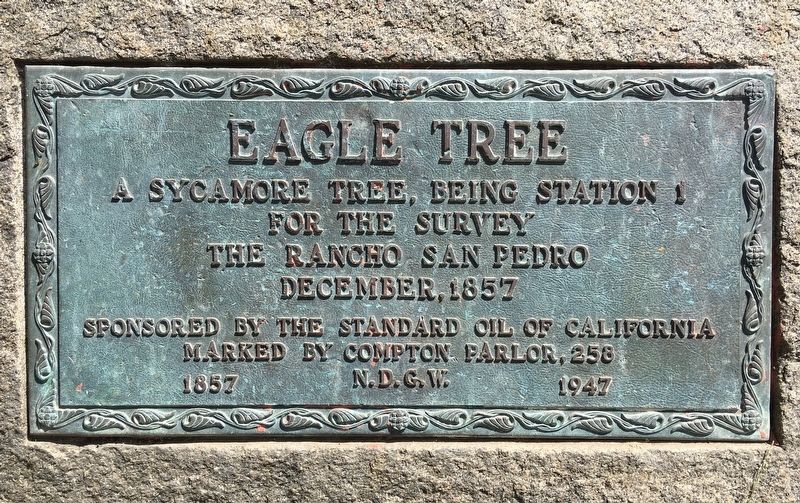
Photographed by Craig Baker, April 27, 2022
1. Eagle Tree Marker
A sycamore tree, being Station 1 for the survey, the Rancho San Pedro, December, 1857.
Erected 1947 by Standard Oil of California, and Compton Parlor 258 N.D.G.W.
Topics and series. This historical marker is listed in these topic lists: Horticulture & Forestry • Landmarks • Natural Features • Settlements & Settlers. In addition, it is included in the Historic Trees, and the Native Sons/Daughters of the Golden West series lists. A significant historical month for this entry is December 1857.
Location. 33° 54.466′ N, 118° 12.685′ W. Marker is in Compton, California, in Los Angeles County. It can be reached from the intersection of Short Avenue and Poppy Avenue. The marker can only be seen with access to private property. Touch for map. Marker is at or near this postal address: 1706 N Short Ave, Compton CA 90221, United States of America. Touch for directions.

Regionally, this marker is in Greater Los Angeles and in the Transverse Ranges. It is also on the American Pacific Coast. Globally, it is in North America, on the Ring of Fire, on the Pacific Rim, in the Western Hemisphere, in the Western World,
this page online
Other nearby markers. At least 8 other markers are within 4 miles of this marker, measured as the crow flies: Heritage House (approx. 1.3 miles away); Maya Obelisk (approx. 2.6 miles away); Watts Towers (approx. 2.7 miles away); PFC James Anderson (approx. 2.8 miles away); Domínguez Ranch House (approx. 2.8 miles away); Egyptian Obelisk (approx. 3 miles away); Paramount Hay Tree (approx. 3.3 miles away); Under the Hay Tree, World’s Hay Price Was Set (approx. 3.4 miles away). Touch for a list and map of all markers in Compton.
Regarding Eagle Tree. Located 11 miles south of El Pueblo de Los Angeles, the tree was a guide post for travelers, and marked the border of Rancho San Pedro and Rancho San Antonio. Birds of prey often perched in the tree, giving it the name Eagle Tree. By 2015 the tree had died. On the evening of April 7, 2022, the Eagle Tree fell over, crushing a car parked behind the apartment building next door.
Also see . . . Eagle Tree Story. Esotouric website excerpt:
Preservationists Kim(Submitted on March 25, 2024, by Craig Baker of Sylmar, California.)Cooper and Richard Schave (Esotouric) urged the City of Compton and Standard Oil’s successor company Chevron Oil to preserve the 7-ton trunk as a historic resource, and it was moved to safety by crane.Photographed by Craig Baker, April 27, 20222. Eagle Tree and MarkerThe hollow base of the fallen tree is behind the marker in this photo.
Then, working with environmental horticulturist Dr. Donald R. Hodel, they arranged with Chevron to access the site over a number of months to take genetically identical cuttings from root suckers from the original specimen. These are being cared for by botanists at The Huntington Library, Art Museum, and Botanical Gardens, California Botanic Garden in Claremont and the Theodore Payne Foundation.
Many of the cuttings have survived, and are growing into young Eagle Trees that will soon be made available for distribution to municipalities and historic sites around Southern California, including the original site in Compton, to preserve the legacy and story of this iconic living landmark.
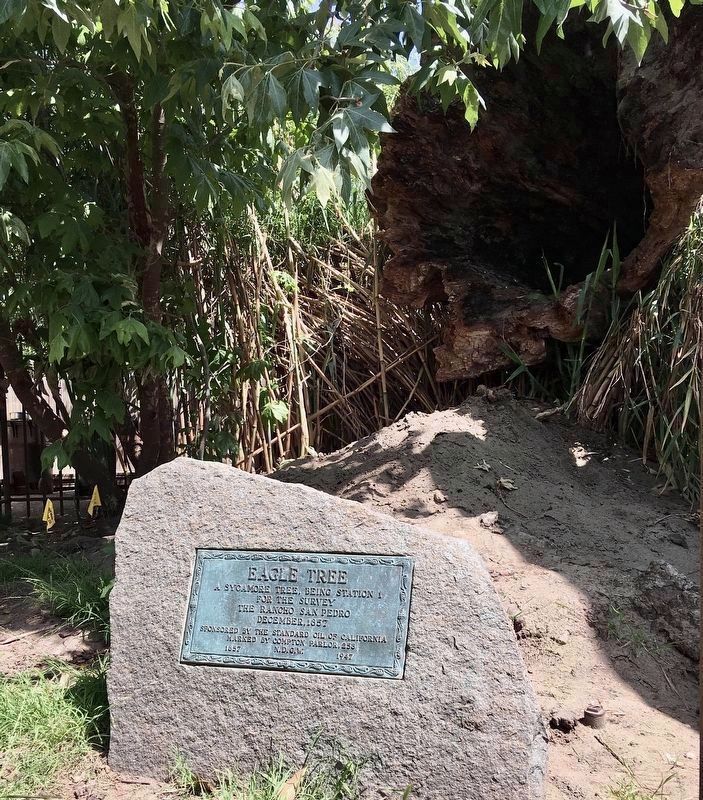
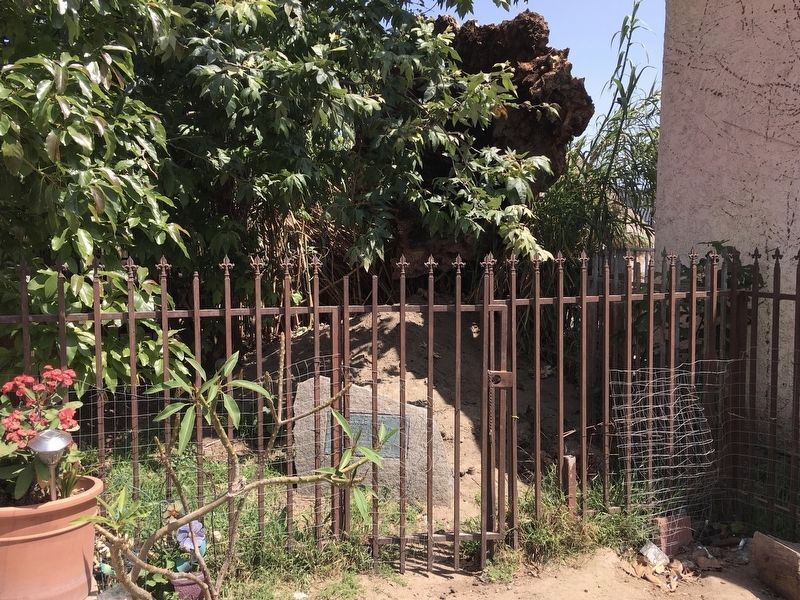
Photographed by Craig Baker, April 27, 2022
3. Eagle Tree Marker
Viewed from the back yard of a private residence.
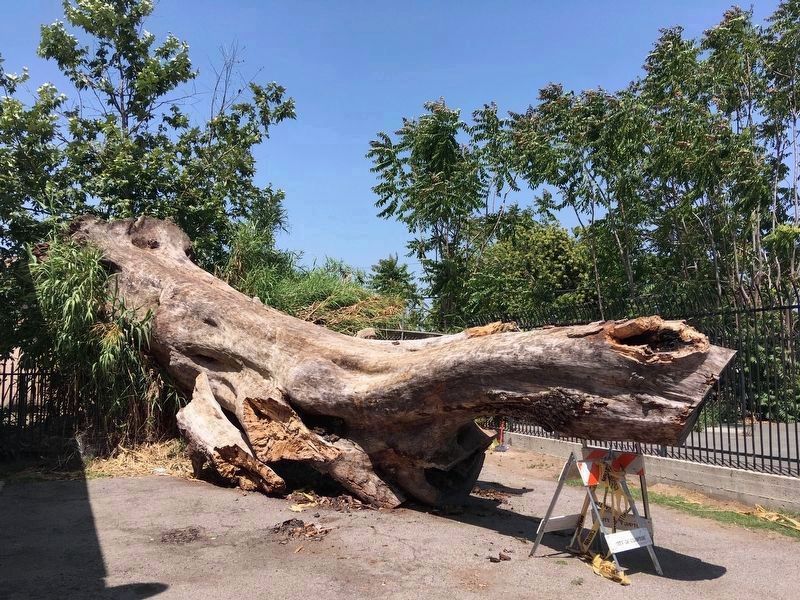
Photographed by Craig Baker, April 27, 2022
4. Eagle Tree
The tree trunk lays in an apartment building parking lot, waiting for removal.
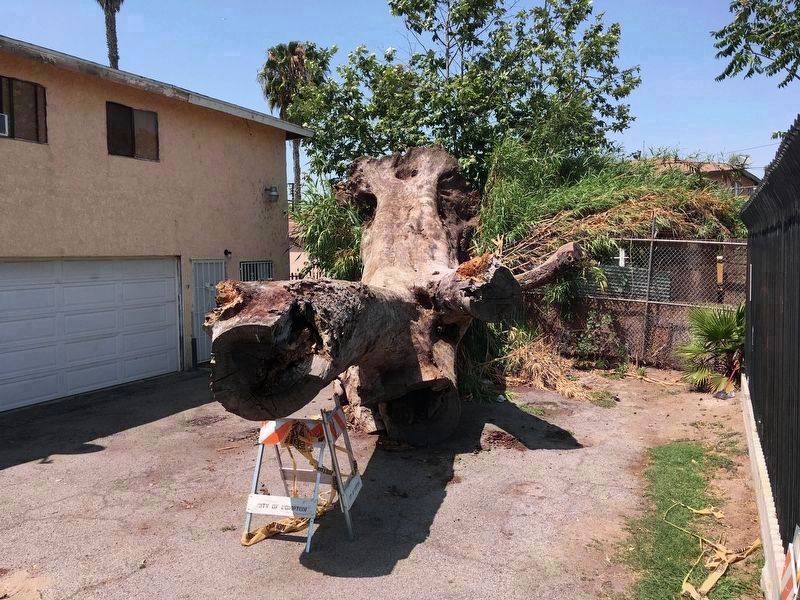
Photographed by Craig Baker, April 27, 2022
5. Eagle Tree
In the parking lot at 1117 E Tucker St.
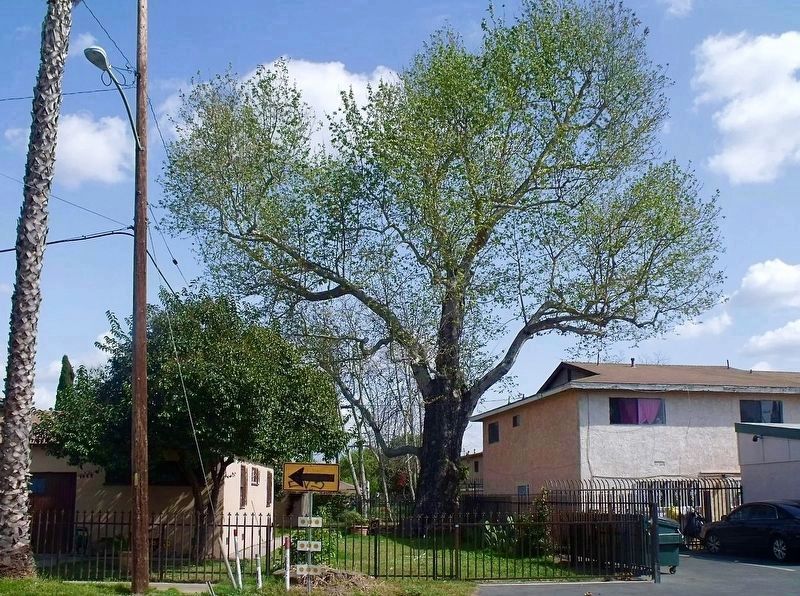
courtesy Compton Chamber of Commerce
6. Pre-2015 Eagle Tree
Credits. This page was last revised on June 29, 2025. It was originally submitted on April 28, 2022, by Craig Baker of Sylmar, California. This page has been viewed 2,891 times since then and 125 times this year. Photos: 1, 2, 3, 4, 5, 6. submitted on April 28, 2022, by Craig Baker of Sylmar, California.
