Near Fort Payne in DeKalb County, Alabama — The American South (East South Central)
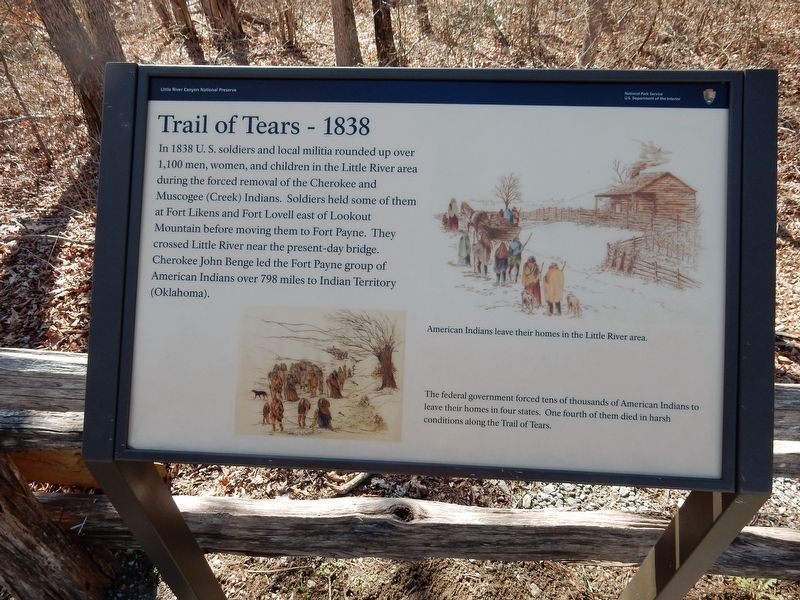
Trail of Tears – 1838
| — | Little River Canyon National Preserve | — |
Courtesy of Thomas P. Martin, March 16, 2017
1. Trail of Tears – 1838 Marker
[Captions]
• (Top) American Indians leave their homes in the Little River area.
• (Bottom) The federal government forced tens of thousands of American Indians to leave their homes in four states. One fourth of them died in harsh conditions along the Trail of Tears.
Erected by National Park Service.
Topics and series. This historical marker is listed in these topic lists: Government & Politics • Indigenous Peoples and Communities. In addition, it is included in the Trail of Tears series list. A significant historical year for this entry is 1838.
Location. 34° 23.728′ N, 85° 37.565′ W. Marker is near Fort Payne, Alabama, in DeKalb County. It can be reached
this page online

Regionally, this marker is in North Alabama. It is also in the American South, specifically in the Deep South, in Appalachia, and specifically in Southern Appalachia. Globally, it is in North America, a Gulf of Mexico state, the Western Hemisphere, the Western World, and the Anglosphere. Historically, it finds itself in what was once the original Cherokee Nation, the territory of the Mississippian Culture, one of the Confederate States of America, and the Antebellum South.
Other nearby markers. At least 8 other markers are within 7 miles of this marker, measured as the crow flies: Indians, Settlers, and Tourists (here, next to this marker); W.P. Brown & Sons Lumber Company (approx. 2.4 miles away); Arthur "Tarzan" White (approx. 2.8 miles away); History of Taff, Alabama (approx. 3.8 miles away); David Hartline (approx.
Photographed by Duane and Tracy Marsteller, May 5, 2022
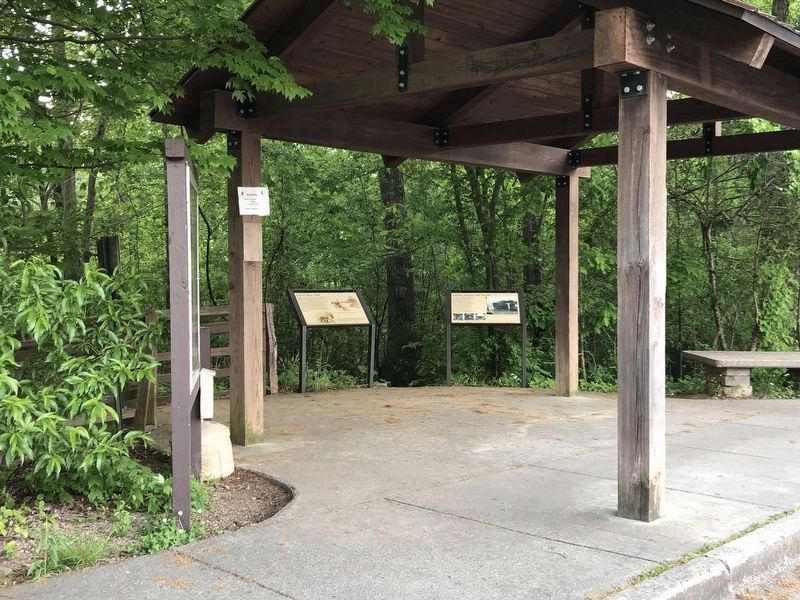
2. Trail of Tears – 1838 Marker on left.
Another marker is no longer nearby. Boom Town Historic District (was approx. 6.3 miles away but has been confirmed missing).
Credits. This page was last revised on May 12, 2022. It was originally submitted on April 29, 2022, by Duane and Tracy Marsteller of Murfreesboro, Tennessee. This page has been viewed 717 times since then and 55 times this year. Photos: 1. submitted on April 29, 2022, by Duane and Tracy Marsteller of Murfreesboro, Tennessee. 2. submitted on May 9, 2022, by Duane and Tracy Marsteller of Murfreesboro, Tennessee.
