Dreta de l'Eixample in Barcelona, Catalonia, Spain — Southwestern Europe (Iberian Peninsula)
Joan Giné i Partagàs
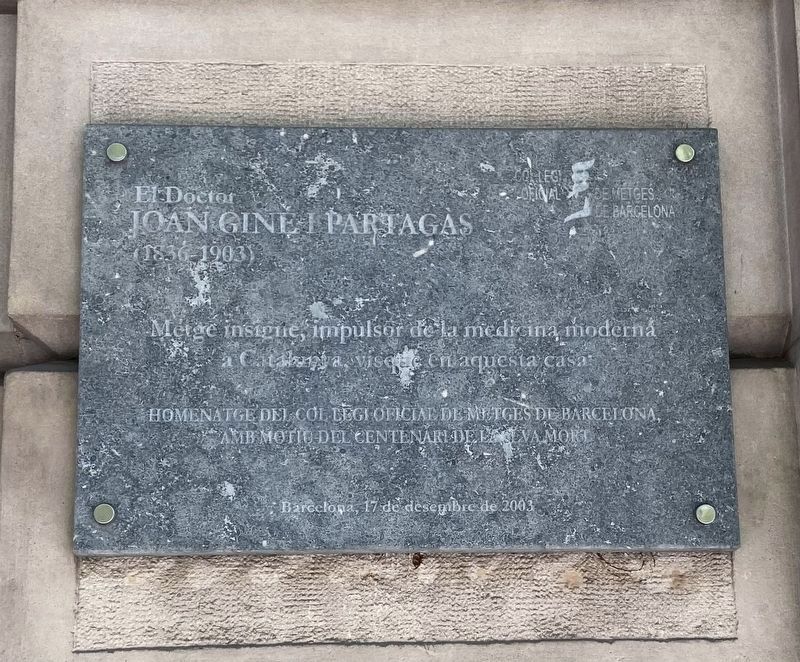
Photographed by Andrew Ruppenstein, April 24, 2022
1. Joan Giné i Partagàs Marker

Joan Giné i Partagàs
(1836-1903)
Metge insigne, impulsor de la medicina moderna a Catalunya, visque en aquesta casa
Homenatge del Col·legi Oficial de Metges de Barcelona,
am motiu del centenári de la seva mort
Dr. Joan Giné i Partagàs (1836-1903), noted physician and proponent of modern medicine in Catalonia, lived in this building.
In homage by the Collegi Oficial de Metges de Barcelona, on the occasion of the centenary of his death.
Erected 2003 by College Official de Metges de Barcelona.
Topics. This historical marker is listed in this topic list: Science & Medicine.
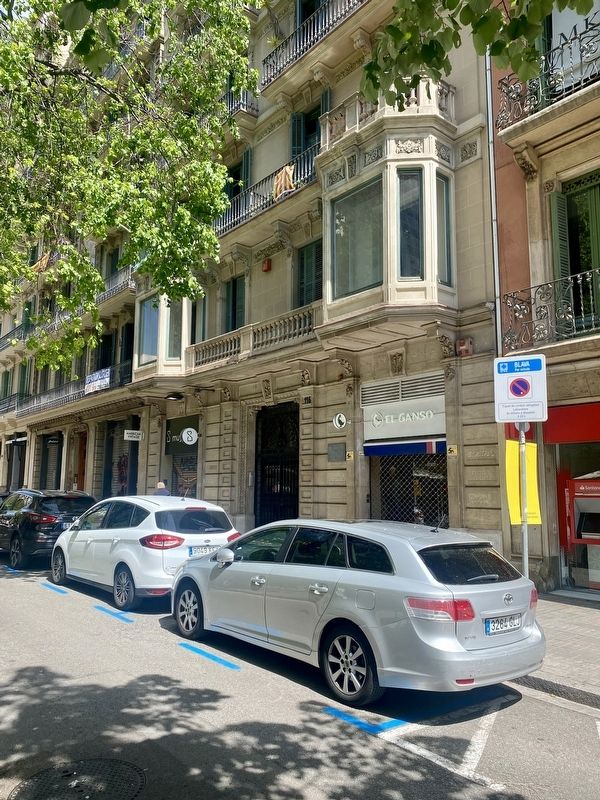
Location. 41° 23.69′ N, 2° 9.514′ E. Marker is in Barcelona, Cataluña (Catalonia). It is in Dreta de l'Eixample. It is on Rambla de Catalunya, on the right when traveling north. Touch for map. Marker is at or near this postal address: Rambla de Catalunya 116, Barcelona, Cataluña 08008, Spain. Touch for directions.

Regionally, it is in the North Atlantic Region, in Europe, in the European Union, in Atlantic Europe, on the Iberian Peninsula,
this page online
Other nearby markers. At least 8 other markers are within walking distance of this marker: Josep M. Lopez-Pico (within shouting distance of this marker); Plaça del Cinc d’Oros (about 210 meters away, measured in a direct line); Frederic Mompou i Dencausse (about 210 meters away); Santiago Rusiñol (approx. 0.2 kilometers away); Teodoro Moscoso (approx. 0.3 kilometers away); Roger de Lauria (approx. half a kilometer away); Maria Aurèlia Capmany (approx. 0.6 kilometers away); Catalan-Basque Civil War Relations (approx. 0.6 kilometers away). Touch for a list and map of all markers in Barcelona.
Also see . . . Joan Giné i Partagàs(Wikipedia).
Excerpt: "He had been considered as the introducer of organic psychiatry, of the first Spanish congress of psychiatry in Barcelona in 1883, where national and international specialists attended. A number of his disciples and collaborators formed the first psychiatric school in Spain. He was also considered as a pioneer in the scientific(Submitted on May 16, 2022.)and autonomous field of dermatology, until then linked to surgical pathology. His dermatological theories, derived from the French School of dermatology, were evaluated in a treatise and consequently were published in 1880.Photographed by Andrew Ruppenstein, April 24, 20222. Joan Giné i Partagàs Marker - wide view
His contribution to the dissemination, through medical journalism, of different scientific currents is considered of great importance. He is among the founders of the Barcelona Medical Institute, the first attempt to implement a free school of medicine. He participated in the writing of The Medical Compiler and directed the journal La Independencia Médica (1869). In the year 1881 he also founded Revista Frenopática Barcelonesa."
Credits. This page was last revised on February 3, 2023. It was originally submitted on May 16, 2022, by Andrew Ruppenstein of Lamorinda, California. This page has been viewed 147 times since then and 13 times this year. Photos: 1, 2. submitted on May 16, 2022, by Andrew Ruppenstein of Lamorinda, California.
