Near Fountain Inn in Greenville County, South Carolina — The American South (South Atlantic)
History - Cedar Falls Park
Photographed by Tom Bosse, May 14, 2022
1. History - Cedar Falls Park Marker
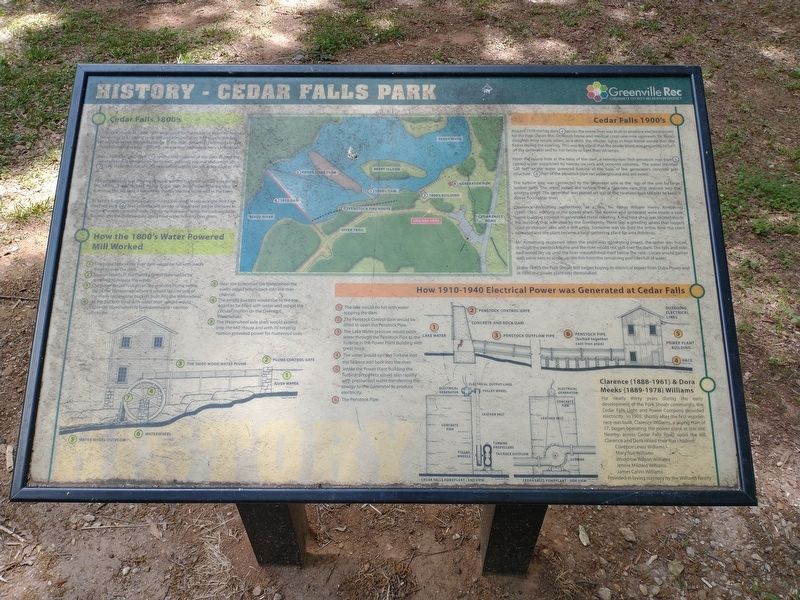
The rock shoals at Cedar Falls were used for hundreds of years by Native Americans as a hunting camp site and transportation ford to cross the Reedy River. Due to the elevation change in the river, generating waterpower was possible and in the early 1800’s this site was used for Hudson Berry’s enterprises.
Berry built a small dam (1) on the side channel of the river to feed the waterwheel that powered his textile mill, grist mill, saw mill and cotton gin. (2) Their store foundations still exist below and on the left at the edge of the river.
The general store was the hub of public activity in the Cedar Falls area during the 1800’s. It was located where Cedar Falls Road meets the parking lot entrance. The old road is evident by the dry stacked stone wall at the creek.
To keep a functional water supply during low water levels and eight inch high concrete curb (3) was constructed on top of the shoals across the river to funnel the water over the dam. During normal water levels the curb would be overrun and the shoals would again have water running over them.
How the 1800’s Water Powered Mill Worked
1.The
this page online
2. Several boards in the Flume Control Gate would be removed to release the water.
3. The water would rush down the wooden Flume to the top of the Waterwheel where it would fall into one of the many rectangular buckets built into the Waterwheel.
4. As the buckets filled with water their weight would cause the Waterwheel to turn downward – counter clockwise.
5. Near the bottom of the Waterwheel the water would return back in the river channel.
6. The empty buckets would rise to the top again to be filled with water and repeat the circular motion on the Overshot Waterwheel.
7. The Waterwheel axle shaft would extend in the Mill House and with its rotating motion provided power for numerous uses.
Cedar Falls 1900’s
Around 1910 the big dam (4) across the entire river was built to produce electrical power for the Fork Shoals Mill, Dr. Ross’s home and medical clinic one mile upstream. Dr. Ross’s daughter Kitty recalls when, as a child, the electric lights in their home would dim and flicker during the evening. This was the signal that the power plant was preparing
Photographed by Tom Bosse, May 14, 2022
2. History - Cedar Falls Park Marker
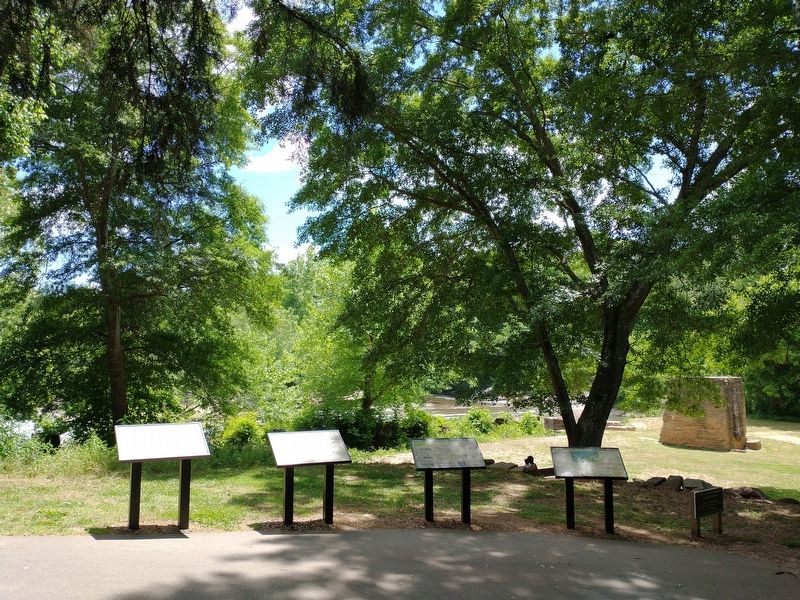
Marker located on far right. Remains of Generator Pier in right background.
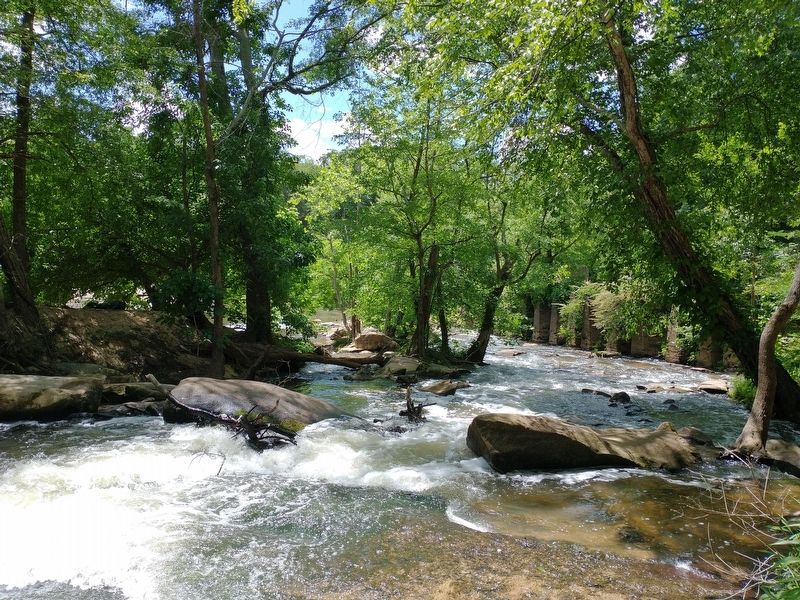
From the round hole at the base of the dam, a seventy-two inch penstock iron pipe (5) carried water supported by twenty-six rock and concrete columns. The water traveled 530 feet to the water powered turbine at the base of the generator’s concrete pier structure. (6) Part of the penstock pipe ran underground and still exists.
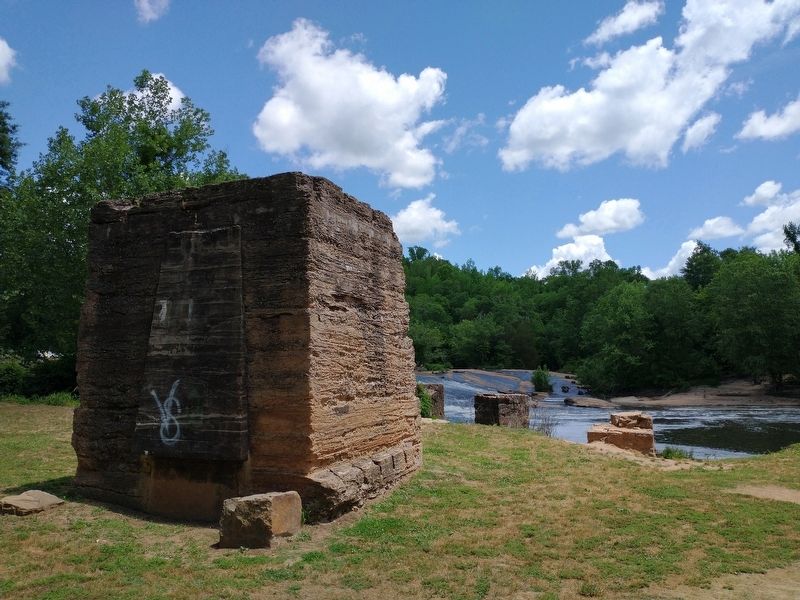
The turbine axle was connected to the generator axle at the top of the pier by large leather belts. The water exited the turbine into a concrete race that drained into the existing creek. The generator was placed on top of the nineteen foot tall pier to keep it above floodwater level.
Lawrence Armstrong remembers, as a boy, his father William Henry Armstrong (1885-1961) working at the power plant. The turbine and generator were inside a pole frame building covered in galvanized metal sheeting. A machine shop was located inside the building that was used by the community. There was a grinding wheel that loggers used to sharpen axes and a drill press. Someone was on duty the entire time the plant operated and the plant became a local
Photographed by Tom Bosse, May 14, 2022
3. Remains of Generator Pier
Mr. Armstrong explained when the plant was generating power, the water was forced through the penstock flume and the river would not spill over the dam. The falls and river bed would dry up until the river reestablished itself below the race. Locals would gather with seine nets to scoop up the fish from the remaining potholes full of water.
In the 1940’s the Fork Shoals Mill began buying its electrical power from Duke Power and in 1950 the power plant was demolished.
How 1910-1940 Electrical Power was Generated at Cedar Falls
1) The lake would be full with water topping the dam.
2) The Penstock Control Gate would be lifted to open the Penstock Pipe.
3) The Lake Water pressure would push water through the Penstock Pipe to the Turbine in the Power plant Building with great force.
4) The water would exit the Turbine into the Tailrace and back into the river.
5) Inside the Power Plant Building the Turbine propellers would spin rapidly with pressurized water transferring the energy to the Generator to produce electricity.
6) The Penstock Pipe.
Clarence (1888-1961) & Dora Meeks (1889-1978) Williams
For

Photographed by Tom Bosse, May 14, 2022
4. 1910 Dam
Clarence Lewis Williams
Mary Sue Williams
Woodrow Wilson Williams
Jennie Mildred Williams
James Calvin Williams
Provided in loving memory by the Williams Family.
Erected by Greenville County Recreation District.
Topics. This historical marker is listed in these topic lists: Industry & Commerce • Parks & Recreational Areas • Settlements & Settlers.
Location. 34° 36.732′ N, 82° 17.913′ W. Marker is near Fountain Inn, South Carolina, in Greenville County. It can be reached from the intersection of Cedar Falls Road and Turner Road, on the right when traveling north. Marker located in Cedar Falls Park. Touch for map. Marker is at or near this postal address: 201 Cedar Falls Road, Fountain Inn SC 29644,
Photographed by Tom Bosse, May 14, 2022
5. Remains of the Penstock Pipe Route can be seen on the right.

Regionally, this marker is in Upstate and in the Greater Greenville-Spartanburg Area. It is also in the American South, specifically in the Deep South, in Appalachia, and specifically in Southern Appalachia. Globally, it is in North America, the Western Hemisphere, the Western World, and the Anglosphere. Historically, it finds itself in what was once the original Cherokee Nation, the territory of the Mississippian Culture, one of the original Thirteen Colonies, one of the Confederate States of America, and the Antebellum South.
Other nearby markers. At least 8 other markers are within 4 miles of this marker, measured as the crow flies: History – Cedar Falls Park (here, next to this marker); Environment – Cedar Falls Park (here, next to this marker); a different marker also named History - Cedar Falls Park (a few steps from this marker); Fork Shoals School (approx. one mile away); Fork Shoals Baptist Church (approx. one mile away); Hopkins Farm (approx. 3.2 miles away); Toney's Store / Militia Muster Ground (approx. 3.2 miles away); Battle of Great Cane Brake (approx. 3.2
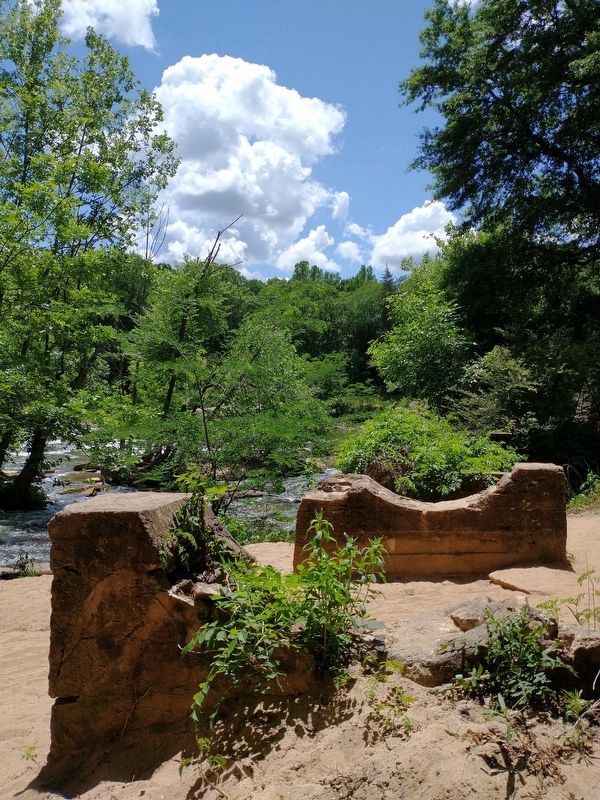
Photographed by Tom Bosse, May 14, 2022
6. Remains of the Penstock Pipe Route.
Related markers. Click here for a list of markers that are related to this marker.
Credits. This page was last revised on May 26, 2022. It was originally submitted on May 25, 2022, by Tom Bosse of Jefferson City, Tennessee. This page has been viewed 2,095 times since then and 189 times this year. Photos: 1, 2, 3, 4, 5, 6. submitted on May 25, 2022, by Tom Bosse of Jefferson City, Tennessee. • Bernard Fisher was the editor who published this page.
