Milford Hundred in Kent County, Delaware — The American Northeast (Mid-Atlantic)
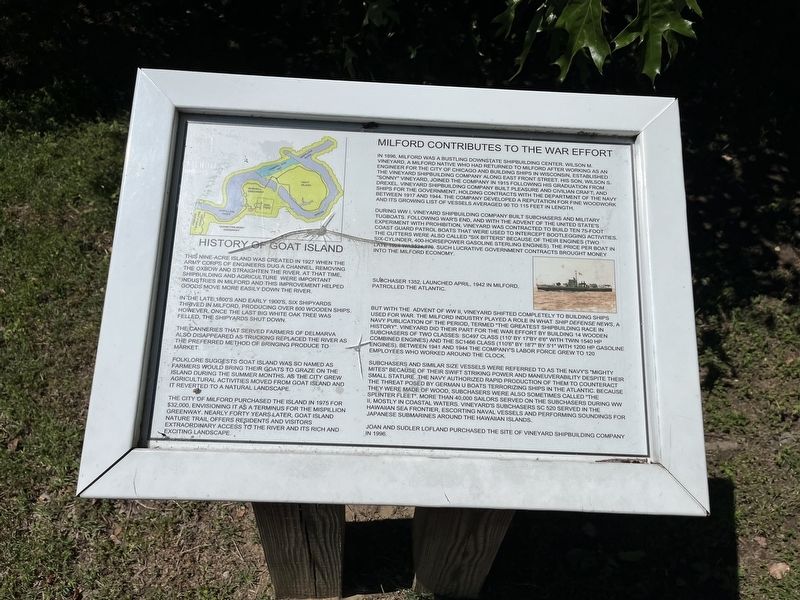
History of Goat Island
⎯⎯⎯
Milford Contributes to the War Effort
Photographed by Devry Becker Jones (CC0), May 28, 2022
1. History of Goat Island / Milford Contributes to the War Effort Marker
History of Goat Island
This nine-acre island was created in 1927 when the Army Corps of Engineers dug a channel removing the oxbow and straighten the river. At that time, shipbuilding and agriculture were important industries in Milford and this improvement helped goods move more easily down the river.
In the late 1800's and early 1900's, six shipyards thrived in Milford, producing over 600 wooden ships. However, once the last big white oak tree was felled, the shipyards shut down.
The canneries that served farmers of Delmarva also disappeared as trucking replaced the river as the preferred method of bringing produce to market.
Folklore suggests Goat Island was so named as farmers would bring their goats to graze on the island during the summer months. As the city grew agricultural activities moved from Goat Island and it reverted to a natural landscape.
The City of Milford purchased the island in 1975 for $32,000, envisioning it as a terminus for the Mispillion Greenway. Nearly forty years later, Goat Island Nature Trail offers residents and visitors extraordinary access to the river and its rich and exciting
this page online
Milford Contributes to the War Efforts
In 1896, Milford was a bustling downstate shipbuilding center, Wilson M. Vineyard, a Milford native who had returned to Milford after working as an engineer for the City of Chicago and building ships in Wisconsin, established the Vineyard Shipbuilding Company along East Front Street. His son, Wilson S. "Sonny" Vineyard, joined the company in 1915 following his graduation from Drexel. Vineyard shipbuilding company built pleasure and civilian craft, and ships for the government, holding contracts with the Department of the Navy between 1917 and 1944. The company developed a reputation for fine woodwork and its growing list of vessels averaged 90 to 115 feet in length.
During WW I, Vineyard Shipbuilding Company built subchasers and military tugboats. Following war's end, and with the advent of the United State's experiment with prohibition, Vineyard was contracted to build ten 75-foot Coast Guard patrol boats that were used to intercept bootlegging activities. The cutters were also called "six bitters" because of their engines (two six-cylinder, 400-horsepower gasoline sterling engines).
Photographed by Devry Becker Jones (CC0), May 28, 2022
2. History of Goat Island / Milford Contributes to the War Effort Marker
But with the advent of WW II, Vineyard shifted completely to building ships used for war. The Milford industry played a role in what Ship Defense News, a Navy publication of the period, termed "the greatest shipbuilding race in history". Vineyard did their part for the war effort by building 14 wooden subchasers of two classes: SC497 Class (110' by 17' by 6'6" with Twin 1540 HP combined engines) and the SC1466 Class (110'6" by 18'7" by 5'1" with 1200 HP gasoline engines). Between 1941 and 1944 the company's labor force grew to 120 employees who worked around the clock.
Subchasters and similar size vessels were referred to as the Navy's "Mighty Mites" because of their swift striking power and maneuverability despite their small stature. The Navy authorized rapid production of them to counteract the threat posed by German U Boats terrorizing ships in the Atlantic. Because they were made of wood, subchasers were also sometimes called "The Splinter Fleet". More than 40,000 sailors served on the subchasers during WW II, mostly in coastal waters. Vineyard's subchasers SC 520 served in the Hawaiian Sea Frontier. Escorting Naval vessels and performing soundings for Japanese submarines around the Hawaiian Islands.
Joan and Sudler Lofland purchased the site of Vineyard Shipbuilding Company in 1996.
[Caption:]
Subchaser 1352, launched April, 1942 in Milford, patrolled the Atlantic.
Topics. This historical marker is listed in these topic lists: Agriculture • Animals • Industry & Commerce • Waterways & Vessels. A significant historical month for this entry is April 1942.
Location. 38° 54.948′ N, 75° 25.202′ W. Marker is in Milford, Delaware, in Kent County. It is in Milford Hundred. It can be reached from Fisher Avenue 0.2 miles north of Mispillion Street, on the left when traveling north. The marker is on the Goat Island Nature Area Trail. Touch for map. Marker is in this post office area: Milford DE 19963, United States of America. Touch for directions.

Regionally, this marker is in the American Mid-Atlantic, on the Delmarva Peninsula, and on the Eastern Seaboard. Globally, it is in the North Atlantic Region, North America, the Western Hemisphere, the Western World, and the Anglosphere. Historically, it finds itself in what was once New Netherland, one of the original Thirteen Colonies, and the Antebellum South.
Other nearby markers. At least 8 other markers are within walking distance of this marker: Milford Parks and Recreation Director… (a few steps from this marker); American Holly (within shouting distance of this marker); The Vinyard Shipbuilding Company (approx. ¼ mile away); Milford Veterans Memorial (approx. 0.3 miles away); Old Calvary Church, Franklin St. (approx. 0.4 miles away); Nixon Palace Theater, N. Walnut St. (approx. 0.4 miles away); Old Red Mill & L.D. Caulk Mfg. Plant (approx. 0.4 miles away); Launching George May Sailing Ship, 1900 (approx. 0.4 miles away). Touch for a list and map of all markers in Milford.
Another marker is no longer nearby. Liberty Tree Memorial (was approx. 0.4 miles away but has been confirmed missing).
Credits. This page was last revised on May 15, 2026. It was originally submitted on May 29, 2022, by Devry Becker Jones of Washington, District of Columbia. This page has been viewed 1,861 times since then and 100 times this year. Photos: 1, 2. submitted on May 29, 2022, by Devry Becker Jones of Washington, District of Columbia.
