
Teotihuacán de Arista in Teotihuacán, Mexico State, Mexico — The Central Highlands (North America)
Temple of the Plumed Serpent
Photographed by J. Makali Bruton, May 16, 2022
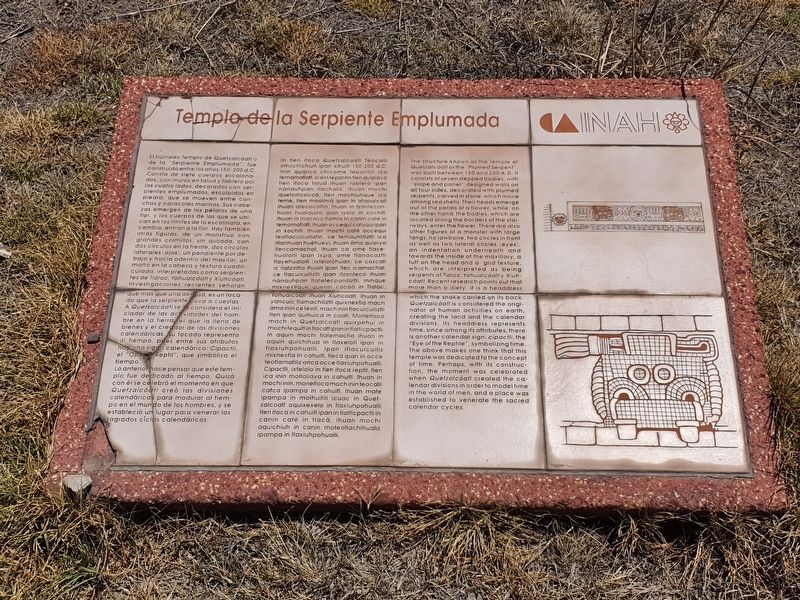
1. Temple of the Plumed Serpent Marker

El llamado Templo de Quetzalcoatl o de la "Serpiente Emplumada", fue construido entre los años 150-200 d. C. Consta de siete cuerpos escalonados, con muros en talud y tablero por los cuatro lados, decorados con serpientes emplumadas, esculpidas en piedra, que se mueven entre conchas y caracoles marinos. Sus cabezas emergen de los pétalos de una flor, y los cuerpos de las que se ubican en los límites de la escalinata, en cambio, entran a la flor. Hay también otras figuras, de un monstruo con grandes colmillos, sin quijada, con dos círculos en la frente, dos círculos laterales (ojos), un pendiente por debajo y hacia adentro del maxilar, un moño en la cabeza y textura cuadriculada, interpretadas como serpientes de Tlaloc, Yohualcóatly Xiuhcóatl. Investigaciones recientes señalan que mas que una dead, es un tocado que la serpiente leva a cuestas. A Quetzalcoatl se considera el iniciador de las actividades del hom- bre en la tierra el que la llena de bienes y el creador de las divisiones calendáricas. Su tocado representa al tiempo, pes entre sus atributos hay otro signo calendárico: Cipactli, el "Ojo Reptil", que simboliza el tiempo.
Lo anterio hace pensar que este templo fue dedicado al tiempo. Quizá con él se celebró el momento en que Quetzalcoatl creó las divisiones calendáricas para modular al tiempo en el mundo de los hombres, y se estableció un lugar para venerar los sagrados ciclos calendáricos.
In tlen itoca Quetzalcoatl Teocalli omochichiuh ipan xihuitl 150-200 d.C. Inin quipiya chicome tepantin ica temamattatt, ica intepantin tlen quipiaya tlen itoca talud ihuan tablero ipan nanauhpan tlachaliz, ihuan mochi quetzalcocoa, tlen mochiuhque ica teme, tlen moolinià ipan in atapalcati ihuan atecocoltin. Ihuan in tzonteconhuan hualquizá ipan iyolo in xochitl, ihuan in inacayo tlamia in canin cate in temamatlatı, ihuan occequi calaquiipan in xochitl. Ihuan mochi caté occequi teotlacuicuiliztin, ce temauhtiliztli ica itlanhuan huehueyi, ihuan àmo quipiya itencamachal, ihuan ca ome tlayehualolli ipan ixpa, ome tlanacaztli tlayehualolli (ixtelolòhuan) ce cozcati ic tlatzintla ihuan ipan itec icamachal. ce flacuicuiliztli ipan itzonteco ihuan nanauhpan tlatetecpaniliztli, ininque mixnextique quenin cocoa in Tlaloc, Yohualcoatl thuan Xiuhcoatl. Ihuan in yancuic flamachiliztli quixnextia mach àmo inin ce teotl, mach inin tlacuicuiliztli tlen ipan quihuica in coatl. Moneltoca mach in Quetzalcoatl quixpehui in mochi tequitl in tlacatt ipan in tlalticpactli, in aquin mochi tlatemactia ihuan in aquin quichihua in flaxeloli ipan in flaxiuhpohualli. Ipan itlacuicuiliz mixnextia in cahuitl, fleca ipan in occe teotlamatiliz onca occe tlaxiuhpohualli. Cipactli, ixtelolo in tlen itoca reptil, tlen ica inin motlaliaya in cahuitl. Ihuan in mochi inin, moneltoca machinin teocalli catca ipampa in cahuitl. Ihuan mate ipampa in molhuitili icuac in Quet- zalcoatl oquixexelo in tlaxiuhpohualli tlen itoca in cahuitl ipan in tlalticpactli in canin cate in tlacâ, ihuan mochi oquichiuh in canin moteotlachihualiz ipampa in tlaxiuhpohualli.
Temple of the Plumed Serpent
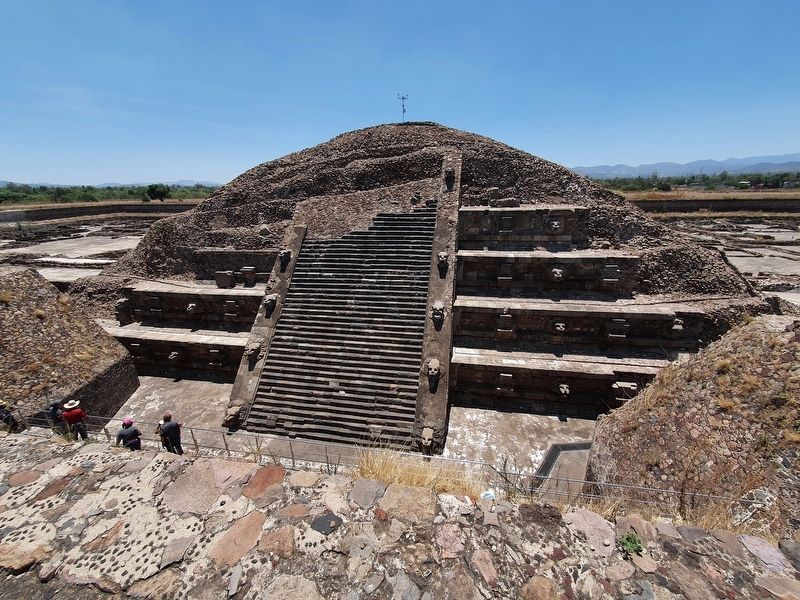
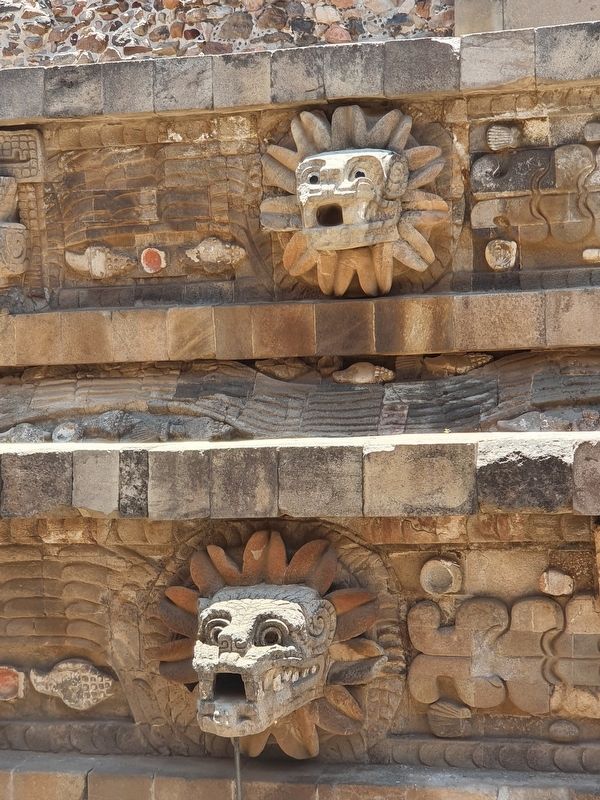
The structure known as the Temple of Quetzalcoatl or the "Plumed Serpent", was built between 150 and 200 A.D. It consists of seven stepped bodies, with "slope and panel" designed walls on all four sides, decorated with plumed serpents, carved in stone, which move among sea shells. Their heads emerge out of the petals of a flower, while, on the other hand, the bodies, which are located along the borders of the stairways, enter the flower. There are also other figures of a monster with large fangs, no jawbone, two circles in front as well as two lateral circles (eyes), an indentation underneath and towards the inside of the maxillary, a tuft on the head and a grid texture, which are interpreted as being serpents of Tlaloc, Yohualcóatl y Xiuhcoatl. Recent research points out that more than a diety, it is a headdress which the snake carried on its back. Quetzalcoatl is considered the originator of human activities on earth, creating the land and the calendar divisions. Its headdress represents time, since among its attributes, there is another calendar sign: cipactli, the "Eye of the Reptile", symbolizing time. The above makes one think that this temple was dedicated to the concept of time. Perhaps, with its construction, the moment was celebrated when Quetzalcoatl created the calendar divisions in order to model time in the world of men, and a place was established to venerate the sacred calendar cycles.
Erected by Instituto
this page online
Topics. This historical marker is listed in these topic lists: Anthropology & Archaeology • Architecture.
Location. 19° 40.895′ N, 98° 50.798′ W. Marker is in Teotihuacán de Arista, Estado de Mexico (Mexico State), in Teotihuacán. It is on Calzada de los Muertos just east of Route 132, on the right when traveling north. Touch for map. Marker is in this post office area: Teotihuacán de Arista MEX 55824, Mexico. Touch for directions.

Regionally, this marker is in Central Mexico and specifically in Mexico City Metropolitan Area. Globally, it is in North America, specifically in Mesoamerica, on the Ring of Fire, and in the Western Hemisphere. Historically, it finds itself in what was once New Spain, a Spanish colony, and the Aztec Empire.
Other nearby markers. At least 8 other markers are within walking distance of this marker: Embedded Platform (within shouting distance of this marker); The Southern Building of Teotihuacan (about 90 meters away, measured in a direct line); Southern Building (about 90 meters away); La Ciudadela (about

Photographed by J. Makali Bruton, May 16, 2022
2. Temple of the Plumed Serpent Marker
The marker is near the point where the Temple of the Plumed Serpent (right) meets with the Embedded Platform (left).
Photographed by J. Makali Bruton, May 16, 2022
3. Temple of the Plumed Serpent
Photographed by J. Makali Bruton, May 16, 2022
4. Temple of the Plumed Serpent Details
Credits. This page was last revised on June 3, 2022. It was originally submitted on June 2, 2022, by J. Makali Bruton of Washington, District of Columbia. This page has been viewed 151 times since then and 15 times this year. Photos: 1, 2. submitted on June 2, 2022, by J. Makali Bruton of Washington, District of Columbia. 3, 4. submitted on June 3, 2022, by J. Makali Bruton of Washington, District of Columbia.
