Near Winchester in Frederick County, Virginia — The American South (Mid-Atlantic)
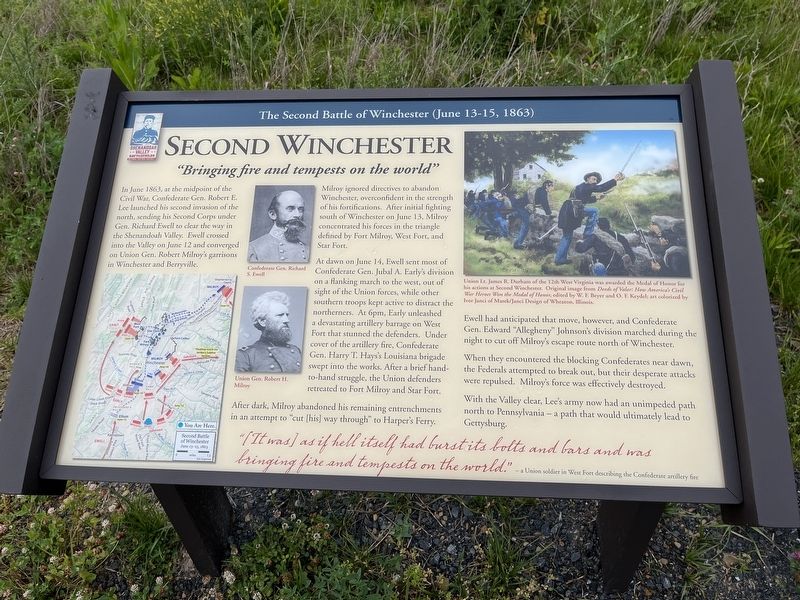
Second Winchester "Bringing fire and tempests on the world"
The Second Battle of Winchester (June 13-15, 1863)
| — | Shenandoah Valley Battlefields National Historic District | — |
Photographed by T. Elizabeth Renich, June 7, 2022
1. The Second Battle of Winchester (June 13-15, 1863) Marker
Milroy ignored directives to abandon Winchester, overconfident in the strength of his fortifications. After initial fighting south of Winchester on June 13, Milroy concentrated his forces in the triangle defined by Fort Milroy, West Fort, and Star Fort.
At dawn on June 14, Ewell sent most of Confederate Gen. Jubal A. Early's division on a flanking march to the west, out of sight of the Union forces, while other southern troops kept active to distract the northerners. At 6pm, Early unleashed a devastating artillery barrage on West Fort that stunned the defenders. Under cover of the artillery fire, Confederate Gen. Harry T. Hays's Louisiana brigade swept into the works. After a brief hand-to-hand struggle, the Union defenders retreated to Fort Milroy and Star Fort.
After dark, Milroy
this page online
Ewell had anticipated that move, however, and Confederate Gen. Edward "Allegheny" Johnson's division marched during the night to cut off Milroy's escape route north of Winchester.
When they encountered the blocking Confederates near dawn, the Federals attempted to break out, but their desperate attacks were repulsed. Milroy's force was effectively destroyed.
With the Valley clear, Lee's army now had an unimpeded path north to Pennsylvania — a path that would ultimately lead to Gettysburg.
"[It was] as if hell itself had burst its bolt and bars and was bringing fire and tempests on the world." — a Union soldier in West Fort describing the Confederate artillery fire
(captions)
(map) Second Battle of Winchester (June 13-15, 1863)
Confederate Gen. Richard S. Ewell
Union Gen. Robert H. Milroy
Union Lt. James R. Durham of the 12th West Virginia was awarded the Medal of Honor for his actions at Second Winchester. Original image from Deeds of Valor: How America's Civil War Heroes Won the Medal of Honor, edited by W.F. Beyer and O.F. Keydel; art colorized by Ivor Janci of Marek/Janci Design of Wheaton, Illinois.
Erected by Shenandoah
Photographed by T. Elizabeth Renich, June 7, 2022
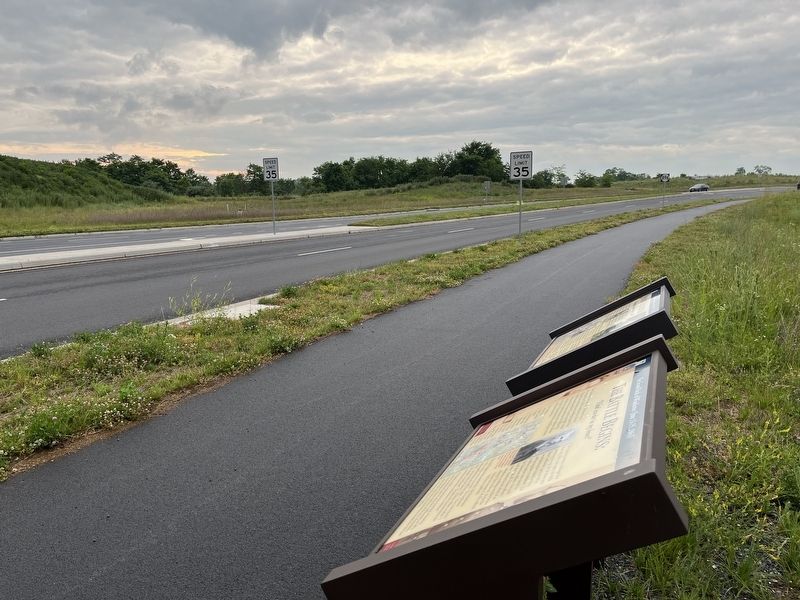
2. The Second Battle of Winchester (June 13-15, 1863) Marker
Topics. This historical marker is listed in this topic list: War, US Civil. A significant historical date for this entry is June 13, 1863.
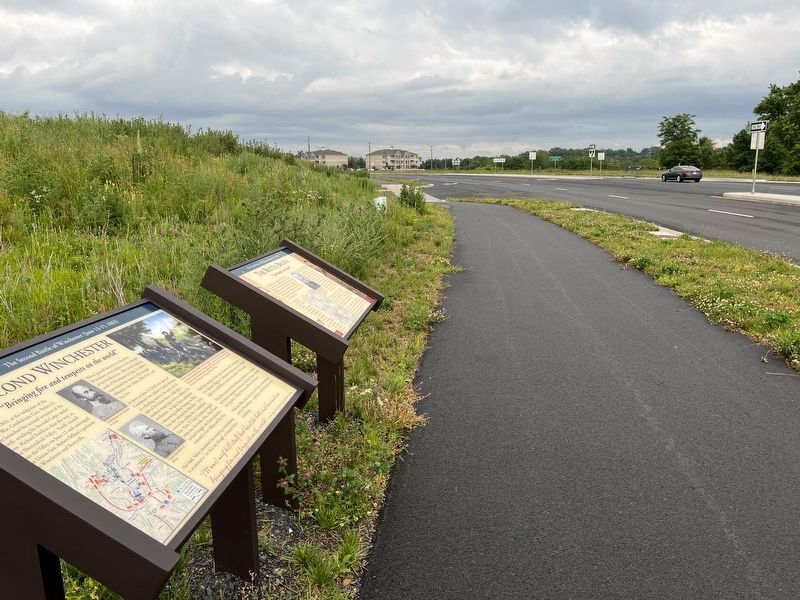
Location. 39° 8.742′ N, 78° 9.815′ W. Marker is near Winchester, Virginia, in Frederick County. It is on Crossover Boulevard (Virginia Route 645) 0.2 miles west of Front Royal Pike (U.S. 522), on the right when traveling west. Touch for map. Marker is in this post office area: Winchester VA 22602, United States of America. Touch for directions.

Regionally, this marker is in the Shenandoah Valley. It is also in the American South, specifically in the Upper South, and in the Mid-Atlantic. Globally, it is in North America, the Western Hemisphere, the Western World, and the Anglosphere. Historically, it finds itself in what was once the territory of the Mississippian Culture, one of the original Thirteen Colonies, one of the Confederate States of America, and the Antebellum South.
Other nearby markers. At least 8 other markers are within 2 miles of this marker, measured as the crow flies: The Battle Begins: "I had murder in my heart" (here, next to this marker);
Photographed by T. Elizabeth Renich, June 7, 2022
3. The Second Battle of Winchester (June 13-15, 1863) Marker
More about this marker. Date of marker being established is unknown, but it seems relatively new, not worn, colors vivid
Also see . . . Second Winchester Battlefield. Shenandoah Valley Battlefields Foundation (Submitted on June 8, 2022.)
Photographed by Bradley Owen, May 31, 2024
4. Second Winchester "Bringing fire and tempests on the world" Marker
Marker is on the left.
Credits. This page was last revised on May 31, 2024. It was originally submitted on June 7, 2022, by T. Elizabeth Renich of Winchester, Virginia. This page has been viewed 655 times since then and 43 times this year. Photos: 1, 2, 3. submitted on June 7, 2022, by T. Elizabeth Renich of Winchester, Virginia. 4. submitted on May 31, 2024, by Bradley Owen of Morgantown, West Virginia. • Bernard Fisher was the editor who published this page.
