Natchez in Adams County, Mississippi — The American South (East South Central)
Ex-"Slaves" as U.S. Civil War Soldiers in the Mississippi Valley Campaign
Photographed by Cajun Scrambler, June 2, 2022
1. Ex-"Slaves" as U.S. Civil War Soldiers in the Mississippi Valley Campaign Marker
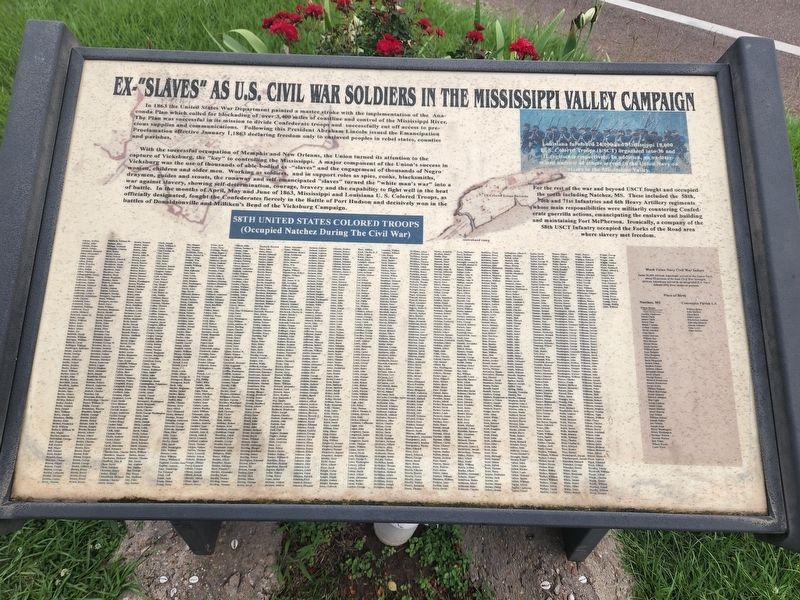
In 1863 the United States War Department painted a master stroke with the implementation of the Anaconda Plan which called for blockading of over 3,400 miles of coastline and control of the Mississippi River. The Plan was successful in its mission to divide Confederate troops and successfully cut off access to precious supplies and communications. Following this President Abraham Lincoln issued the Emancipation Proclamation effective January 1,1863 declaring freedom only to enslaved peoples in rebel states, counties and parishes.
With the successful occupation of Memphis and New Orleans, the Union turned its attention to the capture of Vicksburg, the "key" to controlling the Mississippi. A major component of the Union's success in Vicksburg was the use of thousands of able-bodied ex-"slaves" and the engagement of thousands of Negro women, children and older men. Working as soldiers, and in support roles as spies, cooks, blacksmiths, draymen, guides and scouts, the runaway and self-emancipated "slaves" turned the "white man's war" into a war against slavery, showing self-determination, courage, bravery and the capability
this page online
Louisiana furnished 24,000 and Mississippi 18,000 U.S. Colored Troops (USCT) organized into 36 and 11 regiments respectively. In addition, an undetermined number of others served in the Union Navy on rivers and in the Mississippi Valley.
For the rest of the war and beyond USCT fought and occupied the south including Natchez, MS. These included the 58th, 70th and 71st Infantries and 6th Heavy Artillery regiments whose main responsibilities were militarily countering Confederate guerrilla actions, emancipating the enslaved and building and maintaining Fort McPherson. Ironically, a company of the 58th USCT Infantry occupied the Forks of the Road area where slavery met freedom.
Topics. This historical marker is listed in these topic lists: Military • War, US Civil.
Location. 31° 33.331′ N,
Photographed by Cajun Scrambler, June 4, 2022
2. Ex-"Slaves" as U.S. Civil War Soldiers in the Mississippi Valley Campaign Marker

Regionally, this marker is in Southwest Mississippi and in Natchez Trace Corridor. It is also in the American South, specifically in the Deep South, and in the Great River Road Region. Globally, it is in North America, a Gulf of Mexico state, the Western Hemisphere, the Western World, and the Anglosphere. Historically, it finds itself in what was once New Spain, the Viceroyalty of New France, the territory of the Mississippian Culture, one of the Confederate States of America, and the Antebellum South.
Other nearby markers. At least 8 other markers are within walking distance of this marker: Forks of the Road Historical Site (a few steps from this marker); Forks of the Road (within shouting distance of this marker); a different marker also named Forks of the Road (about 300 feet away, measured in a direct line); History of St. Catherine Street (about 400 feet away); America's Domestic "Slave" Trading Routes To The Deep South (about 500 feet away); Natchez Chapter (approx. ¼ mile away); Monmouth: Upstairs, Downstairs (approx. ¼ mile away); Music on St. Catherine Street (approx. ¼ mile away). Touch for a list and map of all markers in Natchez.
Credits. This page was last revised on June 10, 2022. It was originally submitted on June 10, 2022, by Cajun Scrambler of Assumption, Louisiana. This page has been viewed 469 times since then and 42 times this year. Photos: 1, 2. submitted on June 10, 2022, by Cajun Scrambler of Assumption, Louisiana.
