Akron in Washington County, Colorado — The American Mountains (Southwest)
Last Days of the Buffalo ⎯⎯⎯ Akron Country
Photographed by James Hulse, June 10, 2022
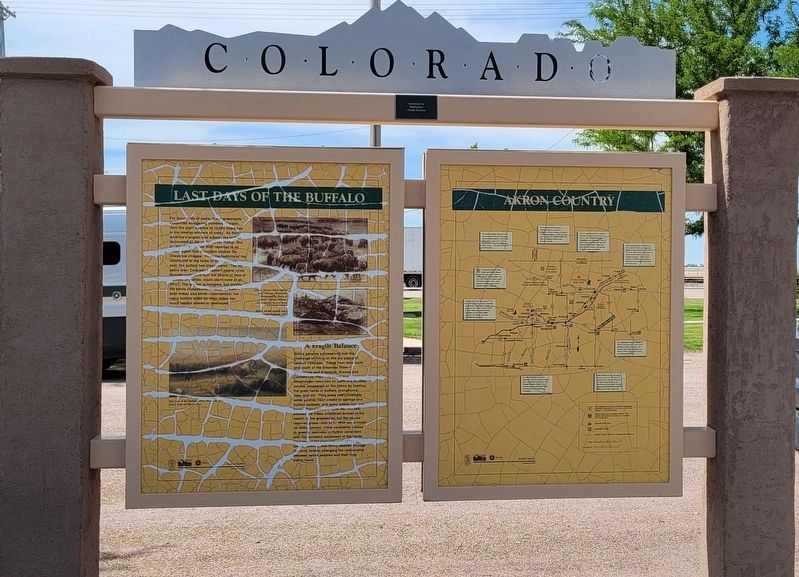
1. Last Days of the Buffalo Marker
Inscription.
Last Days of the Buffalo, also, Akron Country. .
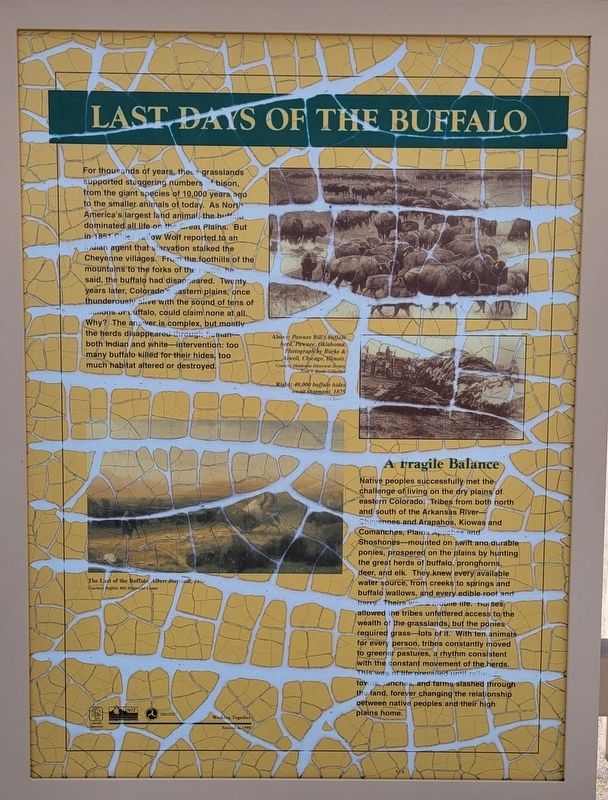
Last Days of the Buffalo. For thousands of years, the grasslands supported staggering numbers of bison, from the giant species of 10,000 years ago to the smaller animals of today. As North America's largest land animal, the buffalo dominated all life on the Great Plains. But in 1851 Chief Yellow Wolf reported to an Indian agent that starvation stalked the Cheyenne villages. From the foothills of the mountains to the forks of the Platte, he said, the buffalo had disappeared. Twenty years later, Colorado's eastern plains, once thunderously alive with the sound of tens of millions of buffalo, could claim none at all. Why? The answer is complex, but mostly the herds disappeared through human - both Indian and white - intervention: too many buffalo killed for their hides, too much habitat altered or destroyed., A Fragile Balance Native peoples successfully met the challenge of living on the dry plains of eastern Colorado. Tribes from both north and south of the Arkansas River - Cheyennes and Arapahos, Kiowas and Comanches, Plains Apaches and Shoshones - mounted on swift and durable ponies, prospered on the plains by hunting the great herds of buffalo, pronghorns, deer, and elk. They knew every available water source, from creeks to springs and buffalo wallows, and every edible root and berry. Theirs was a mobile life. Horses allowed the tribes unfettered access to the wealth of the grasslands, but the ponies required grass - lots of it. With ten animals for every person, tribes constantly moved to greener pastures, a rhythm consistent with the constant movement of the herds. This way of life prevailed until railroads, towns, ranches, and farms slashed through the land, forever changing the relationship between native peoples and their high plains home., Captions Lower Left: The Last of the Buffalo, Albert Bierstadt, 1889 Courtesy Buffalo Bill Historical Center 1st Upper Right: Above: Pawnee Bill's buffalo herd, Pawnee, Oklahoma. Photography by Burke and Atwell, Chicago, Illinois. Courtesy Oklahoma Historical Society Fred S. Barde Collection 2nd Upper Right: Right: 40,000 buffalo hides await shipment, 1875 Colorado Historical Society,
Akron Country.
Last Days of the Buffalo
For thousands of years, the grasslands supported staggering numbers of bison, from the giant species of 10,000 years ago to the smaller animals of today. As North America's largest land animal, the buffalo dominated all life on the Great Plains. But in 1851 Chief Yellow Wolf reported to an Indian agent that starvation stalked the Cheyenne villages. From the foothills of the mountains to the forks of the Platte, he said, the buffalo had disappeared. Twenty years later, Colorado's eastern plains, once thunderously alive with the sound of tens of millions of buffalo, could claim none at all. Why? The answer is complex, but mostly the herds disappeared through human - both Indian and white - intervention: too many buffalo killed for their hides, too much habitat altered or destroyed.
A Fragile Balance
Native peoples successfully met the challenge of living on the dry plains of eastern Colorado. Tribes from both north and south of the Arkansas River - Cheyennes and Arapahos, Kiowas and Comanches, Plains Apaches and Shoshones - mounted on swift and durable ponies, prospered on the plains by hunting
Click or scan to see this page online
the great herds of buffalo, pronghorns, deer, and elk. They knew every available water source, from creeks to springs and buffalo wallows, and every edible root and berry. Theirs was a mobile life. Horses allowed the tribes unfettered access to the wealth of the grasslands, but the ponies required grass - lots of it. With ten animals for every person, tribes constantly moved to greener pastures, a rhythm consistent with the constant movement of the herds. This way of life prevailed until railroads, towns, ranches, and farms slashed through the land, forever changing the relationship between native peoples and their high plains home.
Captions Lower Left: The Last of the Buffalo, Albert Bierstadt, 1889 Courtesy Buffalo Bill Historical Center 1st Upper Right: Above: Pawnee Bill's buffalo herd, Pawnee, Oklahoma. Photography by Burke & Atwell, Chicago, Illinois. Courtesy Oklahoma Historical Society Fred S. Barde Collection 2nd Upper Right: Right: 40,000 buffalo hides await shipment, 1875 Colorado Historical Society
Akron Country
Erected 1998 by Colorado Historical Society and Colorado Department of Transportation.
Topics.
Photographed by James Hulse, June 10, 2022
2. The Last Days of the Buffalo Marker is the marker on the left of the two markers
Location. 40° 9.539′ N, 103° 13.034′ W. Marker is in Akron, Colorado, in Washington County. It is at the intersection of West 1st Street (U.S. 34) and Custer Avenue, on the left when traveling west on West 1st Street. Located at a small city park along the highway. Touch for map. Marker is at or near this postal address: 425 W 1st St, Akron CO 80720, United States of America. Touch for directions.
Regionally, this marker is in the Eastern Plains. It is also in the American Mountain West, on the Great Plains, and specifically on the High Plains. Globally, it is in North America, the Western Hemisphere, the Western World, and the Anglosphere. Historically, it finds itself in what was once the Louisiana Purchase.
Other nearby markers. At least 2 other markers are within walking distance of this marker: Akron (here, next to this marker); Indian Wars 1864-1869 (here, next to this marker).
3. The view of the Last Days of the Buffalo Marker from the street
also commonly known as the American buffalo) was an activity fundamental to the economy and society of the Plains Indians peoples who inhabited the vast grasslands on the Interior Plains of North America, prior to the animal's near-extinction in the late 19th century following US expansion into the West. Bison hunting was an important spiritual practice and source of material for these groups, especially after the European introduction of the horse in the 16th through 18th centuries enabled new hunting techniques. The species' dramatic decline was the result of habitat loss due to the expansion of ranching and farming in western North America, industrial-scale hunting practiced by non-indigenous hunters, increased indigenous hunting pressure due to non-indigenous demand for bison hides and meat, and cases of deliberate policy by settler governments to destroy the food source of the Indigenous peoples during times of conflict. Source: Wikipedia
(Submitted on June 14, 2022, by James Hulse of Medina, Texas.)
Credits. This page was last revised on March 4, 2024. It was originally submitted on June 14, 2022, by James Hulse of Medina, Texas. This page has been viewed 481 times since then and 23 times this year. Photos:1, 2, 3. submitted on June 15, 2022, by James Hulse of Medina, Texas.