Sterling in Loudoun County, Virginia — The American South (Mid-Atlantic)
Vestal's Gap Road
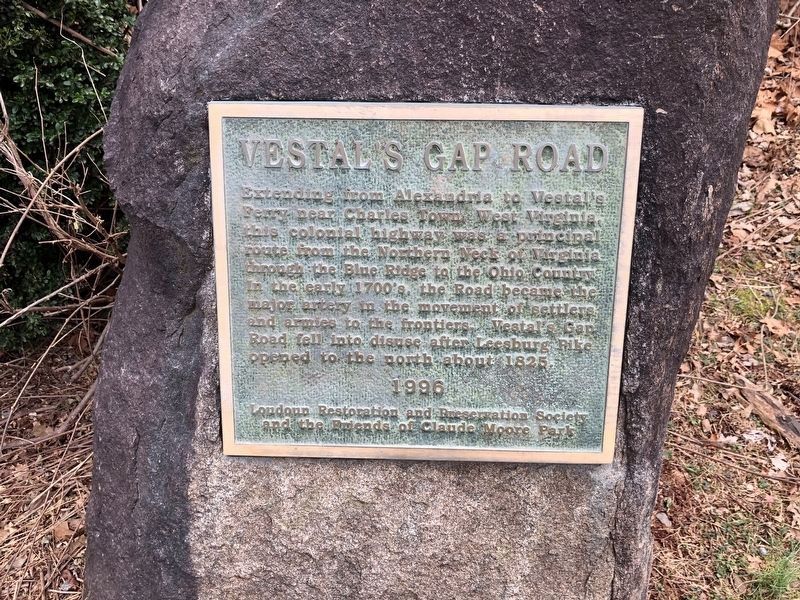
Erected 1996 by Loudoun Restoration and Preservation Society and the Friends of Claude Moore Park.
Topics. This historical marker is listed in these topic lists: Roads & Vehicles • Settlements & Settlers. A significant historical year for this entry is 1825.
Location. 39° 1.078′ N, 77° 24.238′ W. Marker is in Sterling, Virginia, in Loudoun County. It is at the intersection of Old Vestals Gap Road and Heritage Farm Lane, on the right when traveling east on Old Vestals Gap Road. The marker is located on a walking trail in the Claude Moore Park, of the Loudoun County Parks System. From VA 7, go South on Cascades Parkway, CR 637. Turn left onto Old Vestal's Gap Road, the park entrance. The trail follows the trace of Old Vestal's
this page online

Regionally, this marker is in the Washington Metropolitan Area and in Northern Virginia. It is also in the American South, specifically in the Upper South, and in the Mid-Atlantic. Globally, it is in North America, the Western Hemisphere, the Western World, and the Anglosphere. Historically, it finds itself in what was once the territory of the Mississippian Culture, one of the original Thirteen Colonies, one of the Confederate States of America, and the Antebellum South.
Other nearby markers. At least 8 other markers are within walking distance of this marker: Lanesville Historic Area (a few steps from this marker); Lanesville Architecture (a few steps from this marker); Lanesville House and Vestal's Gap Road (a few steps from this marker); The Braddock Campaign (a few steps from this marker); Lanesville Outbuildings (within shouting distance of this marker); Lanesville Families (within shouting distance of this marker); Vestal's Gap Road in the 1800s (about 300 feet away, measured in a direct
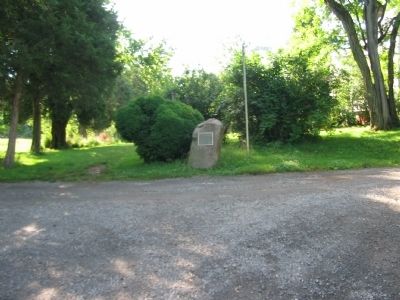
Photographed by Craig Swain, June 14, 2009
2. Vestal's Gap Road Marker
The stone is placed at the end of the service road portion of the trace. Beyond this point the trace is open only to foot traffic.
More about this marker. This marker is duplicated on the other end of the Vestal's Gap Road trace.
Related markers. Click here for a list of markers that are related to this marker. Markers related to Vestal's Gap Road.
Also see . . .
1. Claude Moore Park. The Lanesville Heritage Area. The park site discusses the history of the road. (Submitted on June 17, 2009, by Craig Swain of Leesburg, Virginia.)
2. Vestal's Gap Road: A Historical Perspective. (Submitted on June 17, 2009, by Craig Swain of Leesburg, Virginia.)
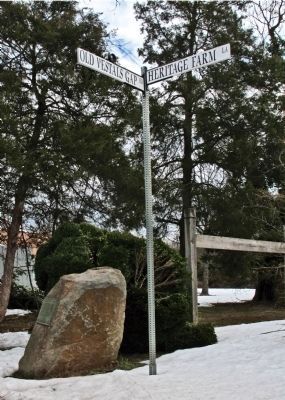
Photographed by Allen C. Browne, February 28, 2010
3. Vestal's Gap Road Marker
at the corner of Vestal's Gap Road and Heritage Farm Lane.
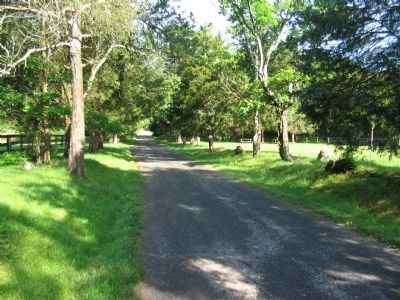
Photographed by Craig Swain, June 14, 2009
4. The Graveled Section of Old Vestal's Gap Road
This portion is still used as a service road, and part of the trail system in the park.
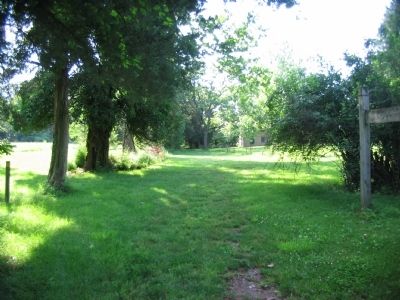
Photographed by Craig Swain, June 14, 2009
5. Eastern End of the Road Trace
Beyond the marker stone, the road trace is a foot path, connecting to the park trail system.
Credits. This page was last revised on December 30, 2020. It was originally submitted on June 17, 2009, by Craig Swain of Leesburg, Virginia. This page has been viewed 2,031 times since then and 82 times this year. Photos: 1. submitted on December 30, 2020, by Devry Becker Jones of Washington, District of Columbia. 2. submitted on June 17, 2009, by Craig Swain of Leesburg, Virginia. 3. submitted on July 28, 2012, by Allen C. Browne of Silver Spring, Maryland. 4, 5. submitted on June 17, 2009, by Craig Swain of Leesburg, Virginia.
