Near Yuma in Yuma County, Colorado — The American Mountains (Southwest)
Battle of Beecher Island
Photographed by James Hulse, June 10, 2022
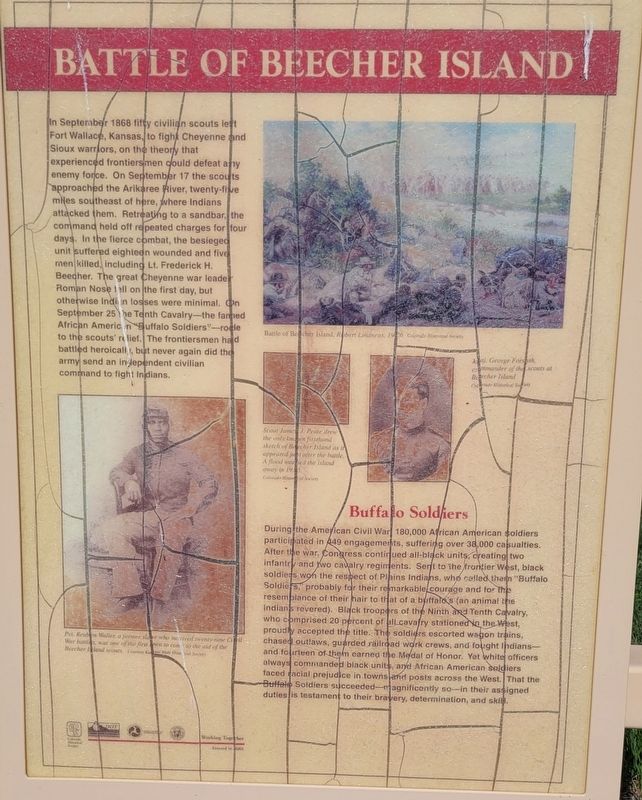
1. Battle of Beecher Island Marker
In September 1868 fifty civilian scouts left Fort Wallace, Kansas, to fight Cheyenne and Sioux warriors, on the theory that experienced frontiersmen could defeat any enemy force. On September 17 the scouts approached the Arikaree River, twenty-five miles southeast of here, where Indians attacked them. Retreating to a sandbar, the command held off repeated charges for four days. In the fierce combat, the besieged unit suffered eighteen wounded and five men killed, including Lt. Frederick H. Beecher. The great Cheyenne war leader Roman Nose fell on the first day, but otherwise Indian losses were minimal. On September 25 the Tenth Cavalry - the famed African American “Buffalo Soldiers" - rode to the scouts' relief. The frontiersmen had battled heroically, but never again did the army send an independent civilian command to fight Indians.
Buffalo Soldiers
During the American Civil War, 180,000 African American soldiers participated in 449 engagements, suffering over 38,000 casualties. After the war, Congress continued all-black units, creating two infantry and two cavalry regiments. Sent to the frontier West, black soldiers
this page online
Captions
Lower Left: Pvt. Reuben Waller, a former slave who survived twenty-nine Civil War battles, was one of the first men to come to the aid of the Beecher Island scouts.
Courtesy Kansas Historical Society
Upper Right: Battle of Beecher Island. Robert Lindneux, 1926. Colorado Historical Society
Middle Right: Scout James J. Peace drew the only known firsthand sketch of Beecher Island as it appeared just after the battle. A flood washed the island away in 1935. Colorado Historical Society
Middle Right: Maj. George Forsyth, commander of the scouts at Beecher Island. Colorado Historical Society
Erected 2001
Photographed by James Hulse, June 10, 2022
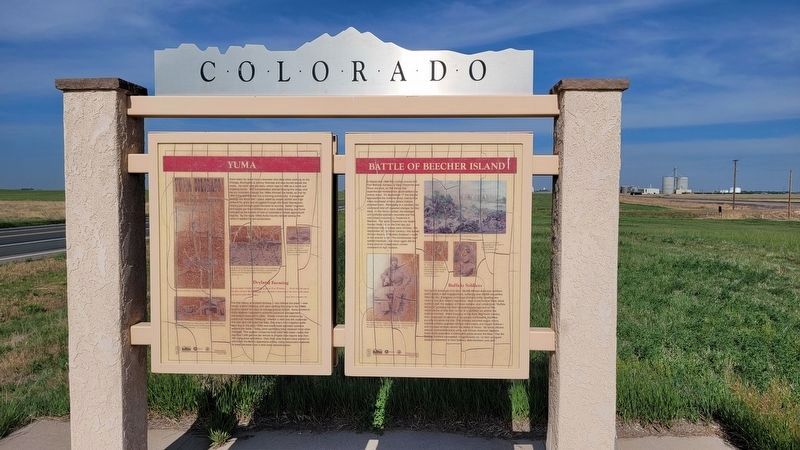
2. The Battle of Beecher Island Marker is on the right of the two markers
Topics. This historical marker is listed in these topic lists: African Americans • Indigenous Peoples and Communities • Wars, US Indian. A significant historical month for this entry is September 1868.
Location. 40° 7.137′ N, 102° 39.626′ W. Marker is near Yuma, Colorado, in Yuma County. It is at the intersection of U.S. 34 and County Highway J, on the right when traveling west on U.S. 34. The marker is located at a small roadside pullout. Touch for map. Marker is in this post office area: Yuma CO 80759, United States of America. Touch for directions.

Regionally, this marker is in the Eastern Plains. It is also in the American Mountain West, on the Great Plains, and specifically on the High Plains. Globally, it is in North America, the Western Hemisphere, the Western World, and the Anglosphere. Historically, it finds itself in what was once the Louisiana Purchase.
Other nearby markers. At least one other marker is within walking distance of this marker: Yuma (here, next to this marker).
Also see . . . Battle of Beecher Island. Wikipedia
Photographed by James Hulse, June 10, 2022
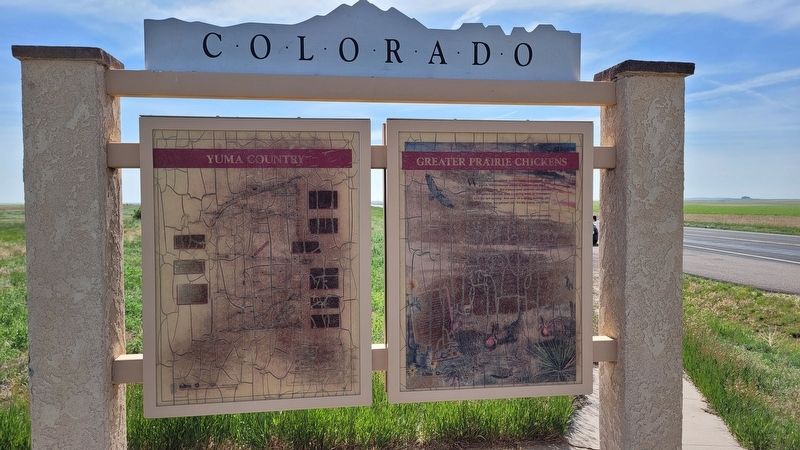
3. Reverse side - Battle of Beecher Island Marker
Photographed by James Hulse, June 10, 2022
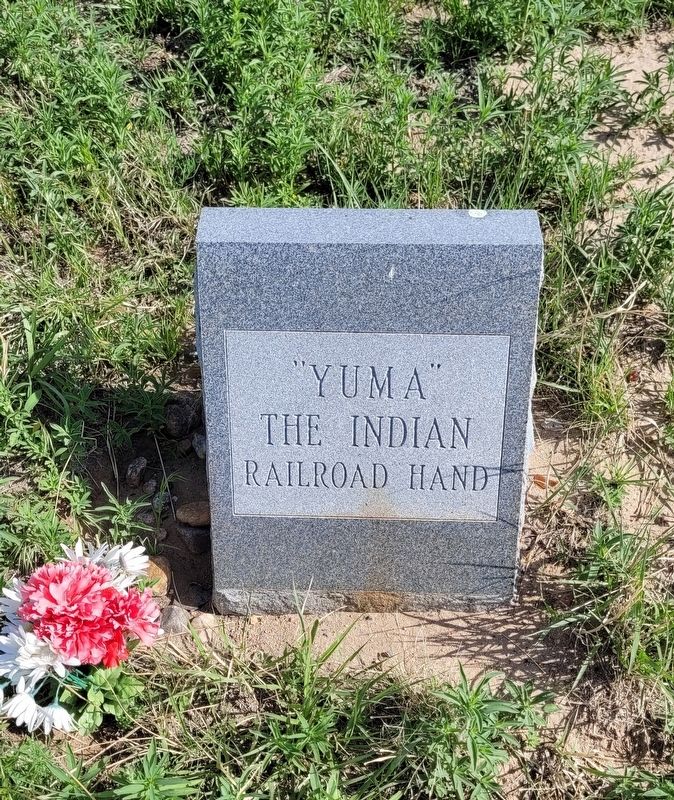
4. Yuma gravestone next to the markers
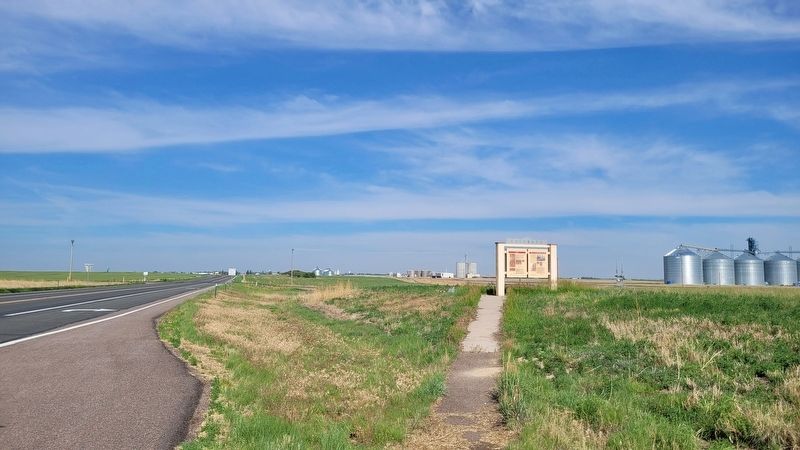
Photographed by James Hulse, June 10, 2022
5. The view of the Markers from the street
Credits. This page was last revised on June 16, 2024. It was originally submitted on June 30, 2022, by James Hulse of Medina, Texas. This page has been viewed 999 times since then and 74 times this year. Photos: 1, 2, 3, 4, 5. submitted on July 1, 2022, by James Hulse of Medina, Texas.
