Avondale in Cincinnati in Hamilton County, Ohio — The American Midwest (Great Lakes)
Centuries of Wildlife in Ohio
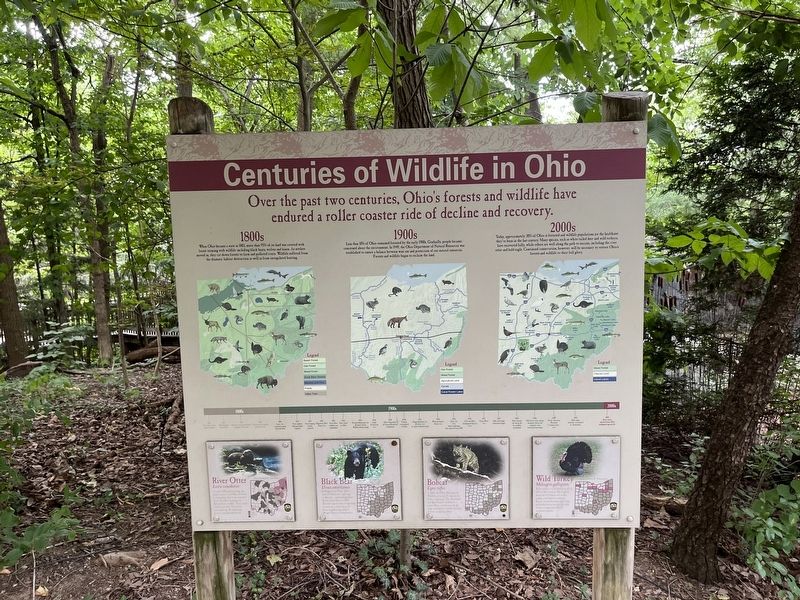
Over the past two centuries, Ohio's forests and wildlife have endured a roller coaster ride of decline and recovery.
1800s: When Ohio became a state in 1803, more than 95% of its land was covered with forest teeming with wildlife including black bears, wolves and bison. As settlers moved in, they cut down forests to farm and polluted rivers. Wildlife suffered from the dramatic habitat destruction as well as from unregulated hunting.
1900s: Less than 10% of Ohio remained forested by the early 1900s. Gradually, people became concerned about the environment. In 1949, the Ohio Department of Natural Resources was established to ensure a balance between wise use and protection of our natural resources. Forests and wildlife began to reclaim the land.
2000s: Today, approximately 30% of Ohio is forested and wildlife populations are the healthiest they've been in the last century. Many species, such as white-tailed deer and wild turkeys, have recovered fully, while others are well along the path to success, including the river otter and bald eagle. Continued conservation, however, will be necessary to restore Ohio's forests
this page online
River Otter
Lutra canadensis
At over 5,000 and counting, the otter's recovery in Ohio has been so successful that it was removed from the Ohio Endangered Species List in 2002. They can be found in at least 44 counties, encompassing 48 watersheds (rivers, streams and lakes).
Black Bear
Ursus americanus
Endangered in Ohio, there were 65 black bear sightings in the state, representing about 41 individual bears in 2003. The bear population is expected to increase as bears move from neighboring states to occupy Ohio's eastern forests.
Bobcat
Lynx rufus
In 2003, the Ohio Division of Wildlife received 32 reports of bobcat sightings. The abundance and distribution of bobcats is expected to rise because of the large amount of suitable forested habitat in eastern Ohio.
Wild Turkey
Meleagris gallowpavo
Wild turkeys can be found in all of Ohio's 88 counties. The highest densities of turkeys are in the unglaciated eastern counties. Recent reintroductions have been successful in increasing the wild turkey's range into Ohio's western counties.
Erected by Cincinnati Zoo and Botanical Garden.
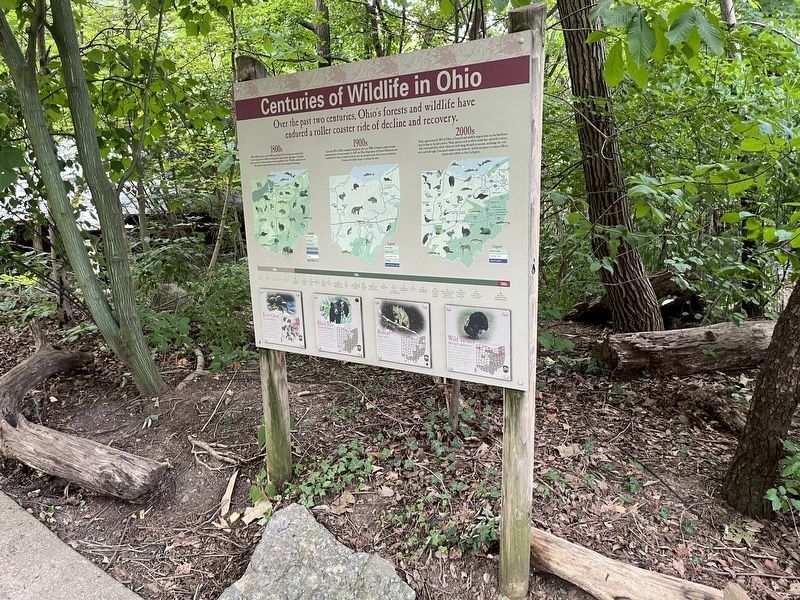
Topics. This historical marker is listed in these topic lists: Animals • Environment • Natural Resources. A significant historical year for this entry is 1803.
Location. 39° 8.74′ N, 84° 30.457′ W. Marker is in Cincinnati, Ohio, in Hamilton County. It is in Avondale. It can be reached from Vine Street north of Erkenbrecher Avenue, on the right when traveling north. Touch for map. Marker is at or near this postal address: 3400 Vine St, Cincinnati OH 45220, United States of America. Touch for directions.

Regionally, this marker is in the American Midwest and in the Ohio River Valley. Globally, it is in North America, the Western Hemisphere, the Western World, and the Anglosphere. Historically, it finds itself in what was once the Haudenosaunee (Iroquois) Confederacy, the territory of the Mississippian Culture, and the Northwest Territory.
Other nearby markers. At least 8 other markers are within walking distance of this marker: Gray Fox (a few steps from this marker); A Fierce Green Fire (a few steps from this marker); The River Otter's Return (a few steps from this marker); Mexican Wolf (a few steps from this marker); Healthy Oceans = Healthy Penguins & People (within shouting distance of this marker); Meet AP063 (within shouting distance of this marker); Saving Species Through Science (within shouting distance of this marker); Garden of Peace (within shouting distance of this marker). Touch for a list and map of all markers in Cincinnati.
Credits. This page was last revised on February 4, 2023. It was originally submitted on July 2, 2022, by Devry Becker Jones of Washington, District of Columbia. This page has been viewed 587 times since then and 57 times this year. Photos: 1, 2. submitted on July 2, 2022, by Devry Becker Jones of Washington, District of Columbia.
