Avondale in Cincinnati in Hamilton County, Ohio — The American Midwest (Great Lakes)
Blue-and-Yellow Macaw
Ara ararauna
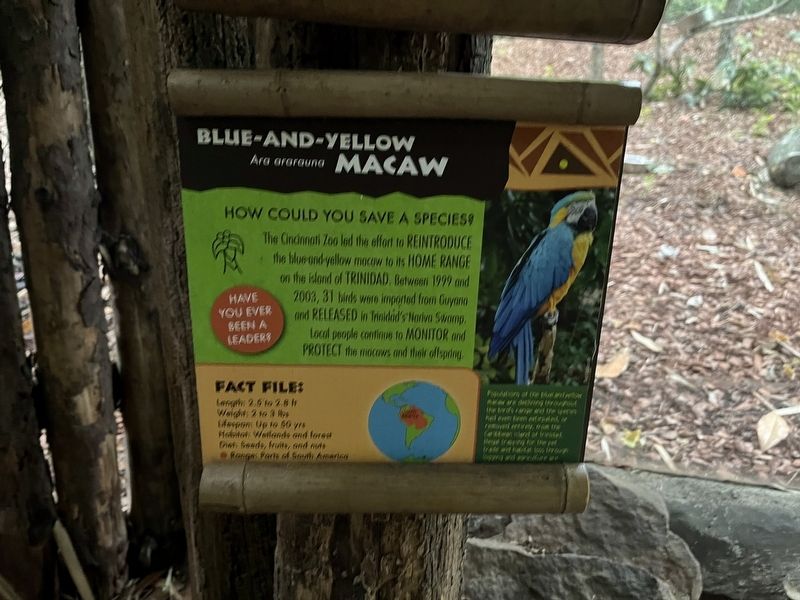
How could you save a species?
The Cincinnati Zoo led the effort to reintroduce the blue-and-yellow macaw to its home range on the island of Trinidad. Between 1999 and 2003, 31 birds were imported from Guyana and released in Trinidad's Nariva Swamp. Local people continue to monitor and protect the macaws and their offspring.
Have you ever been a leader?
Fact File:
Length: 2.5 to 2.8 ft
Weight: 2 to 3 lbs
Lifespan: Up to 50 yrs
Habitat: Wetlands and forest
Diet: Seeds, fruits, and nuts
Range: Parts of South America
[Sidebar:]
Populations of the blue and yellow macaw are declining throughout the bird's range and the species had even been extirpated, or removed entirely, from the Caribbean island of Trinidad. Illegal trapping for the pet trade and habitat loss through logging and agriculture are threatening the species.
Erected by Cincinnati Zoo and Botanical Garden.
Topics. This historical marker is listed in these topic lists: Animals • Environment • Industry & Commerce • Natural Resources. A significant historical year for this entry is 1999.
Location. 39° 8.763′ N, 84° 30.389′ W.
this page online

Regionally, this marker is in the American Midwest and in the Ohio River Valley. Globally, it is in North America, the Western Hemisphere, the Western World, and the Anglosphere. Historically, it finds itself in what was once the Haudenosaunee (Iroquois) Confederacy, the territory of the Mississippian Culture, and the Northwest Territory.
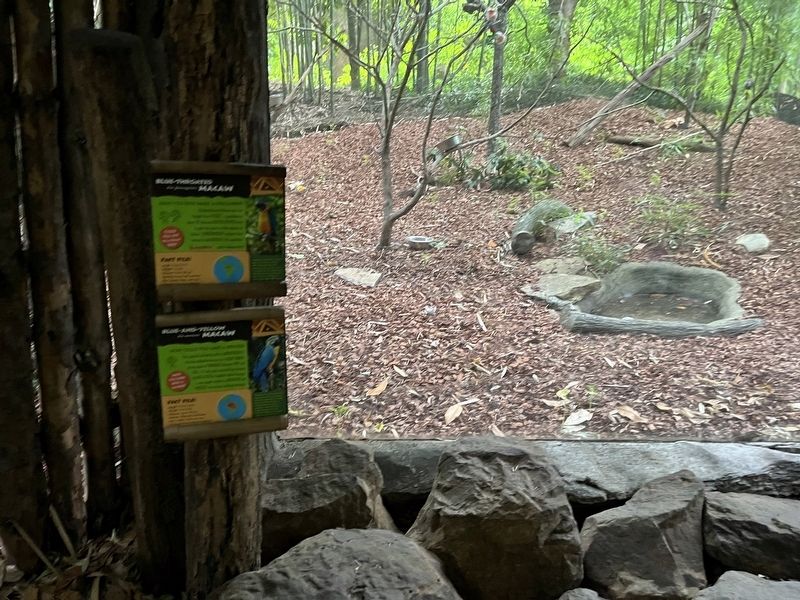
Other nearby markers. At least 8 other markers are within walking distance of this marker: Blue-Throated Macaw (here, next to this marker); The Aqueduct (within shouting distance of this marker); Roman Period (within shouting distance of this marker); Hellenistic Peirod (within shouting distance of this marker); Persian Period (within shouting distance of this marker); Iron Age (within shouting distance of this marker); Byzantine Period (within shouting distance of this marker);
Credits. This page was last revised on February 4, 2023. It was originally submitted on July 2, 2022, by Devry Becker Jones of Washington, District of Columbia. This page has been viewed 401 times since then and 17 times this year. Photos: 1, 2. submitted on July 2, 2022, by Devry Becker Jones of Washington, District of Columbia.
Editor’s want-list for this marker. Clearer photos of the marker and its context. • Can you help?
