Ocala in Marion County, Florida — The American South (South Atlantic)
Treaty of Payne’s Landing
Fort King National Historic Landmark
Photographed by Brandon D Cross, July 4, 2022
1. Treaty of Payne’s Landing Marker
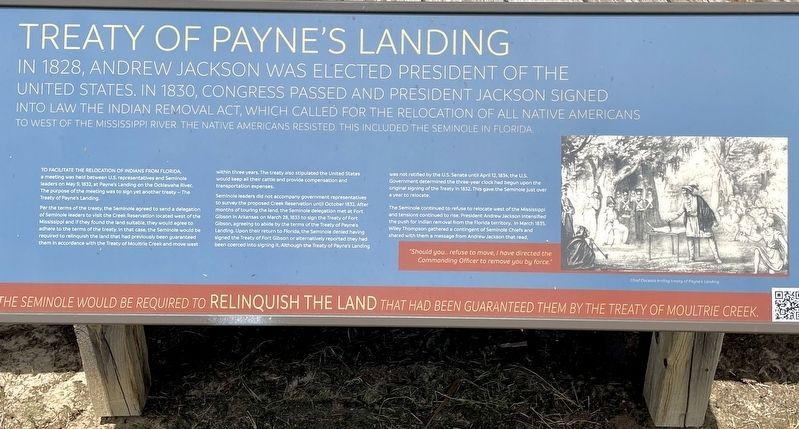
To facilitate the relocation of Indians from Florida, a meeting was held between U.S. representatives and Seminole leaders on May 9, 1832, at Payne's Landing on the Ocklawaha River. The purpose of the meeting was to sign yet another treaty - The Treaty of Payne's Landing.
Per the terms of the treaty, the Seminole agreed to send a delegation of Seminole leaders to visit the Creek Reservation located west of the Mississippi and if they found the land suitable, they would agree to adhere to the terms of the treaty. In that case, the Seminole would be required to relinquish the land that had previously been guaranteed them in accordance with the Treaty of Moultrie Creek and move west within three years. The treaty also stipulated the United States would keep all their cattle and provide compensation and transportation
this page online
Seminole leaders did not accompany government representatives to survey the proposed Creek Reservation until October 1832. After months of touring the land, the Seminole delegation met at Fort Gibson in Arkansas on March 28, 1833 to sign the Treaty of Fort Gibson, agreeing to abide by the terms of the Treaty of Payne's Landing. Upon their return to Florida, the Seminole denied having signed the Treaty of Fort Gibson or alternatively reported they had been coerced into signing it. Although the Treaty of Payne’s Landing was not ratified by the U.S. Senate until April 12, 1834, the U.S. Government determined the three-year clock had begun upon the original signing of the Treaty in 1832. This gave the Seminole just over a year to relocate.
The Seminole continued to refuse to relocate west of the Mississippi and tensions continued to rise. President Andrew Jackson intensified the push for Indian removal from the Florida territory. In March 1835, Wiley Thompson gathered a contingent of Seminole Chiefs and shared with them a message from Andrew Jackson that read,
“Should you… refuse to move, I have directed the Commanding Officer to remove you by force.”
Photographed by Brandon D Cross, July 4, 2022
2. Treaty of Payne’s Landing Marker
Chief Osceola knifing treaty of Payne’s Landing
Erected by Florida Department of State/Division of Historical Resources.
Topics. This historical marker is listed in these topic lists: Forts and Castles • Indigenous Peoples and Communities • Settlements & Settlers • Wars, US Indian. A significant historical date for this entry is May 9, 1832.
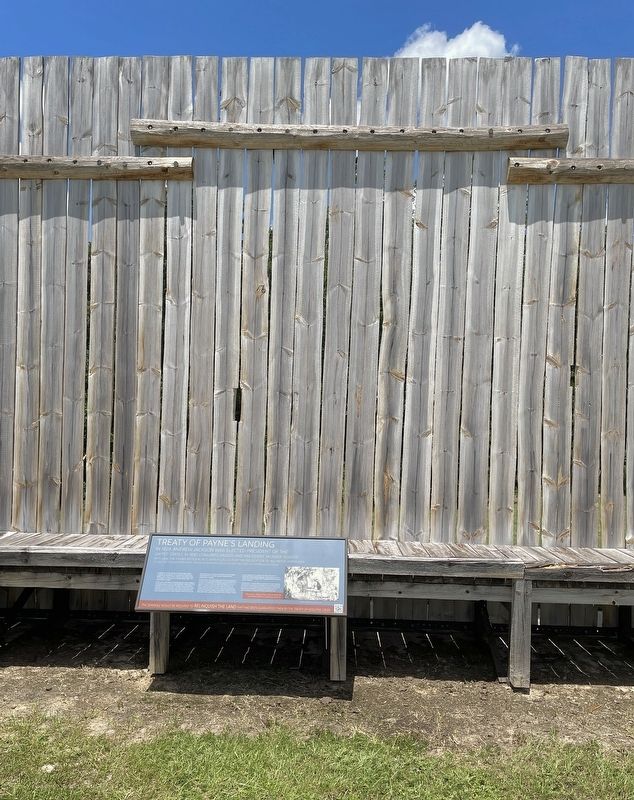
Location. 29° 11.226′ N, 82° 4.986′ W. Marker is in Ocala, Florida, in Marion County. It can be reached from the intersection of East Fort King Street and SE 39th Avenue, on the left when traveling east. Marker is located on the grounds of the Fort King National Historic Landmark. Touch for map. Marker is at or near this postal address: 3925 E Fort King St, Ocala FL 34470, United States of America. Touch for directions.

Regionally, this marker is in the American South. Globally, it is in the North Atlantic Region, North America, a Gulf of Mexico state, the Western Hemisphere, the Western World, and the Anglosphere. Historically, it finds itself in what was once New Spain, the territory of the Mississippian Culture, one of the Confederate States of America, and the Antebellum South.
Other nearby markers. At least 8 other markers are within walking distance of this marker: The Treaty of Moultrie Creek (here, next to this marker); Dade Massacre (a few steps from this marker); Attack on Fort King (a few steps from this marker); It was a Hard Life at Fort King (within shouting distance of this marker); The U.S. Army on the frontier (within shouting distance of this marker); The Second Seminole War / The Third Seminole War (within shouting distance of this marker); The First Seminole War (within shouting distance of this marker); The Seminole War (within shouting distance of this marker). Touch for a list and map of all markers in Ocala.
Also see . . .
1. Treaty of Payne’s Landing. (Submitted on July 8, 2022, by Brandon D Cross of Flagler Beach, Florida.)
2. Fort King National Historic Landmark. (Submitted on July 8, 2022, by Brandon D Cross of Flagler Beach, Florida.)
Credits. This page was last revised on July 13, 2022. It was originally submitted on July 7, 2022, by Brandon D Cross of Flagler Beach, Florida. This page has been viewed 1,388 times since then and 124 times this year. Photos: 1, 2. submitted on July 8, 2022, by Brandon D Cross of Flagler Beach, Florida. • Bernard Fisher was the editor who published this page.
