
Girona, Catalonia, Spain — Southwestern Europe (Iberian Peninsula)
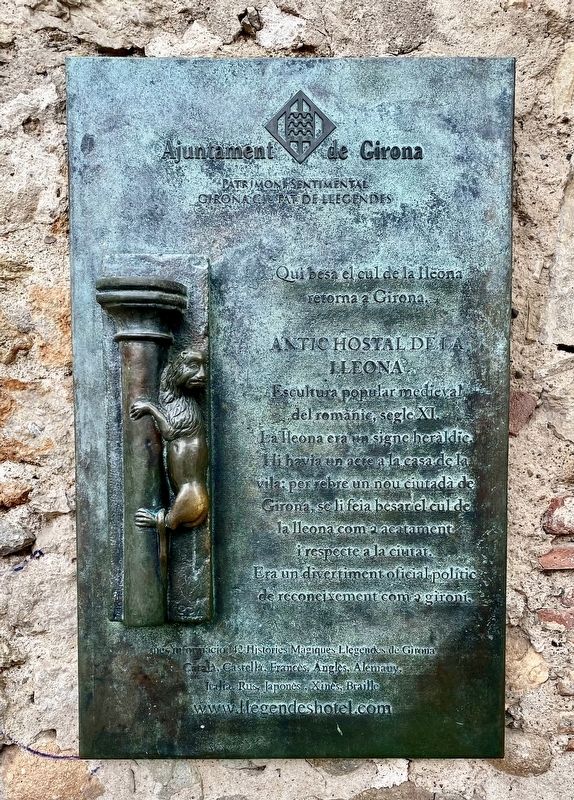
Antic Hostal de la Lleona
⎯⎯⎯
Old Hostel of the Lion
Patrimoni Sentimentali - Girona Ciutat De Llegendes
Photographed by Andrew Ruppenstein, April 27, 2022
1. Antic Hostal de la Lleona / Old Hostel of the Lion Marker

Qui besa el cul de la lleona retorna a Girona.
Escultura popular medieval del romànic, segle XI. La lleona era un signe heraldic. Hi havia un acte a la casa de la vila: per rebre un nou ciutadà de Girona, se li feia bèsar el cul de la lleona com a acatament i respecte a la ciutat. Era un divertiment oficial polític de reconeixement com a gironí.
Més informació: 42 Histories Magiques Llegendes de Girona
Catala, Castellà, Francès, Angles, Alemany, Italia. Rus, Japonès, Xines, Braille
www.llegendeshotel.com
Who kisses the lioness' butt returns to Girona.
Medieval folk sculpture of the Romanesque, 11th century. The lion was a heraldic sign. The action in the city hall to receive a new citizen of Girona was this: the new citizen was made to kiss the butt of the lioness as a show of obedience and respect for the city. It was an act of official political amusement of recognition for the inhabitants of Girona.
More information: 42 magical legends of Girona (in) Catalan, Castillian (Spanish), French, English, German, Italian, Russian, Japanese, Chinese, and Braille can be found at www.llegendeshotel.com.
Erected by Ajuntament de Girona.
Topics. This historical marker is listed in these topic lists: Animals • Anthropology & Archaeology.
Location. 41° 59.275′ N,
this page online

Regionally, it is in the North Atlantic Region, in Europe, in the European Union, in Atlantic Europe, on the Iberian Peninsula, in the Schengen Area, in a coastal Mediterranean country, and in the Western World. Historically, it finds itself in what was once the Byzantine Empire, a Spanish colony, and the Roman Empire.
Other nearby markers. At least 6 other markers are within walking distance of this marker: General Don Mariano Alvarez de Castro (about 90 meters away, measured in a direct line); Ramon Font i Miquel (1840-1901) (about 180 meters away); Rafael Masó i Valentí (about 210 meters away); Joachim Vayreda i Vila (about 240 meters away); Xuixo (approx. 0.4 kilometers away); Miquel de Palol i Felip (approx. 0.4 kilometers away).
Also see . . . The Lioness' Bottom (Hotel Museu Llegendes de Girona). PDF (English version) of the The Book of Legends of Girona, which delivers pretty much what one would expect from the title. The Lion legend is on page
Photographed by Andrew Ruppenstein, April 27, 2022
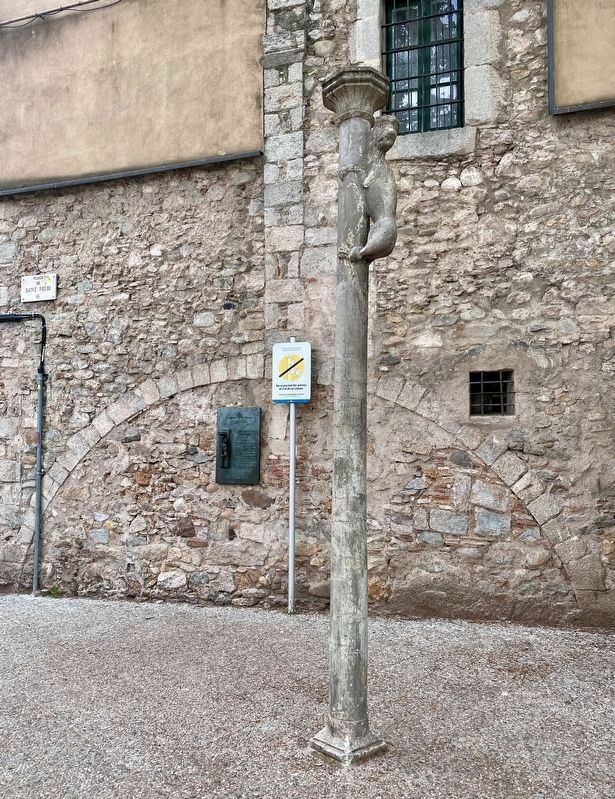
2. Antic Hostal de la Lleona / Old Hostel of the Lion Marker - wide view
The marker is visible on the wall in the background, and the lion(ess), a replica, is atop the column.
Excerpt: "In Calderers Street, previously known as Perolers Street, at Number 19, there was a Romanesque column with a lion climbing up it. Possibly, this sculpture was used to give the famous Hostal de la Lleona, which was functioning during the Middle Ages and continued right up to modern times, a claim to fame....Since 1986 a reproduction of the lioness has been erected in Carrer Calderes, in Saint Feliu Square, very near to the place where the original figure was. It has steps to facilitate the ritual."(Submitted on July 8, 2022.)
Additional keywords. folklore
Photographed by Andrew Ruppenstein, April 27, 2022
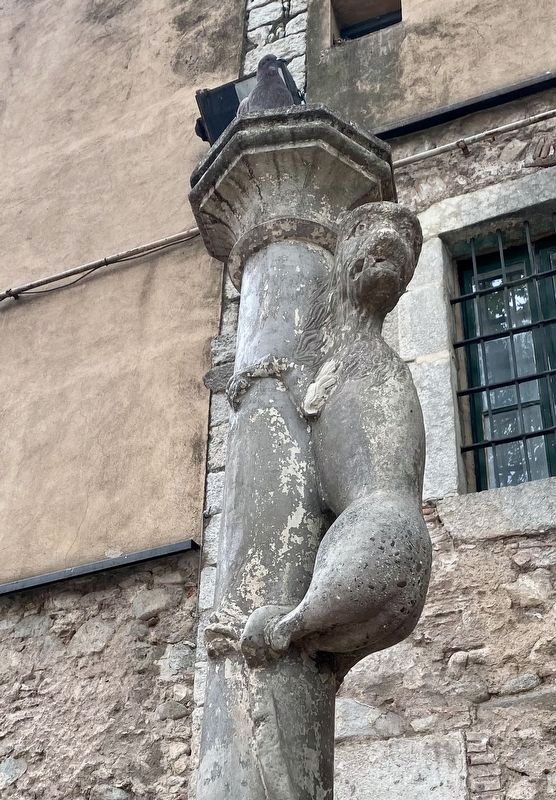
3. Kiss it
Photographed by Andrew Ruppenstein, April 27, 2022
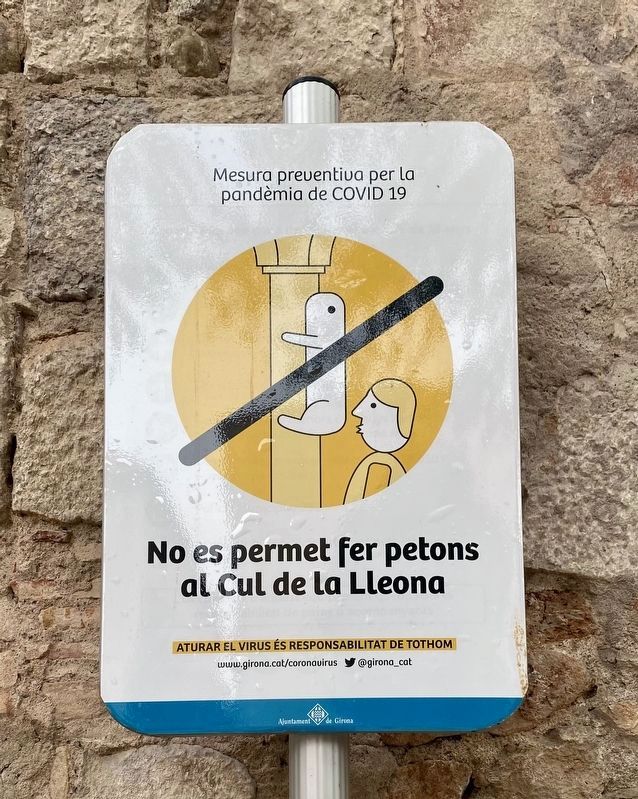
4. Don't kiss it
Prior to the Covid pandemic, the lion's derriere was available for tender moments. But as a preventive measure against the spread of the disease, the city removed the steps that visitors mounted to do the kissing, and put up the above sign.
Credits. This page was last revised on July 8, 2022. It was originally submitted on July 8, 2022, by Andrew Ruppenstein of Lamorinda, California. This page has been viewed 1,106 times since then and 93 times this year. Photos: 1, 2. submitted on July 8, 2022, by Andrew Ruppenstein of Lamorinda, California. 3, 4. submitted on July 8, 2022.
