Purdy in Greensville County, Virginia — The American South (Mid-Atlantic)
Double Bridges
Fateful Decision: Wilson Turns North
| — | Wilson-Kautz Raid | — |
Photographed by Bernard Fisher, June 21, 2009
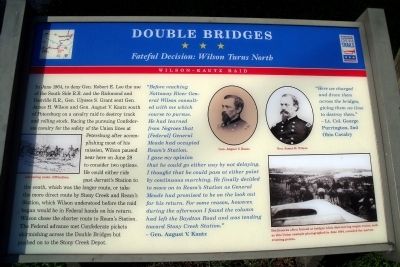
1. Double Bridges CWT Marker
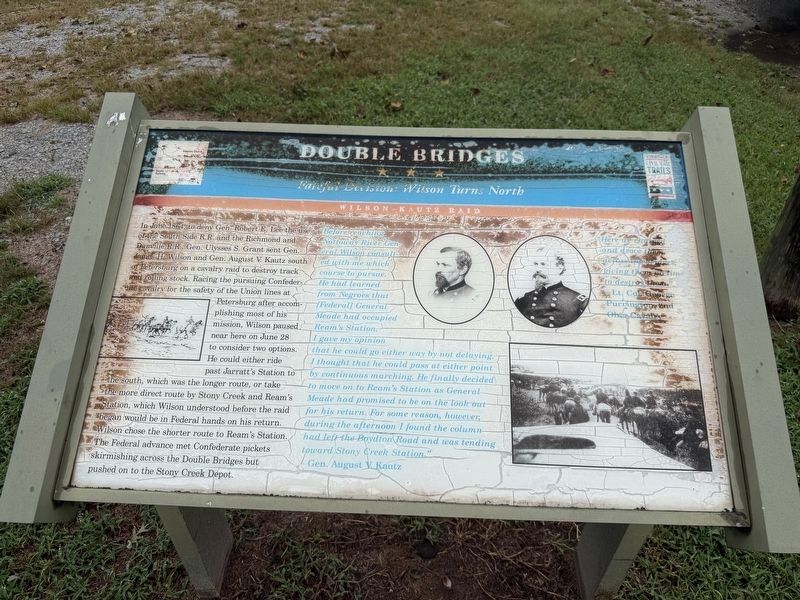
In June 1864, to deny Gen. Robert E. Lee the use of the South Side R.R. and the Richmond and Danville R.R., Gen. Ulysses S Grant sent Gen. James H. Wilson and Gen. August V. Kautz south of Petersburg on a cavalry raid to destroy track and rolling stock. Racing the pursuing Confederate cavalry for the safety of the Union lines at Petersburg after accomplishing most of his mission, Wilson paused near here on June 28 to consider two options. He could either ride past Jarratt’s Station to the south, which was the longer route, or take the more direct route by Stony Creek and Ream’s Station, which Wilson understood before the raid began would be in Federal hands on his return. Wilson chose the shorter route to Ream’s Station. Federal advance met Confederate pickets skirmishing across the Double Bridges but pushed on to the Stony Creek Depot.
“Before reaching Nottoway River General Wilson consulted with me which course to pursue. He had learned from Negroes that [Federal] General Meade had occupied Ream's Station. I gave my opinion that he could go either way by not delaying. I thought that he could pass at either point by continuous marching. He finally decided to move on to Ream’s Station as General Meade had promised to be on the look out for his return. For some reason, however, during the afternoon I found the column had left the Boydton Road and was tending toward Stony Creek Station.”- Gen. August V. Kautz
Click or scan to see
this page online
“Here we charged and drove them across the bridges, giving them no time to destroy them.” - Lt. Col. George Purrington, 2nd Ohio Cavalry
Erected by Virginia Civil War Trails.
Topics and series. This historical marker is listed in these topic lists: Railroads & Streetcars • War, US Civil. In addition, it is included in the Virginia Civil War Trails series list. A significant historical month for this entry is June 1864.
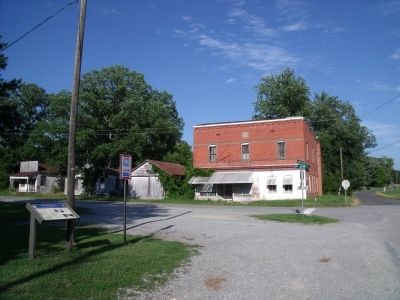
Location. 36° 49.377′ N, 77° 35.313′ W. Marker has been reported damaged. Marker is in Purdy, Virginia, in Greensville County. It is at the intersection of Smoky Ordinary Road and Purdy Road, on the left when traveling east on Smoky Ordinary Road. Touch for map. Marker is at or near this postal address: 31 Smoky Ordinary Rd, Emporia VA 23847, United States of America. Touch for directions.

Regionally, this marker is in Southside Virginia and specifically in Central Virginia. It is also in the American South and specifically in the Upper South. Globally, it is in North America, the Western Hemisphere, the Western World, and the Anglosphere. Historically, it finds itself in what
Photographed by Devry Becker Jones (CC0), September 6, 2026
2. Double Bridges Marker
Unfortunately, the marker has weathered significantly.
Other nearby markers. At least 8 other markers are within 8 miles of this location, measured as the crow flies: Brunswick County / Greensville County (approx. 5.9 miles away); Meherrin Indians (approx. 5.9 miles away); Brunswick County, Virginia (approx. 5.9 miles away); Mabry's Chapel (approx. 5.9 miles away); Site of Homestead (approx. 6 miles away); Jarratt's Station (approx. 6.8 miles away); Old Halifax Road (approx. 7.1 miles away); Reedy Creek Baptist Church (approx. 7.2 miles away).
More about this marker. On the left is a sketch entitled "Advancing under difficulties." On the upper right are portraits of "Gen. August V. Kautz" and "Gen. James H. Wilson". On the lower right is a photo with the caption, "Bottlenecks often formed at bridges when slow-moving wagon trains, such as this Union example photographed in June 1864, crowded the narrow crossing points."
Photographed by Bernard Fisher, June 21, 2009
3. Smoky Ordinary Rd & Purdy Rd
Credits. This page was last revised on September 6, 2026. It was originally submitted on June 22, 2009, by Bernard Fisher of Richmond, Virginia. This page has been viewed 1,819 times since then and 81 times this year. Photos: 1. submitted on June 22, 2009, by Bernard Fisher of Richmond, Virginia. 2. submitted on September 6, 2026, by Devry Becker Jones of Washington, District of Columbia. 3. submitted on June 22, 2009, by Bernard Fisher of Richmond, Virginia.
