Ocala in Marion County, Florida — The American South (South Atlantic)
David Laffey Heritage Garden
Fort King National Historic Landmark
Photographed by Brandon D Cross, July 4, 2022
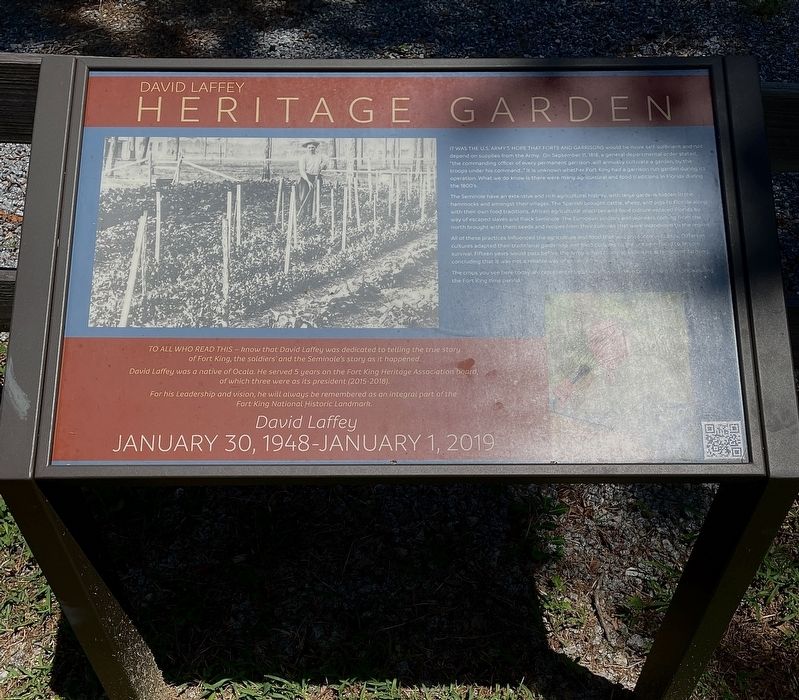
1. David Laffey Heritage Garden Marker
It was the U.S. Army’s hope that forts and garrisons would be more self-sufficient and not depend on supplies from the Army. On September 11, 1818, a general departmental order stated, "the commanding officer of every permanent garrison. will annually cultivate a garden, by the troops under his command…" it is unknown whether Fort King had a garrison run garden during its operation. What we do know is there were many agricultural and food traditions in Florida during the 1800's.
The Seminole have an extensive and rich agricultural history, with large gardens hidden in the hammocks and amongst their villages. The Spanish brought cattle, sheep, and pigs to Florida along with their own food traditions. African agricultural practices and food culture entered Florida by way of escaped slaves and Black Seminole. The European soldiers and pioneers coming from the north brought with them seeds and recipes from their cultures that were introduced to the region.
All of these practices influenced the agriculture and food that was produced in Florida. Different cultures adapted their traditional gardening and food cultures
this page online
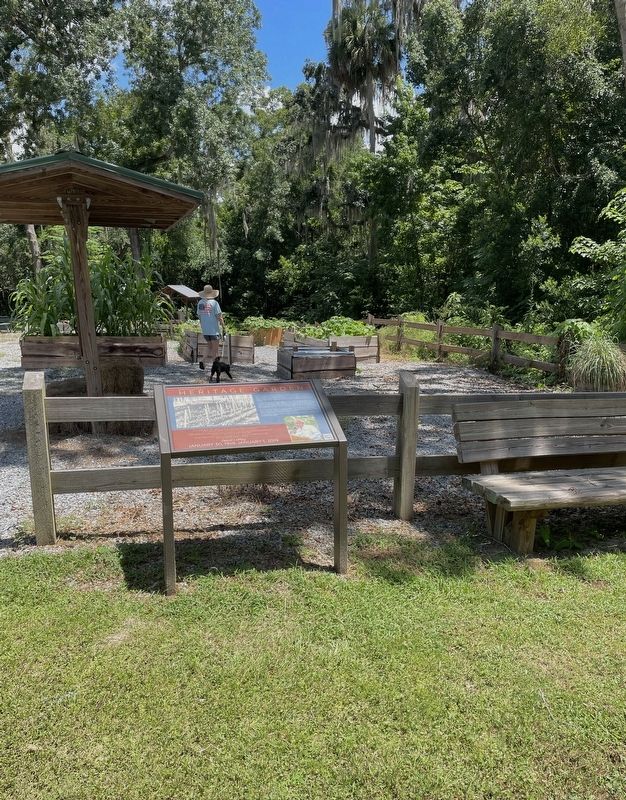
The crops you see here today are representative of what you would have seen growing in Florida during the Fort King time period.
of Fort King, the soldiers’ and the Seminole’s story as it happened.
David Laffey was a native of Ocala. He served 5 years on the Fort King Heritage Association board, of which three were as its president (2015-2018).
For his Leadership and vision, he will always be remembered as an integral part of the Fort King National Historic Landmark.
David Laffey
January 30, 1948 - January 1, 2019
Erected by Florida Department of State/Division of Historical Resources.
Topics. This historical marker is listed in these topic lists: African Americans • Agriculture • Forts and Castles • Horticulture & Forestry • Indigenous Peoples and Communities • Settlements & Settlers. A significant historical date for this entry is September 11, 1818.
Location. 29° 11.234′ N,
Photographed by Brandon D Cross, July 4, 2022
2. David Laffey Heritage Garden Marker

Regionally, this marker is in the American South. Globally, it is in the North Atlantic Region, North America, a Gulf of Mexico state, the Western Hemisphere, the Western World, and the Anglosphere. Historically, it finds itself in what was once New Spain, the territory of the Mississippian Culture, one of the Confederate States of America, and the Antebellum South.
Other nearby markers. At least 8 other markers are within walking distance of this marker: Fort King (about 300 feet away, measured in a direct line); The Second Fort (about 300 feet away); A Tale of Two Forts (about 300 feet away); Fort King Road (about 300 feet away); The First Seminole War (about 300 feet away); The Seminole War (about 300 feet away); The Second Seminole War / The Third Seminole War (about 300 feet away); a different marker also named Fort King (about 400 feet away). Touch for a list and map of all markers in Ocala.
Also see . . .
1. David Laffey. (Submitted on July 12, 2022, by Brandon D Cross of Flagler Beach, Florida.)
2. Fort King National Historic Landmark. (Submitted on July 12, 2022, by Brandon D Cross of Flagler Beach, Florida.)
Credits. This page was last revised on June 17, 2024. It was originally submitted on July 12, 2022, by Brandon D Cross of Flagler Beach, Florida. This page has been viewed 260 times since then and 27 times this year. Photos: 1, 2. submitted on July 12, 2022, by Brandon D Cross of Flagler Beach, Florida. • Bernard Fisher was the editor who published this page.
