
Shockoe Bottom in Richmond, Virginia — The American South (Mid-Atlantic)
Winfree Cottage
| — | Richmond Slave Trail | — |
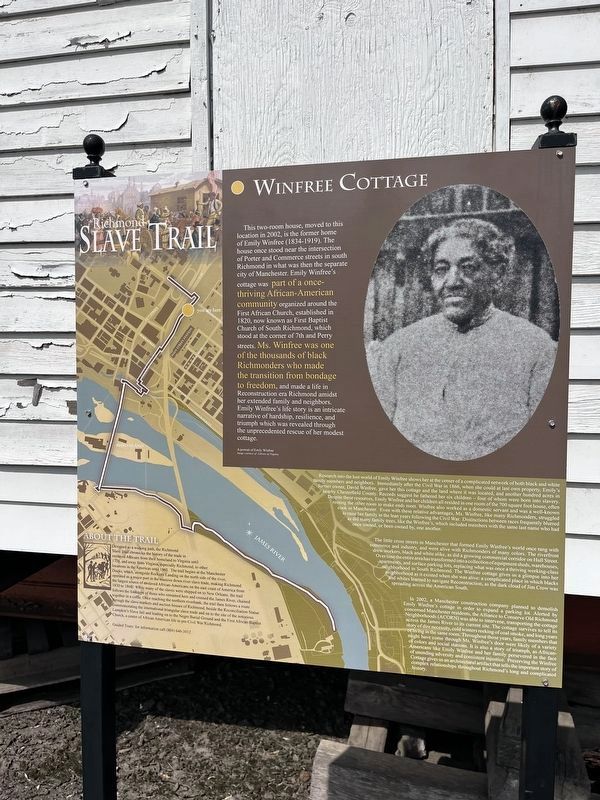
This two-room house, moved to this location in 2002, is the former home of Emily Winfree (1834-1919). The house once stood near the intersection of Porter and Commerce Streets in south Richmond in what was then the separate city of Manchester. Emily Winfree's cottage was part of a once-thriving African-American community organized around the First African Church, established in 1820, now known as First Baptist Church of South Richmond, which stood at the corner of 7th and Perry streets. Ms. Winfree was one of the thousands of black Richmonders who made the transition from bondage to freedom, and made a life in Reconstruction era Richmond amidst her extended family and neighbors. Emily Winfree's life story is an intricate narrative of hardship, resilience, and triumph which was revealed through the unprecedented rescue of her modest cottage.
Research into the lost world of Emily Winfree shows her at the center of a complicated network of both black and white family members and neighbors. Immediately after the Civil War in 1866, when she could at last own property, Emily's former owner, David Winfree, gave her this cottage
this page online
The little cross streets in Manchester that formed Emily Winfree's world once rang with commerce and industry, and were alive with Richmonders of many colors. The riverfront drew workers, black and white alike, as did a growing commercial corridor on Hull Street. Over time the entire area has transformed into a collection of equipment sheds, warehouses, apartments, and surface parking lots,
Photographed by Lou Donkle, January 18, 2022
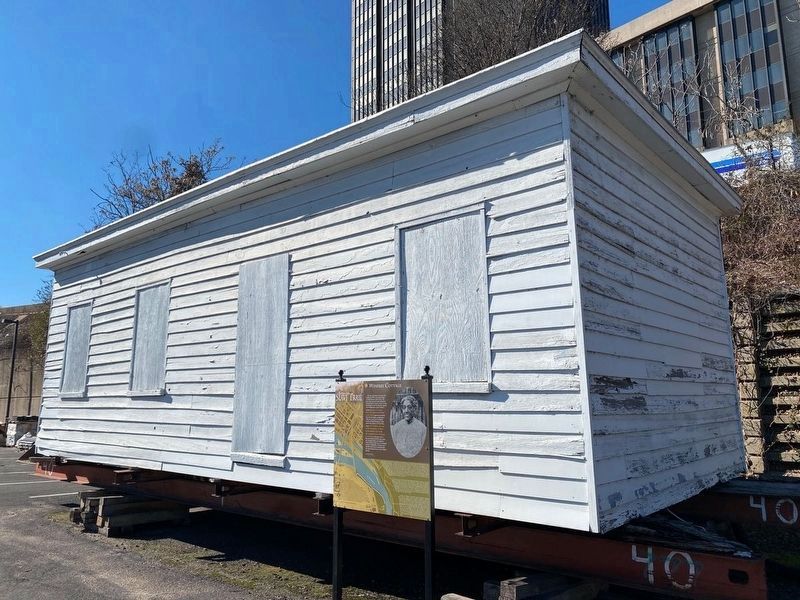
2. Winfree Cottage with Marker in Front
In 2002, a Manchester construction company planned to demolish Emily Winfree's cottage in order to expand a parking lot. Alerted by concerned Manchester residents, the Alliance to Conserve Old Richmond Neighborhoods (ACORN) was able to intervene, transporting the cottage across the James River to its current site. The cottage survives to tell its story of dire necessity, cold winters reeking of coal smoke, and long years of living in the same room. Throughout those years, family members that might have come through Ms. Winfree's door were likely of a variety of colors and social stations. It is also a story of triumph, as African-Americans like Emily Winfree and her family persevered in the face of unending adversity and consistent injustice. Preserving the Winfree Cottage gives us an architectural artifact

Photographed by Lou Donkle, January 18, 2022
3. Winfree Cottage Marker
About the Trail
Designed as a walking path, the Richmond Slave Trail chronicles the history of the trade in enslaved Africans from their homeland to Virginia until 1778, and away from Virginia, especially Richmond, to other locations in the Americas until 1865. The trail begins at the Manchester Docks, which, alongside Rocketts Landing on the north side of the river, operated as a major port in the massive downriver slave trade, making Richmond the largest source of enslaved blacks on the east coast of America from 1830 to 1860. While many of the slaves were shipped on to New Orleans and to other Deep South ports, the trail follows the footsteps of those who remained here and crossed the James River, often chained together in a coffle. Once reaching the northern riverbank, the trail then follows a route through the slave markets and auction houses of Richmond, beside the Reconciliation Statue commemorating the international triangular slave trade and on to the site of the notorious Lumpkin’s Slave Jail and leading on to Richmond’s

Photographed by Robert j Poe, November 30, 2024
4. Winfree Cottage Marker
I believe the Winfree Cottage belonged to my Grandmother. At the time it was on 8th street in Richmond VA. My uncle continued to live there until he died in 2002. At that point i think the city of Richmond took possession of the property. I have many good memories visiting there as a child.
Guided Tours: for information call (804) 646-3012
(caption)
A portrait of Emily Winfree Image courtesy of Library of Virginia
Erected 2011 by Richmond Slave Trail Commission. (Marker Number 15.5.)
Topics. This historical marker is listed in these topic lists: Abolition & Underground RR • African Americans. A significant historical year for this entry is 1834.
Location. 37° 32.182′ N, 77° 25.733′ W. Marker is in Richmond, Virginia. It is in Shockoe Bottom. It can be reached from East Franklin Street east of North 15th Street, on the left when traveling east. Cottage and marker are east of, and backed-up against, the I-95 overpass in a parking lot south of Lumpkin's Slave Jail. It is between Broad Street and Franklin Street. Touch for map. Marker is at or near this postal address: 1500 E Franklin St, Richmond VA 23219, United States of America. Touch for directions.

Regionally, this marker is in Central Virginia. It is also in the American South and specifically in the Upper South. Globally, it is in North America, the Western Hemisphere, the Western World, and the Anglosphere. Historically, it finds itself in what was once the territory of the Mississippian Culture, one of the original Thirteen Colonies, one of the Confederate States of America, and the Antebellum South.
Other nearby markers. At least 8 other markers are within walking distance of this marker: A different marker also named Lumpkin's Jail (within shouting distance of this marker); Gabriel Prosser Execution Site (about 400 feet away, measured in a direct line); Execution of Gabriel (about 400 feet away); Kahal Kadosh Beth Shalome (about 700 feet away); Richmond’s African Burial Ground (about 700 feet away); The Triangle (about 700 feet away); Reconciliation Statue (about 700 feet away); Odd Fellows Hall (about 700 feet away). Touch for a list and map of all markers in Richmond.
Other markers no longer nearby. The Slave Trade In Richmond (was a few steps from this marker but has been reported to have been replaced with another marker now near it); Lumpkins Jail (was a few steps from this marker but has been reported to have been replaced with another marker now near it); Old Negro Burial Ground (was about 400 feet away but has been replaced with another marker now near it); a different marker also named Richmond's African Burial Ground (was about 700 feet away but has been replaced with another marker now near it).
Credits. This page was last revised on August 14, 2025. It was originally submitted on July 26, 2022, by Lou Donkle of Valparaiso, Indiana. This page has been viewed 1,671 times since then and 102 times this year. Last updated on July 29, 2022, by Lou Donkle of Valparaiso, Indiana. Photos: 1. submitted on September 9, 2024, by Devry Becker Jones of Washington, District of Columbia. 2, 3. submitted on July 26, 2022, by Lou Donkle of Valparaiso, Indiana. 4. submitted on December 1, 2024, by Robert j Poe of Boston, Massachusetts. • Devry Becker Jones was the editor who published this page.
