Split Rock Lighthouse State Park near Beaver Bay in Lake County, Minnesota — The American Midwest (Upper Plains)
Geology of the Split Rock Region
July 27, 2022
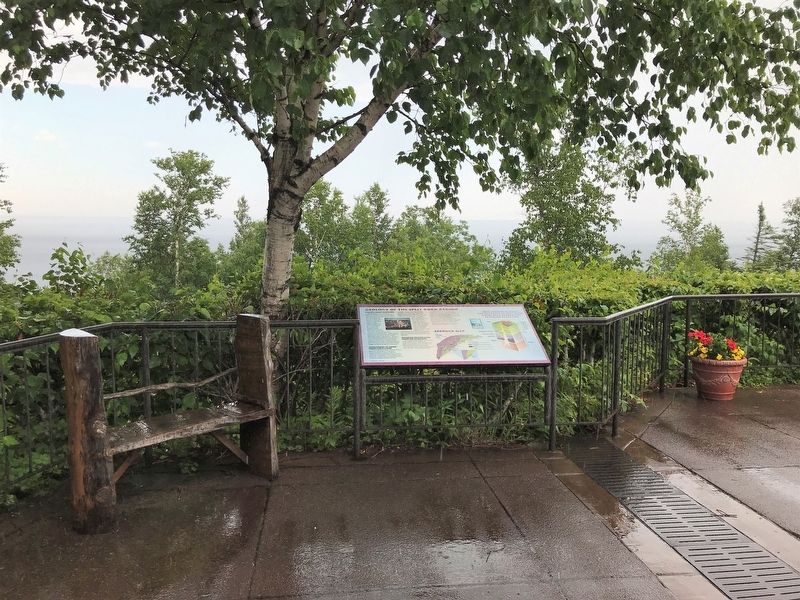
1. Geology of the Split Rock Region Marker
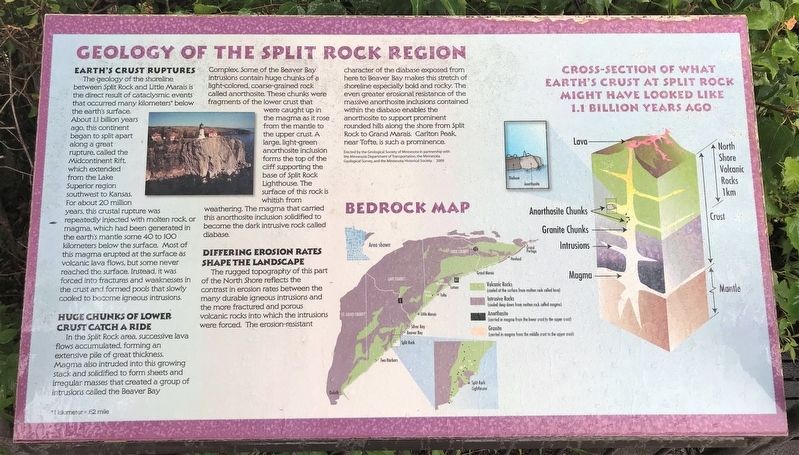
Earth's Crust Ruptures
The geology of the shoreline between Split Rock and Little Marais is the direct result of cataclysmic events that occurred many kilometers* below the earth's surface. About 1.1 billion years ago, this continent began to split apart along a great rupture, called the Midcontinent Rift, which extended from the Lake Superior region southwest to Kansas. For about 20 million years, this crustal rupture was repeatedly injected with molten rock, or magma, which had been generated in the earth's mantle some 40 to 100 kilometers below the surface. Most of this magma erupted at the surface as volcanic lava flows, but some never reached the surface. Instead, it was forced into fractures and weaknesses in the crust and formed pools that slowly cooled to become igneous intrusions.
*1 kilometer = .62 mile
Huge Chunks Of Lower Crust Catch A Ride
In the Split Rock area, successive lava flows accumulated, forming an extensive pile of great thickness. Magma also intruded into this growing stack and solidified to form sheets and irregular masses that created a group of intrusions called the Beaver Bay Complex.
this page online
Differing Erosion Rates Shape The Landscape
The rugged topography of this part of the North Shore reflects the contrast in erosion rates between the many durable igneous intrusions and the more fractured and porous volcanic rocks into which the intrusions were forced. The erosion-resistant character of the diabase exposed from here to Beaver Bay makes this stretch of shoreline especially bold and rocky. The even greater erosional resistance of the massive anorthosite inclusions contained within the diabase enables the anorthosite to support prominent rounded hills along the shore from Split Rock to Grand Marais. Carlton
July 27, 2022
2. Geology of the Split Rock Region Marker
Bedrock Map
[green] Volcanic Rocks (cooled at the surface from molten rock called lava)
[brown] Intrusive Rocks (cooled deep down from molten rock called magma)
[black] Anorthosite (carried in magma from the lower crust to the upper crust)
[pale] Granite (carried in magma from the middle crust to the upper crust)
Cross-Section Of What Earth's Crust At Split Rock Might Have Looked Like 1.1 Billion Years Ago
Erected 2009 by the Geological Society of Minnesota in partnership with the Minnesota Department of Transportation, the Minnesota Geological Survey, and the Minnesota Historical Society.
Topics and series. This historical marker is listed in this topic list: Natural Features. In addition, it is included in the Lighthouses, and the Minnesota: Geological Society of Minnesota series lists.
Location. 47° 12.055′ N, 91° 21.992′ W. Marker is near Beaver Bay, Minnesota, in Lake County. It is in Split Rock Lighthouse State Park. It can be reached from Split Rock Lighthouse Road half a mile south of North Shore Scenic Drive (State Highway 61). Located at the Split Rock Lighthouse Historic Site, on the east side of the Visitor Center. Touch for map. Marker is at or near this postal address: 3713 Split Rock Lighthouse Rd, Two Harbors MN 55616, United States of America. Touch for directions.

Regionally, this marker is in the Arrowhead Region, in the Iron Range, and in the North Shore. It is also in the American Midwest and in the Corn Belt. Globally, it is in North America, in the Great North Woods, on the Great Lakes, on Lake Superior’s North Shore, in the Western Hemisphere, in the Western World, and in the Anglosphere. Historically, it finds itself in what was once the Viceroyalty of New France, Rupert’s Land, the territory of the Mississippian Culture, and the Northwest Territory.
Other nearby markers. At least 8 other markers are within walking distance of this marker: Anchor of the Madeira (within shouting distance of this marker); The Gales of November (within shouting distance of this marker); Steam Engine Hoist (within shouting distance of this marker); Oil House (within shouting distance of this marker); Storage Barn (within shouting distance of this marker); Home Away From Home (within shouting distance of this marker); Fog Signal (within shouting distance of this marker); Lighthouse (about 300 feet away, measured in a direct line). Touch for a list and map of all markers in Beaver Bay.
Other markers no longer nearby. The Gales of November (was within shouting distance of this marker but has been replaced with another marker now near it); Steam Hoist Engine (was within shouting distance of this marker but has been replaced with another marker now near it).
Credits. This page was last revised on August 12, 2026. It was originally submitted on August 17, 2022. This page has been viewed 756 times since then and 69 times this year. Photos: 1, 2. submitted on August 17, 2022.
