Near Luling in Caldwell County, Texas — The American South (West South Central)
Wattsville Gin
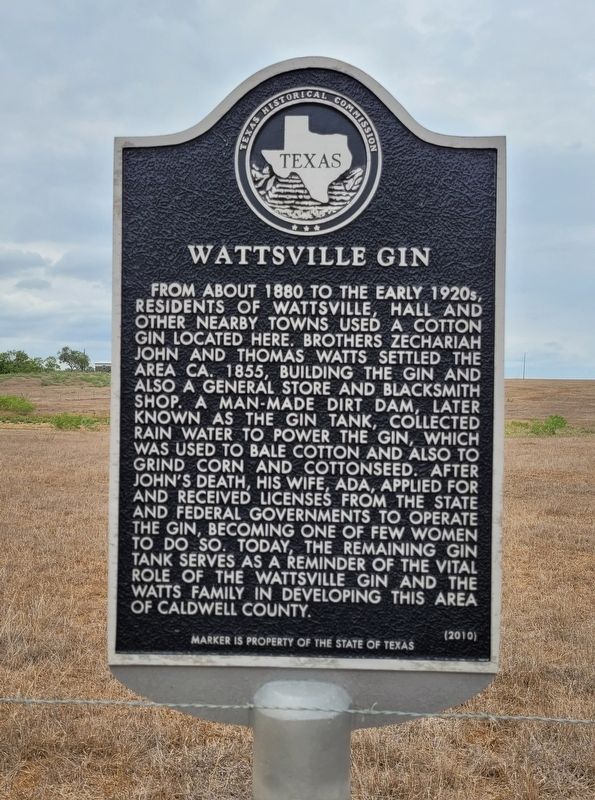
Photographed by James Hulse, August 21, 2022
1. Wattsville Gin Marker
Erected 2010 by Texas Historical Commission. (Marker Number 16585.)
Topics. This historical marker is listed in these topic lists: Industry & Commerce • Settlements & Settlers • Women. A significant historical year for this entry is 1880.
Location. 29° 45.462′ N, 97° 33.718′ W. Marker is near Luling, Texas, in Caldwell County. It is on Wattsville Road 0.4 miles west of Tenney Creek Road (County
this page online

Regionally, this marker is in the Hill Country and in the Austin Metropolitan Area. It is also in the American South. Globally, it is in North America, a Gulf of Mexico state, the Western Hemisphere, the Western World, and the Anglosphere. Historically, it finds itself in what was once New Spain, the Republic of Texas, one of the Confederate States of America, and the Antebellum South.
Other nearby markers. At least 8 other markers are within 7 miles of this marker, measured as the crow flies: Hall Cemetery (approx. 1½ miles away); Clearfork Baptist Church (approx. 2.6 miles away); McNeil Baptist Church (approx. 3.7 miles away); McNeil Cemetery (approx. 3.8 miles away); Fleming Memorial Cemetery (approx. 6.6 miles away); Jeffrey Cemetery (approx. 6.7 miles away); Bethel Primitive Baptist Church (approx. 6.7 miles away); Theodore S. Lee (approx. 7.1 miles away). Touch for a list and map
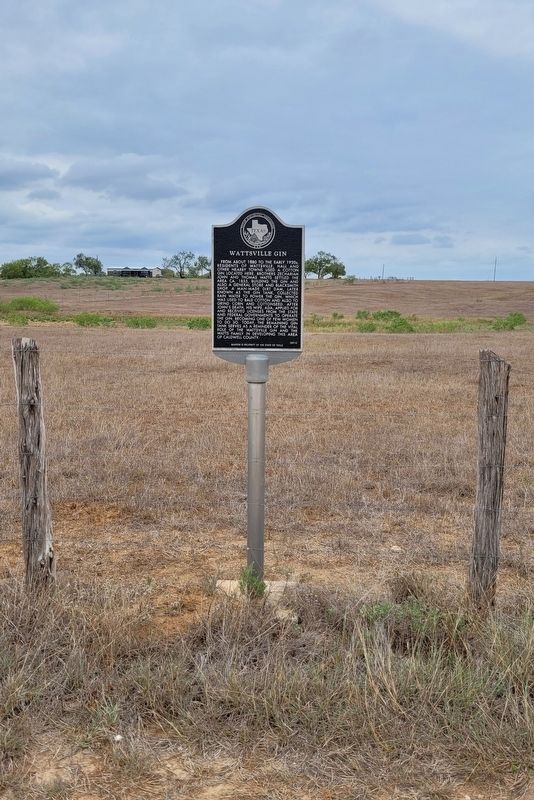
Photographed by James Hulse, August 21, 2022
2. Wattsville Gin Marker
Also see . . . Cotton Ginning. Texas State Historical Association
Before cotton can be spun into yarn or thread and woven into cloth, the fibers must be separated from their seeds. In 1793 Eli Whitney had invented the cotton gin, a shortened term for "cotton engine." Whitney's patented machine featured a wooden cylinder with iron teeth or spikes, a grooved breastwork of brass or iron through which the spikes could pass but the seeds could not, and a brush cylinder behind the breastwork to clear cotton fibers from the spikes. Ginned seed cotton, or lint, was carried in baskets or allowed to fall into a lint room for storage. The lint was then packed by foot or wooden pestle into a sack and taken to market.(Submitted on August 23, 2022, by James Hulse of Medina, Texas.)
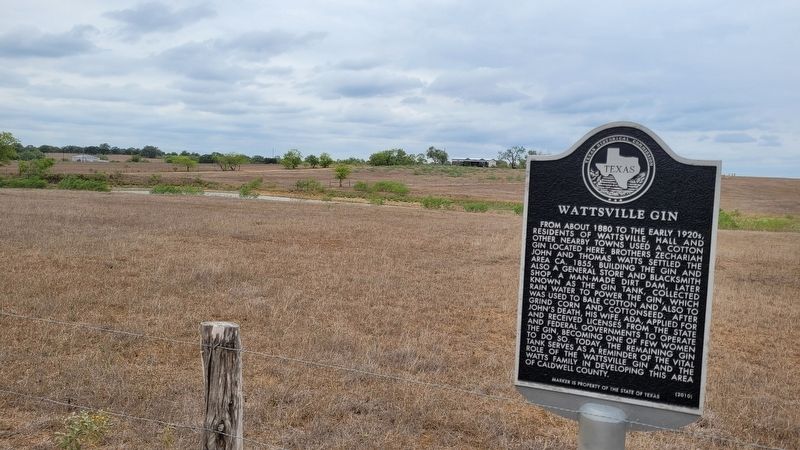
Photographed by James Hulse, August 21, 2022
3. The view of the Wattsville Gin Marker and the man-made dirt dam in the background

Photographed by James Hulse, August 21, 2022
4. The view of the Wattsville Gin Marker from the road
Credits. This page was last revised on August 23, 2022. It was originally submitted on August 23, 2022, by James Hulse of Medina, Texas. This page has been viewed 571 times since then and 34 times this year. Photos: 1, 2, 3, 4. submitted on August 23, 2022, by James Hulse of Medina, Texas.
