DeSoto in Washington County, Missouri — The American Midwest (Upper Plains)
Petroglyphs
Photographed by Thomas Smith, August 28, 2022
1. Petroglyphs Marker
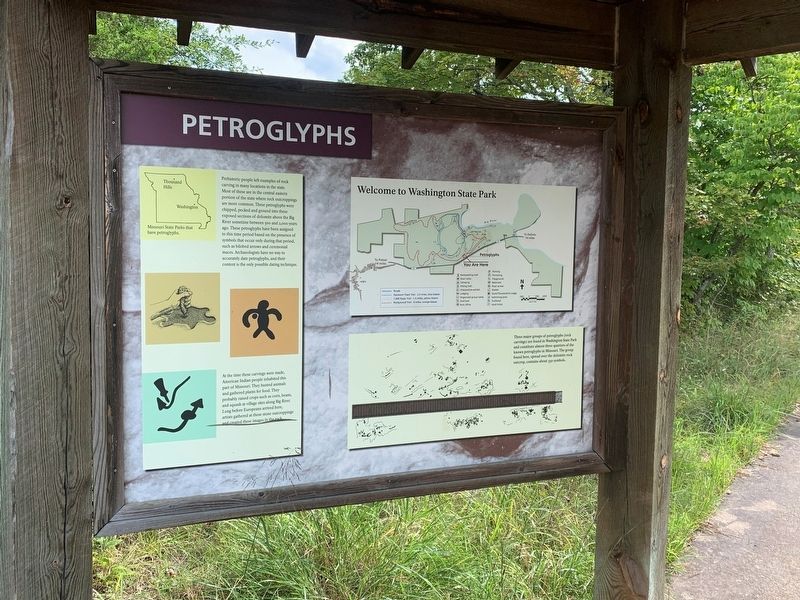
Prehistoric people left examples of rock carving in many locations in the state. Most of these are in the central eastern portion of the state where rock outcroppings are more common. These petroglyphs were chipped, pecked and ground into these exposed sections of dolomite above the Big River sometime between 500 and 2,000 years ago. These petroglyphs have been assigned to this time period based on the presence of symbols that occur only during that period, such as bilobed arrows and ceremonial maces. Archaeologists have no way to accurately date petroglyphs, and their content is the only possible dating technique.
At the time these carvings were made, American Indian people inhabited this part of Missouri. They hunted animals and gathered plants for food. They probably raised crops such as corn, beans, and squash at village sites along Big River. Long before Europeans arrived here, artists gathered at these stone outcroppings and created these images in the rock.
Topics. This historical marker is listed in these topic lists: Anthropology & Archaeology • Indigenous Peoples and Communities. A significant historical year for this entry is 1 CE.
Location. 38° 4.746′ N,
this page online

Regionally, this marker is in South-Central Missouri. It is also in the American Ozarks, in the Lewis & Clark Corridor, and in the Corn Belt. Globally, it is in North America, the Western Hemisphere, the Western World, and the Anglosphere. Historically, it finds itself in what was once the territory of the Mississippian Culture, the Louisiana Purchase, and the Antebellum South.
Other nearby markers. At least 8 other markers are within 11 miles of this marker, measured as the crow flies: Rock Carvings (here, next to this marker); The Petroglyphs of Washington State Park (approx. 0.4 miles away); The Korean War (approx. 0.4 miles away); Veterans Memorial (approx. 7.1 miles away); Mooney's Bridge (approx. 8.9 miles away); In Memory of Aime Amant Vaille (approx. 10.7 miles away); Artesian Spring / Valles Mines (approx. 10.7 miles away); Slave Cabin (approx. 10.7 miles away).
Credits. This page was last revised on November 23, 2024. It was originally submitted on August 31, 2022, by Thomas Smith of Waterloo, Ill. This page has been viewed 352 times since then and 34 times this year. Photo 1. submitted on August 31, 2022, by Thomas Smith of Waterloo, Ill. • Devry Becker Jones was the editor who published this page.
