Marker Logo
THE HISTORICAL
MARKER DATABASE
“Bite-Size Bits of Local, National, and Global History”
Central East Austin in Travis County, Texas — The American South (West South Central)
 

Lynching in America
⎯⎯⎯
Lynching in Travis County

Community Remembrance Project
 
 
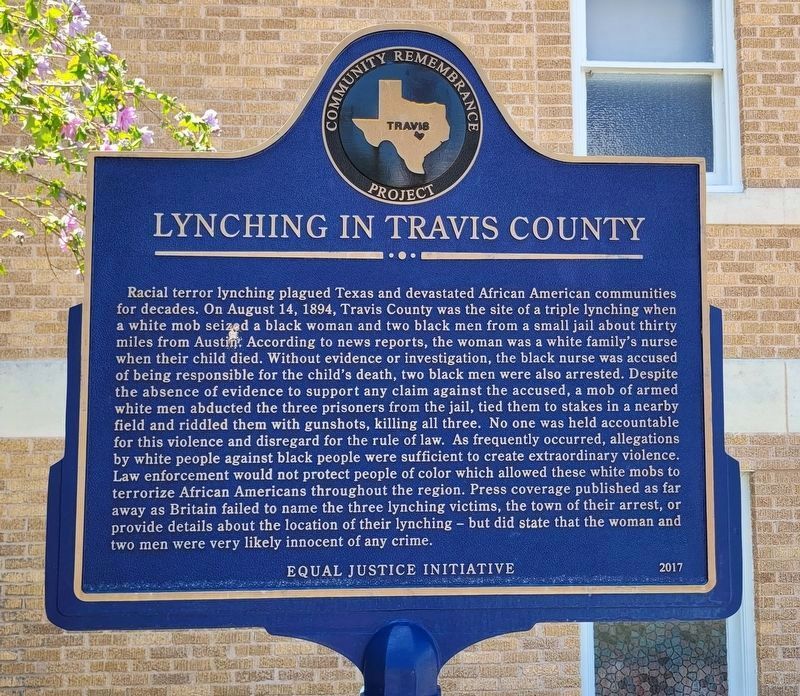
Lynching in America side of the Marker image. Click for full size.
Photographed by James Hulse, November 12, 2022
1. Lynching in America side of the Marker
Inscription.
Lynching in America
Thousands of black people were the victims of lynching and racial violence in the United States between 1877 and 1950. The lynching of African Americans during this era was a form of racial terrorism intended to intimidate black people and enforce racial hierarchy and segregation. Lynching was most prevalent in the South. After the Civil War, violent resistance to equal rights for African Americans and an ideology of white supremacy led to violent abuse of racial minorities and decades of political, social, and economic exploitation. Lynching became the most public and notorious form of terror and subordination. White mobs were usually permitted to engage in racial terror and brutal violence with impunity. Many black people were pulled out of jails or given over to mobs by law enforcement officials who were legally required to protect them. Terror lynchings often included burning and mutilation, sometimes in front of crowds numbering in the thousands. In response to this racial terror and violence, millions of black people fled the South and never returned, which deepened the anguish and pain of lynching.
Paid Advertisement
Click or scan to see
this page online
Many lynchings were not reported, and many names of lynching victims will never be known, but more than 330 racial terror lynchings of African Americans have been documented in Texas alone.

Lynching in Travis County
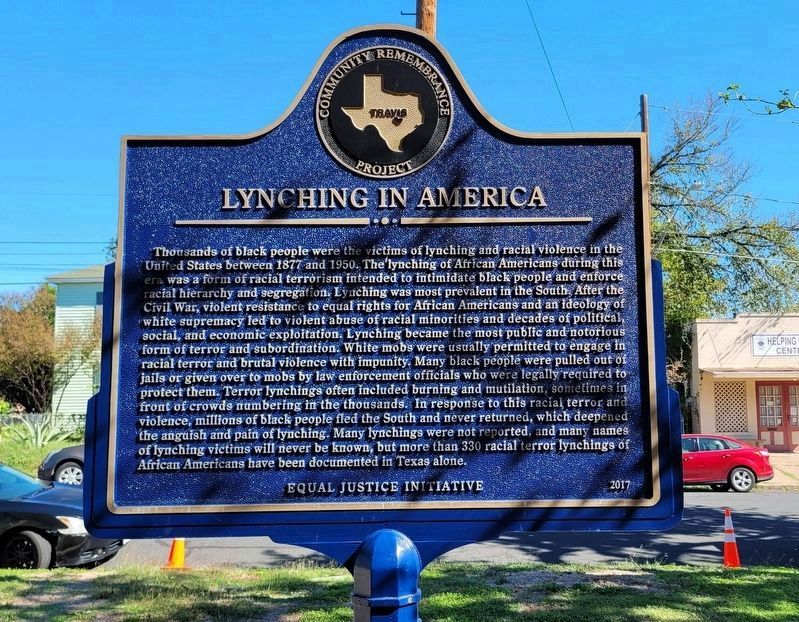
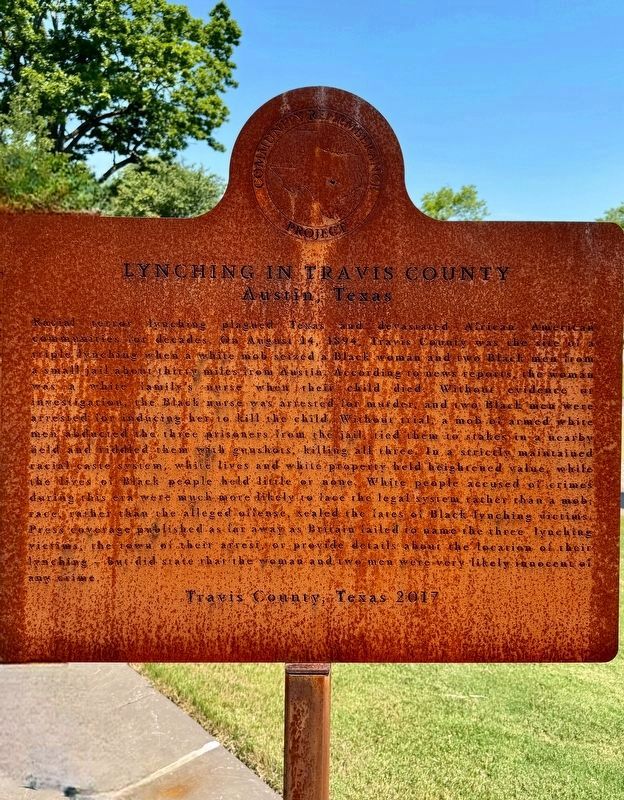
Racial terror lynching plagued Texas and devastated African American communities for decades. On August 14, 1894, Travis County was the site of a triple lynching when a white mob seized a black woman and two black men from a small jail about thirty miles from Austin: According to news reports, the woman was a white family's nurse when their child died. Without evidence or investigation, the black nurse was accused of being responsible for the child's death, two black men were also arrested. Despite the absence of evidence to support any claim against the accused, a mob of armed white men abducted the three prisoners from the jail, tied them to stakes in a nearby field and riddled them with gunshots, killing all three. No one was held accountable for this violence and disregard for the rule of law. As frequently occurred, allegations by white people against black people were sufficient to create extraordinary violence.
Lynching in Travis County side of the Marker image. Click for full size.
Photographed by James Hulse, August 29, 2022
2. Lynching in Travis County side of the Marker
Law enforcement would not protect people of color which allowed these white mobs to terrorize African Americans throughout the region. Press coverage published as far away as Britain failed to name the three lynching victims, the town of their arrest, or provide details about the location of their lynching - but did state that the woman and two men were very likely innocent of any crime.
 
Erected 2017 by Equal Justice Initiative and Travis Community Remembrance Project.
 
Topics and series. This historical marker is listed in these topic lists: African AmericansCivil Rights. In addition, it is included in the Lynching in America series list. A significant historical date for this entry is August 14, 1894.
 
Location. 30° 16.182′ N, 97° 43.561′ W. Marker is in Austin, Texas, in Travis County. It is in Central East Austin. It is at the intersection of San Bernard Street and Hackberry Street, on the right when traveling south on San Bernard Street. Located in front of the Wesley United Methodist Church, next to a Texas Historical Commission marker. Touch for map. Marker is at or near this postal address: 1164 San Bernard St, Austin TX 78702,
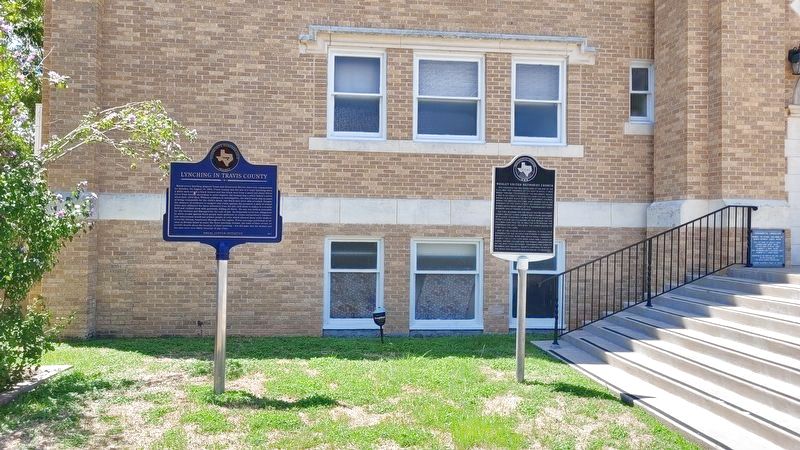
The Lynching in Travis County Marker next to a Texas Historical Commission marker image. Click for full size.
Photographed by James Hulse, August 29, 2022
3. The Lynching in Travis County Marker next to a Texas Historical Commission marker

United States of America. Touch for directions.

Regionally, this marker is in Central Texas. It is also in the American South. Globally, it is in North America, a Gulf of Mexico state, the Western Hemisphere, the Western World, and the Anglosphere. Historically, it finds itself in what was once New Spain, the Republic of Texas, one of the Confederate States of America, and the Antebellum South.

Other nearby markers. At least 8 other markers are within walking distance of this marker: Wesley United Methodist Church (here, next to this marker); Thompson Home (within shouting distance of this marker); George Washington Carver Branch Library (about 500 feet away, measured in a direct line); Desegregation of Texas Public Schools (about 600 feet away); Victory Grill (approx. 0.2 miles away); Colored Teachers State Association of Texas Building (approx. 0.2 miles away); State Cemetery of Texas (approx. 0.2 miles away); Winslow Turner (approx. 0.2 miles away). Touch for a list and map of all markers in Austin.
 
Also see . . .  Lynching. Texas State Historical Association
Lynching is the illegal killing of a person under
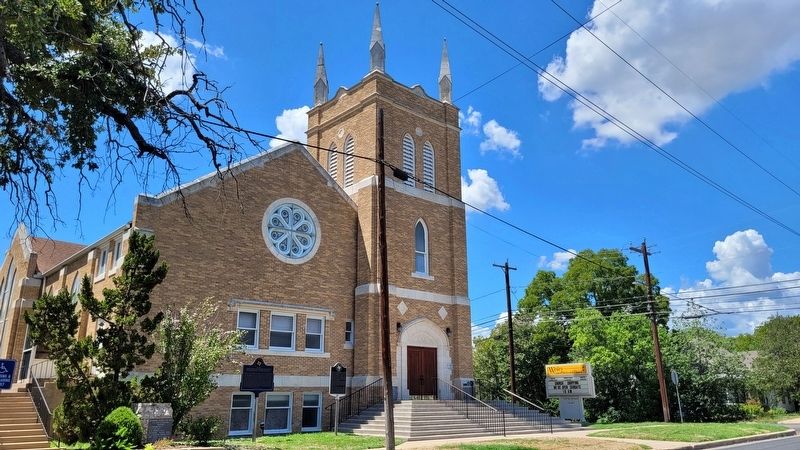
The view of the Lynching in Travis County Marker in front of Wesley United Methodist Church image. Click for full size.
Photographed by James Hulse, August 29, 2022
4. The view of the Lynching in Travis County Marker in front of Wesley United Methodist Church
the pretext of service to justice, race, or tradition. Though it often refers to hanging, the word became a generic term for any form of execution without due process of law.
(Submitted on September 2, 2022, by James Hulse of Medina, Texas.) 
 
Lynching in Travis County Marker image. Click for full size.
Photographed by Brandon D Cross
5. Lynching in Travis County Marker
“A Replica marker of one side is located at the Equal Justice Initiatives' National Memorial for Peace and Justice in Montgomery, Alabama. The Equal Justice Initiative supports efforts to locally memorialize documented victims of racial violence and to educate communities about the history of racial injustice.” Mark Hilton
 
 
Credits. This page was last revised on October 23, 2024. It was originally submitted on September 1, 2022, by James Hulse of Medina, Texas. This page has been viewed 1,481 times since then and 81 times this year. Photos:   1. submitted on November 13, 2022, by James Hulse of Medina, Texas.   2, 3, 4. submitted on September 2, 2022, by James Hulse of Medina, Texas.   5. submitted on October 16, 2024, by Brandon D Cross of Flagler Beach, Florida.

m=205225

CeraNet Cloud Computing sponsors the Historical Marker Database.
This website earns income from purchases you make after using our links to Amazon.com. We appreciate your support.
Paid Advertisement
Jul. 14, 2026