Barton Hills in Austin in Travis County, Texas — The American South (West South Central)
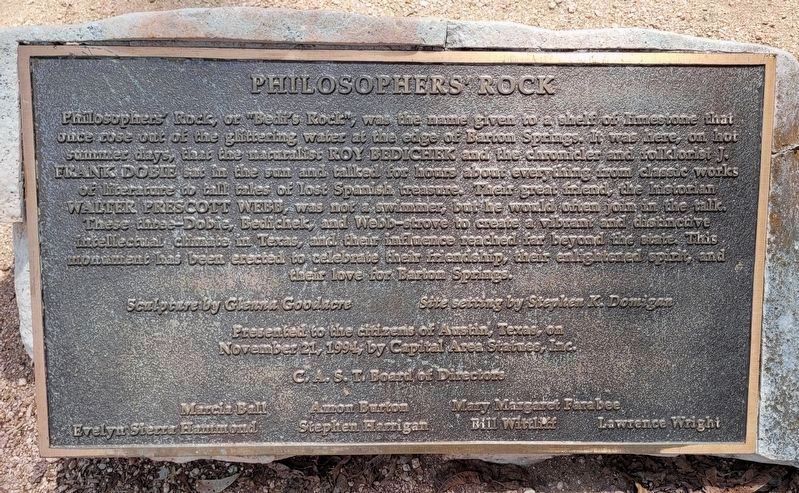
Philosophers’ Rock
Photographed by James Hulse, August 29, 2022
1. Philosophers’ Rock Marker
The main marker is located on the northwest section of the monument.
Site setting by Stephen K. Domigan
Presented to the citizens of Austin, Texas, on
November 21, 1994; by Capital Area Statues, Inc.
C.A.S.T. Board of Directors
Marcia Ball • Evelyn Sierra Hammond • Amon Burton • Stephen Harrigan • Mary Margaret Faral • Bill Wittliff • Lawrence Wright
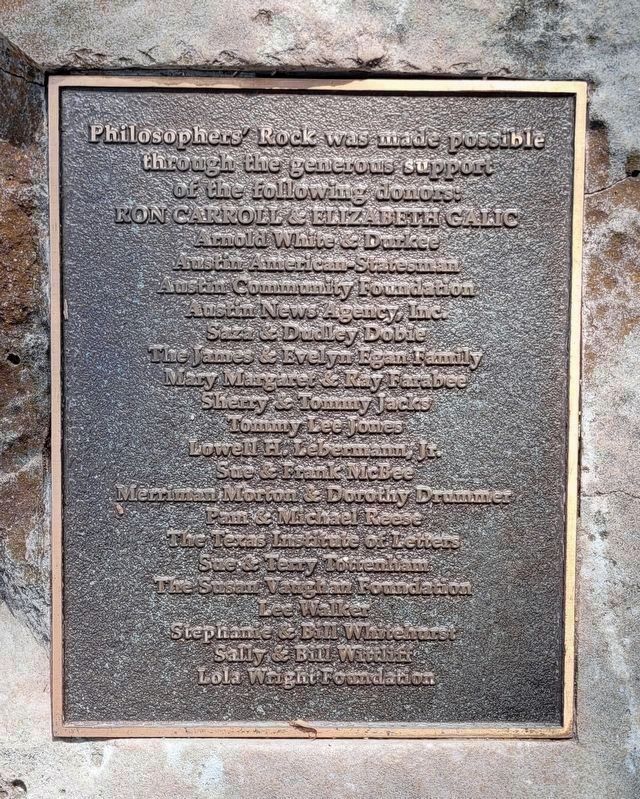
(Donors Plaque)
this page online
Ron Carroll & Elizabeth Galic • Arnold White & Durkee • Austin American-Statesman • Austin Community Foundation • Austin News Agency, Inc. • Saza & Dudley Dobie • The James & Evelyn Egan Family • Mary Margater & Ray Farabee • Sherry & Tommy Jacks • Tommy Lee Jones • Lowell H. Lebermann, Jr. • Sue & Frank McBee • Merriman Morton & Dorothy Drummer • Pam & Michael Reese • The Texas Institute of Letters • Sue & Terry Tottenham • The Susan Vaughan Foundation • Lee Walker Stephanie & Bill Whitehurst • Sally & Bill Wattsers • Lola Wright Foundation
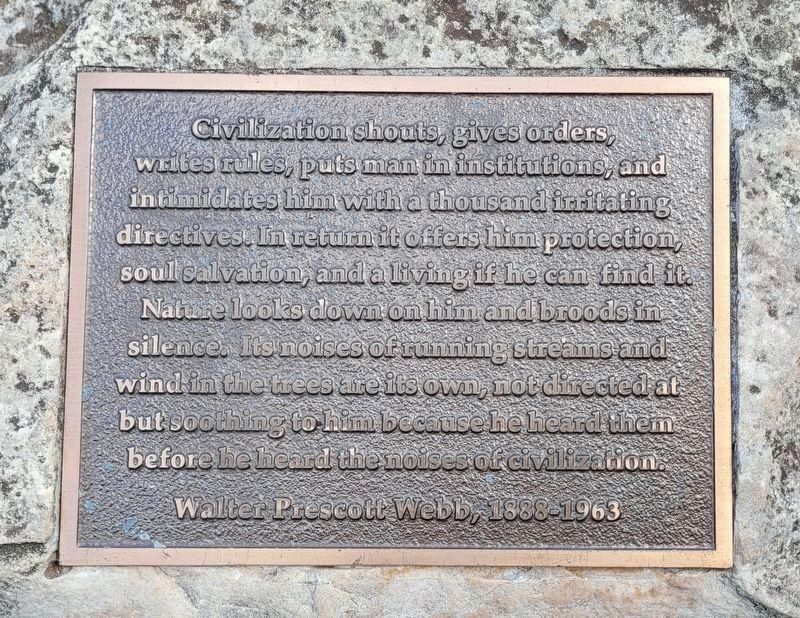
(Walter Prescott Webb Plaque)
Walter Prescott Webb, 1888-1963
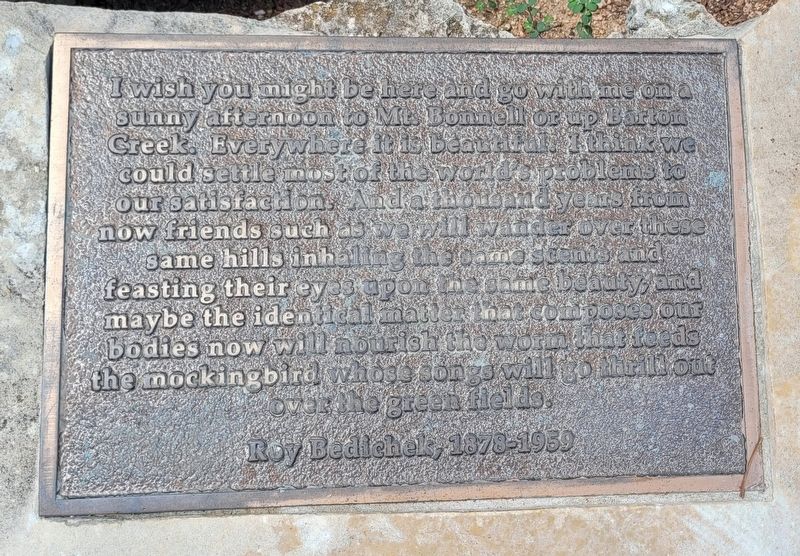
(Roy Bedichek Plaque)
Photographed by James Hulse, August 29, 2022
2. Donors Plaque - Philosophers’ Rock
The donors plaque is located on the right side of the main marker of the monument.
Roy Bedichek, 1878-1959
Erected 1994 by Capital Area Statues.
Topics. This historical marker is listed in these topic lists: Arts, Letters, Music • Communications • Parks & Recreational Areas. A significant historical date for this entry is November 21, 1994.
Location. 30° 15.855′ N, 97° 46.251′ W. Marker is in Austin, Texas, in Travis County. It is in Barton Hills. It is on William Barton Drive 0.2 miles west of Barton Springs Road, on the left when traveling west. The marker and monument are located at the entrance to the Barton Springs. Touch for map. Marker is at or near this postal address: 2201 William Barton Drive, Austin
Photographed by James Hulse, August 29, 2022
3. 3rd Plaque - Walter Prescott Webb
The Webb plaque was located on the southwest section of the monument and behind the stand statue of Webb.

Regionally, this marker is in Central Texas. It is also in the American South. Globally, it is in North America, a Gulf of Mexico state, the Western Hemisphere, the Western World, and the Anglosphere. Historically, it finds itself in what was once New Spain, the Republic of Texas, one of the Confederate States of America, and the Antebellum South.
Other nearby markers. At least 8 other markers are within walking distance of this marker: Andrew Jackson Zilker (a few steps from this marker); Barton Springs (a few steps from this marker); Approximate Location of the Missions (about 500 feet away, measured in a direct line); Rocky Cliff (approx. 0.3 miles away); Swedes of Texas (approx. 0.3 miles away); Swedish Log Cabin (approx. 0.3 miles away); Esperanza School Building (approx. 0.3 miles away); Old I.V. Davis Homestead (approx. half a mile away). Touch for a list and map of all markers in Austin.
Also see . . .
1. Roy Bedichek. Wikipedia
At the urging of his friends, Walter Prescott Webb and J. Frank Dobie, he took a leave of absence in February 1946(Submitted on September 4, 2022, by James Hulse of Medina, Texas.)to write his first book, Adventures with a Texas Naturalist. His second book and third books were awarded the Carr P. Collins Award for the best Texas book of the day by the Texas Institute of Letters (TIL). His last book was released posthumously.Photographed by James Hulse, August 29, 20224. 4th Plaque - Roy Bedichek
2. Walter Prescott Webb. Wikipedia
Webb worked as a bookkeeper in San Marcos and as an optometrist's assistant in San Antonio. Then, in 1918, he was invited to join the history faculty at the University of Texas. He wrote his Master of Arts thesis on the Texas Rangers in 1920 and was encouraged to pursue his PhD. After a year of study at the University of Chicago, he returned to Austin, where he began a historical work on the West. The result of this work was The Great Plains, published in 1931, hailed as great breakthrough in the interpretation of the history of the region, and declared the outstanding contribution to American history since World War I by the Social Science Research Council in 1939.(Submitted on September 4, 2022, by James Hulse of Medina, Texas.)
3. J. Frank Dobie. Wikipedia
Dobie(Submitted on September 4, 2022, by James Hulse of Medina, Texas.)began to publish his first articles in 1919; by 1920 he was writing articles mostly about Longhorn cattle and life in the southwest. That year, he left the University of Texas faculty to work on his uncle's ranch in La Salle County, north of Laredo, where he developed a desire to write about Texas ranch life and southwestern folklore.Photographed by James Hulse, August 29, 20225. The Philosophers Rock and MarkersThe Philosophers’ Rock and Markers are located at the entrance to Barton Springs.
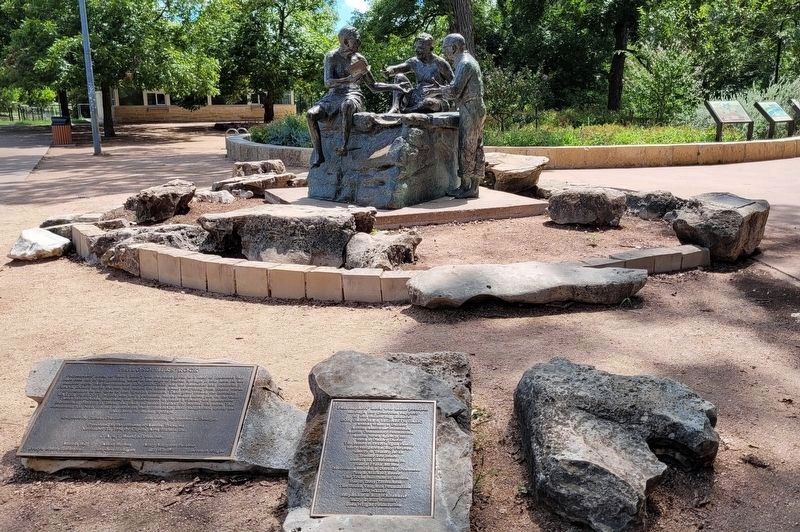
Photographed by James Hulse, August 29, 2022
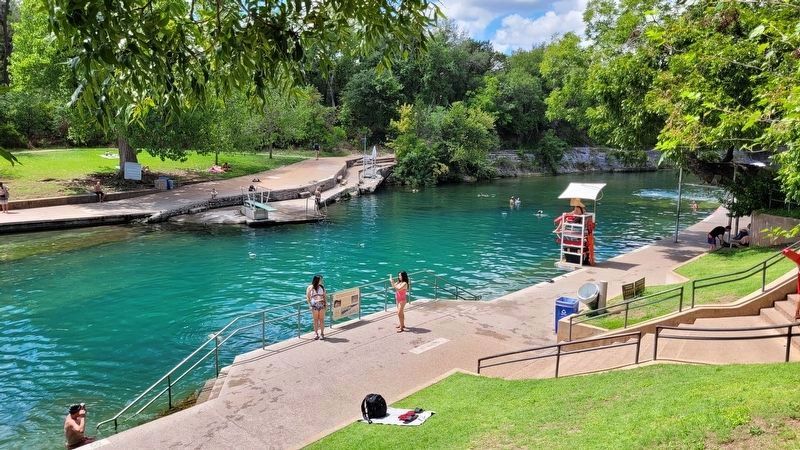
6. Barton Springs
Photographed by James Hulse, August 29, 2022
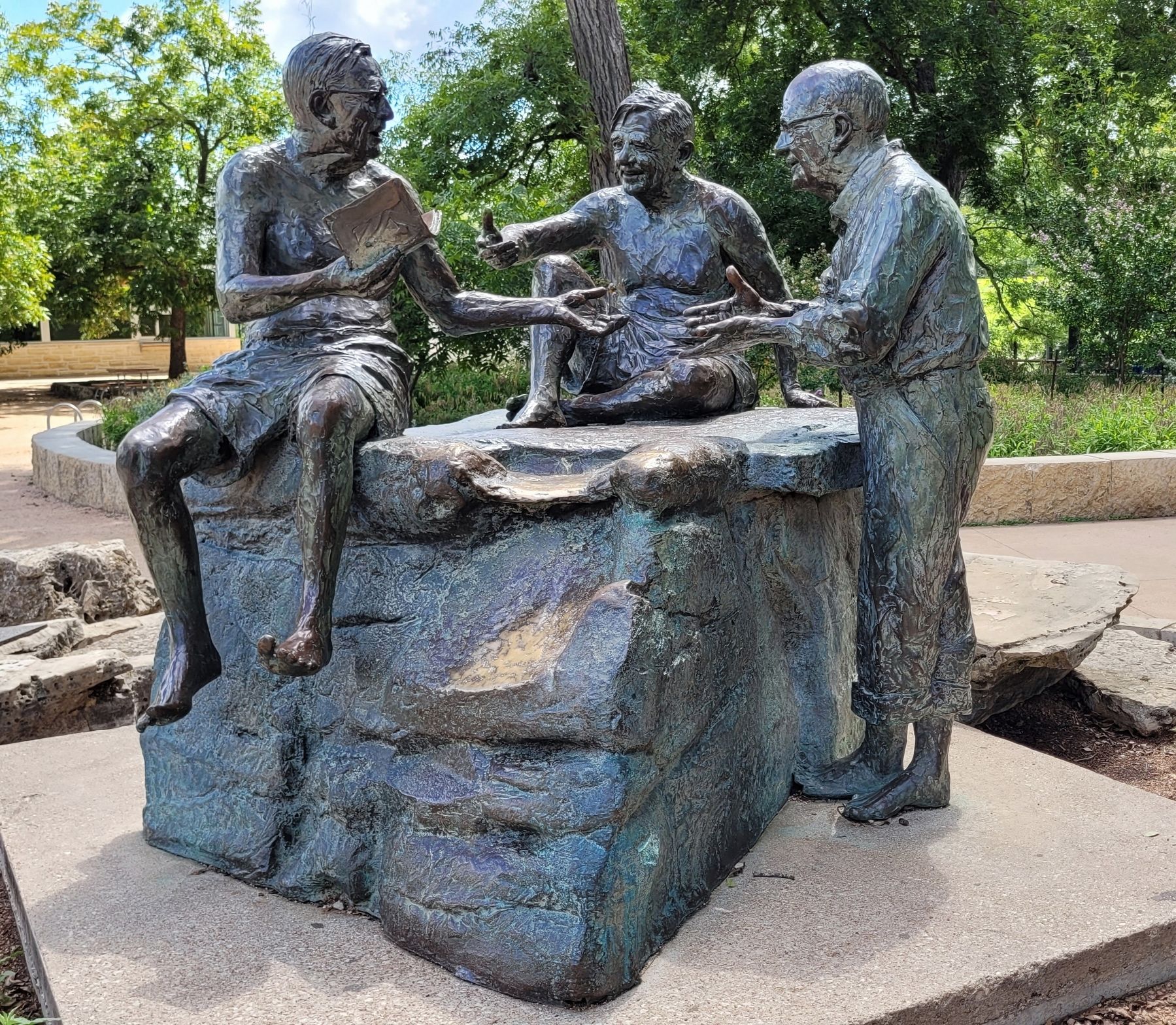
7. Closeup of the Philosophers’ Rock
Credits. This page was last revised on February 1, 2023. It was originally submitted on September 1, 2022, by James Hulse of Medina, Texas. This page has been viewed 4,656 times since then and 305 times this year. Photos: 1, 2, 3, 4, 5, 6, 7. submitted on September 4, 2022, by James Hulse of Medina, Texas.
