Montgomery in Montgomery County, Alabama — The American South (East South Central)
Bill Traylor
(1853-1949)
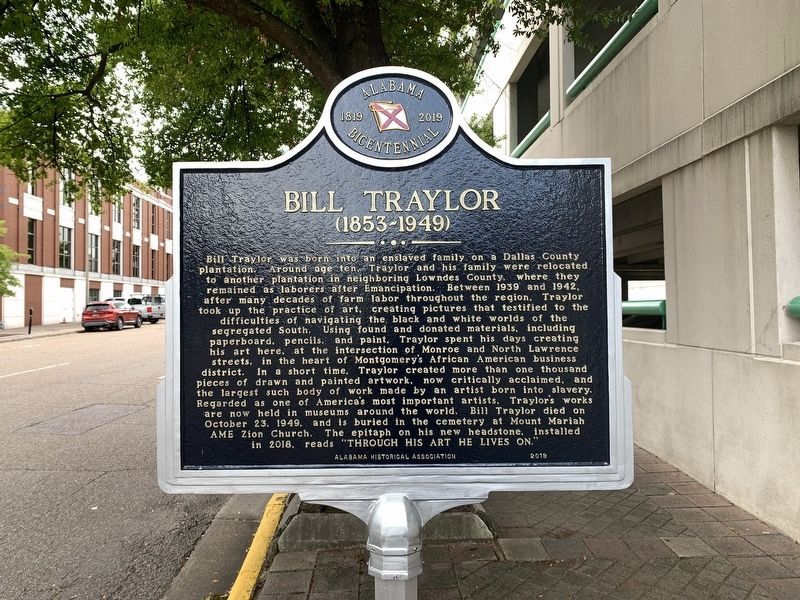
Photographed by Tim Fillmon, July 19, 2022
1. Bill Traylor Marker
this page online
Erected 2019 by Alabama Historical Association.
Topics and series. This historical marker is listed in these topic lists: African Americans • Arts, Letters, Music. In addition, it is included in the Alabama Historical Association series list. A significant historical date for this entry is October 23, 1949.
Location. 32° 22.707′ N, 86° 18.382′ W. Marker is in Montgomery, Alabama, in Montgomery County. It is at the intersection of North Lawrence Street and Monroe Street, on the left when traveling north on North Lawrence Street. Touch for map. Marker is at or near this postal address: 85 N Lawrence St, Montgomery AL 36104, United States of America. Touch for directions.

Regionally, this marker is in the Tri-Counties River Region. It is also in the American South, specifically in the Deep South, and in the Black Belt. Globally, it is in North America, a Gulf of Mexico state, the Western Hemisphere, the Western World, and the Anglosphere. Historically, it finds itself in what was once the territory of the Mississippian Culture, one of the Confederate States
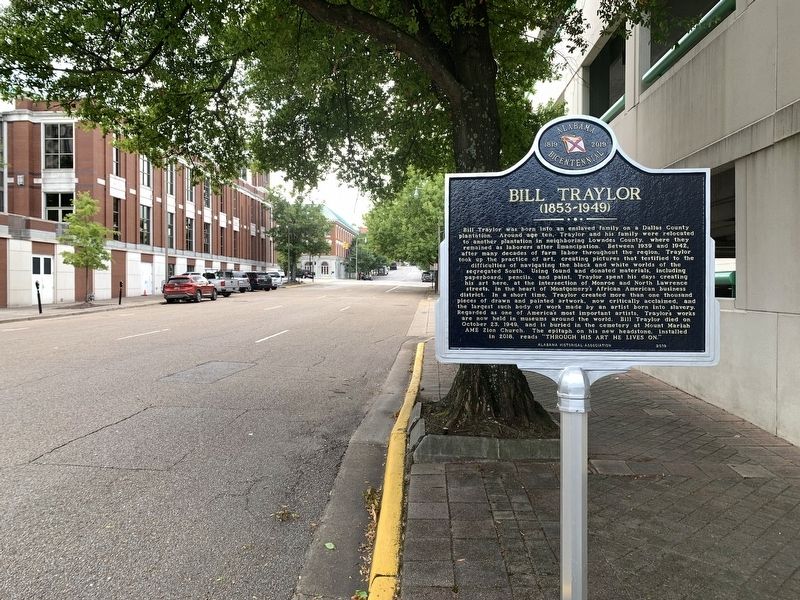
Photographed by Tim Fillmon, July 19, 2022
2. Bill Traylor Marker
Other nearby markers. At least 8 other markers are within walking distance of this marker: Montgomery's Slave Depots / Montgomery's Slave Traders (within shouting distance of this marker); Montgomery City Hall / Funeral for Hank Williams (about 300 feet away, measured in a direct line); The E. L. Posey Parking Lot (about 400 feet away); Montgomery Advertiser (Alabama Power Company) (about 400 feet away); Chris’ Hot Dogs (about 400 feet away); The Capital City Guards (about 400 feet away); General Richard Montgomery Statue (about 500 feet away); Elijah Cook / City of Montgomery v. Rosa Parks (about 500 feet away). Touch for a list and map of all markers in Montgomery.
Other markers no longer nearby. Dan Emmett - Score of Dixie (was about 400 feet away but has been permanently removed); Montgomery Theatre (was about 400 feet away but has been confirmed missing).
Also see . . . Bill Traylor (Smithsonian American Art Museum). (Submitted on September 2, 2022, by Tim Fillmon of Webster, Florida.)
Credits. This page was last revised on September 2, 2022. It was originally submitted on September 2, 2022, by Tim Fillmon of Webster, Florida. This page has been viewed 655 times since then and 60 times this year. Photos: 1, 2. submitted on September 2, 2022, by Tim Fillmon of Webster, Florida.
