Tenleytown in Northwest Washington in Washington, District of Columbia — The American Northeast (Mid-Atlantic)
Fort Reno
Civil War Defenses of Washington
| — | 1861-1865 | — |
Photographed by F. Robby, July 7, 2009
1. Fort Reno Marker
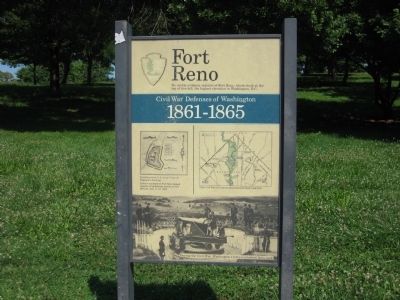
No visible evidence remains of Fort Reno, which stood at the top of this hill, the highest elevation in Washington, D.C.
[drawing of Fort Reno]
Fort Reno from U.S. Army Corps of Engineers drawing. Cannon mounted at Fort Reno helped repulse a Confederate attack on Fort Stevens, July 11-12, 1864.
Map of northern DC
Other Civil War fort locations administered by Rock Creek Park.
Photo of unnamed Washington fort, but now known to be an 1862 photo of Union heavy artillery 100 pound cannon and crew, Fort Stevens, Washington DC. (Photo by Sipley/ClassicStock/Getty Images)
During the Civil War, Washington's forts overlooked farm land.
Erected by National Park Service, U.S. Department of the Interior.
Topics and series. This historical marker is listed in these topic lists: Forts and Castles • War, US Civil. In addition, it is included in the Defenses of Washington series list. A significant historical date for this entry is July 11, 1865.
Location. 38° 57.055′ N, 77° 4.509′ W. Marker is in Northwest Washington in Washington, District of Columbia. It is in Tenleytown. It is at the intersection of Nebraska Avenue Northwest
this page online

Regionally, this marker is in the Washington Metropolitan Area. It is also in the American Northeast, in the Upper South, in the Mid-Atlantic, in the Tidewater, and in the Chesapeake Bay Region. Globally, it is in North America, the Western Hemisphere, the Western World, and the Anglosphere.
Other nearby markers. At least 8 other markers are within walking distance of this marker: Three R's (within shouting distance of this marker); Schools (within shouting distance of this marker); Suburban Style (about 400 feet away, measured in a direct line); a different marker also named Fort Reno (about 500 feet away); a different marker also named Fort Reno (about 500 feet away); a different marker also named Fort Reno (about 600 feet away); A Field of Many Battles (about 600 feet away); a different marker also named Fort Reno (about 700 feet away). Touch for a list and map of all markers in
Photographed by F. Robby, July 7, 2009
2. Fort Reno Marker
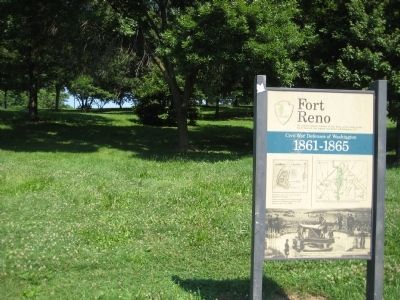
This view is looking west up the hill where Fort Reno was located.
Also see . . . Major General Jesse Lee Reno. (Submitted on March 13, 2011, by Richard E. Miller of Oxon Hill, Maryland.)
Additional commentary.
1. Fort Reno Particulars
From "Mr. Lincoln's Forts: A Guide to the Civil War Defenses of Washington," by Benjamin Franklin Cooling III and Walton H. Owen II:
The fort was first named Fort Pennsylvania, but later renamed to honor Major General Jesse Reno, who was killed in the battle of South Mountain in September 1862. The fort covered the three roads that converged at Tennallytown (now Tenleytown, a neighborhood of Washington, DC), leading to Georgetown.
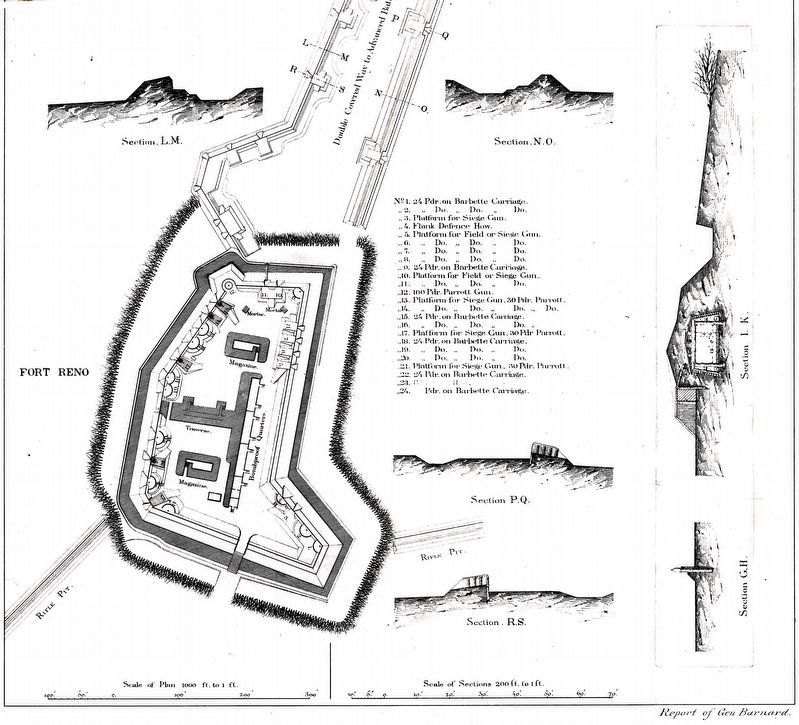
The fort had a perimeter of 517 yards, with 27 guns and mortars. The mounted guns included two 8-inch siege howitzers, nine 24-pdr howitzers, one 100-pdr Parrott Rifle, four 30-pdr Parrott Rifles, two 10-inch mortars, and two 24-pdr Coehorn mortars. A battery to the north mounted seven more 20-pdr Parrott Rifles.
Units stationed at the fort included the 7th Pennsylvania Reserves (36th Infantry Regiment), 59th New York Infantry, 9th and 10th Rhode Island Infantry, and the 10th Rhode Island battery.
On July
Photographed by F. Robby, July 7, 2009
3. Point Reno
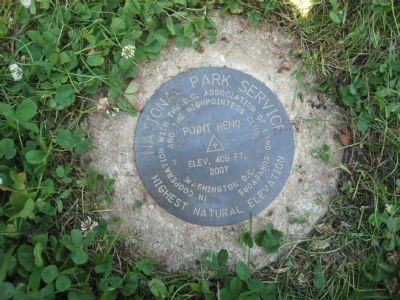
As described on the Fort Reno marker, about 1/10th mile up the hill is this marker in the ground indicating the highest natural elevation in Washington, D.C.
— Submitted July 13, 2009, by Craig Swain of Leesburg, Virginia.
National Archives
4. Fort Reno
Plan & Sections of Fort and Battery, NAID: 122207519, Drawer 171, Sheet 111,Maps and Charts.

Photographed by Mike McKeown, March 8, 2025
5. Fort Reno Marker
The marker is damaged.
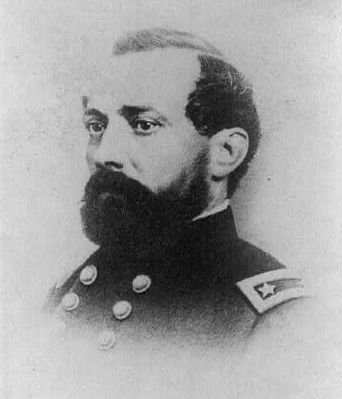
Photographed by Wikipedia
6. Maj. Gen. Jesse L. Reno
Credits. This page was last revised on March 9, 2025. It was originally submitted on July 7, 2009, by F. Robby of Baltimore, Maryland. This page has been viewed 2,715 times since then and 80 times this year. Photos: 1, 2, 3. submitted on July 7, 2009, by F. Robby of Baltimore, Maryland. 4. submitted on March 13, 2024, by Allen C. Browne of Silver Spring, Maryland. 5. submitted on March 8, 2025, by Mike McKeown of Baltimore, Maryland. 6. submitted on March 13, 2011, by Richard E. Miller of Oxon Hill, Maryland.
