Cape Charles in Northampton County, Virginia — The American South (Mid-Atlantic)
A Changing Way of Life…
⎯⎯⎯
Appreciating Our Beach
Photographed by Bernard Fisher, September 19, 2022
1. A Changing Way of Life… side of the marker
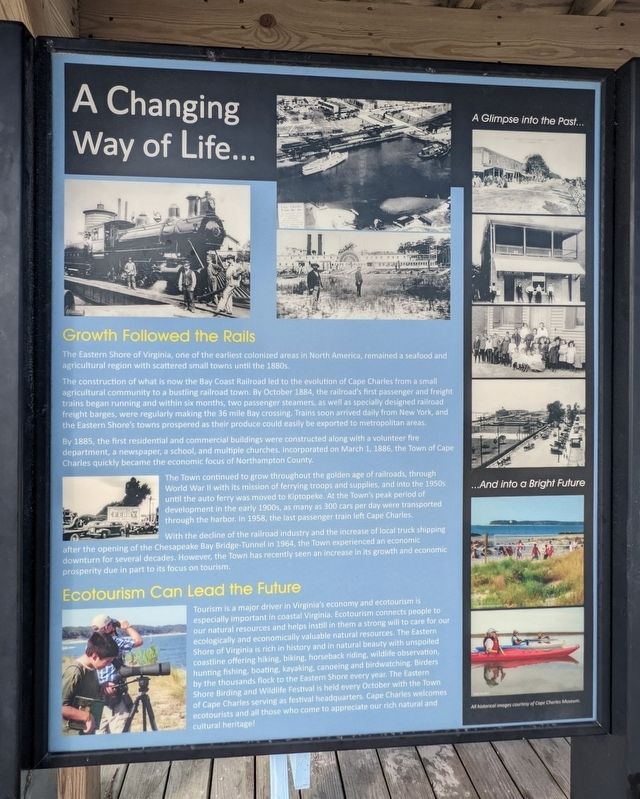
The Eastern Shore of Virginia, one of the earliest colonized areas in North America, remained a seafood and agricultural region with scattered small towns until the 1880s.
The construction of what is now the Bay Coast Railroad led to the evolution of Cape Charles from a small agricultural community to a bustling railroad town. By October 1884, the railroad's first passenger and fright trains began running and within six months, two passenger steamers, as well as specially designed railroad freight barges, were regularly making the 36 mile Bay crossing. Trains soon arrived daily from New York, and the Eastern Shore's towns prospered as their produce could easily be exported to metropolitan areas.
By 1885, the first residential and commercial buildings were constructed along with a volunteer fire department, a newspaper, a school, and multiple churches. Incorporated on March 1, 1886, the Town of Cape Charles quickly became the economic focus of Northampton County.
The Town continued to grow throughout the golden age of railroads, through World War Il with its
this page online
With the decline the railroad industry and the increase of local truck shipping after the opening of the Chesapeake Bay Bridge-Tunnel in 1964, the Town experienced an economic downturn for several decades. However, the Town has recently seen an increase in its growth and economic prosperity due in part to its focus on tourism.
Ecotourism Can Lead the Future
Tourism is a major driver in Virginia's economy and ecotourism is especially important in coastal Virginia. Ecotourism connects people to our natural resources and helps instill in them a strong will to care for our ecologically and economically valuable natural resources. The Eastern Shore of Virginia is rich in history and in natural beauty with unspoiled coastline offering hiking, biking, horseback riding, wildlife observation, hunting fishing, boating, kayaking, canoeing and birdwatching. Birders
A Glimpse into the Past…
…And into a Bright Future
All historical images courtesy of Cape Charles Museum.
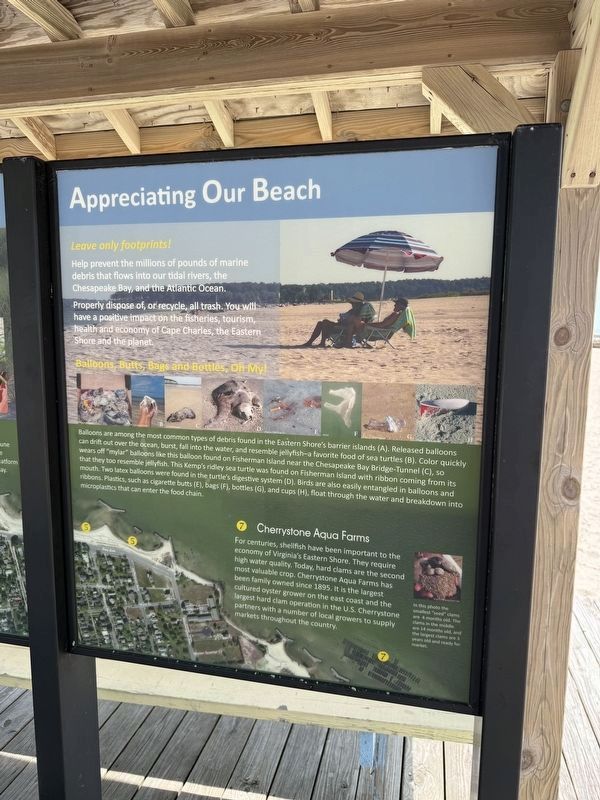
Help prevent the millions of pounds of marine debris that flows into our tidal rivers, the Chesapeake Bay, and the Atlantic Ocean.
Properly dispose of, or recycle, all trash. You will have a positive impact on the fisheries, tourism, health and economy of Cape Charles, the Eastern Shore and the planet.
Balloons, Butts, Bags and Bottles, Oh My!
Balloons are among the most common types of debris found in the Eastern Shore's barrier islands (A). Released balloons can drift out over the ocean, burst, fall into the water, and resemble jellyfish—a favorite food of sea turtles (B). Color quickly wears off "mylar" balloons like this balloon found on Fisherman Island near the Chesapeake
Photographed by Bernard Fisher, September 19, 2022
3. A Changing Way of Life… / Appreciating Our Beach Marker
Cherrystone Aqua Farms
For centuries, shellfish have been important to the economy of Virginia's Eastern Shore. They require high water quality. Today, hard clams are the second most valuable crop. Cherrystone Aqua Farms has been family owned since 1895. It is the largest cultured oyster grower on the east coast and the largest hard clam operation in the U.S. Cherrystone partners with a number of local growers to supply markets throughout the country.
[Caption:]
In this photo the smallest "seed" clams are 4 months old. The clams in the middle are 14 months old, and the largest clams are 3 years old and ready for market.
Topics. This historical marker is listed in these topic lists: Agriculture

Photographed by Devry Becker Jones (CC0), June 5, 2026
4. A Changing Way of Life… / Appreciating Our Beach Marker
Location. 37° 16.045′ N, 76° 1.399′ W. Marker is in Cape Charles, Virginia, in Northampton County. It is at the intersection of Bay Avenue and Mason Avenue, on the left when traveling north on Bay Avenue. Touch for map. Marker is at or near this postal address: 21 Bay Ave, Cape Charles VA 23310, United States of America. Touch for directions.

Regionally, this marker is on the Eastern Shore. It is also in the American South, specifically in the Upper South, on the Delmarva Peninsula, in the Tidewater, and on the Eastern Seaboard. Globally, it is in the North Atlantic Region, North America, the Western Hemisphere, the Western World, and the Anglosphere. Historically, it finds itself in what was once the territory of the Mississippian Culture, one of the original Thirteen Colonies, one of the Confederate States of America, and the Antebellum South.
Other nearby markers. At least 8 other markers are within walking distance of this marker: A Dynamic Environment (here, next to this marker); Rails Overlooking the Chesapeake Bay (within shouting distance of this marker); The Chesapeake Bay Impact Crater (within shouting distance of this marker); Peter Jacob Carter (within shouting distance of this marker); Veterans War Memorial (approx. ¼ mile away); The Eastern Shore Railroad (approx. 0.3 miles away); Pilot House (approx. 0.8 miles away); The Caboose (approx. 0.8 miles away). Touch for a list and map of all markers in Cape Charles.
Another marker is no longer nearby. Cape Charles to Little Creek (was approx. ¼ mile away but has been permanently removed).
Credits. This page was last revised on June 7, 2026. It was originally submitted on September 19, 2022, by Bernard Fisher of Richmond, Virginia. This page has been viewed 709 times since then and 51 times this year. Photos: 1. submitted on September 19, 2022, by Bernard Fisher of Richmond, Virginia. 2. submitted on June 7, 2026, by Devry Becker Jones of Washington, District of Columbia. 3. submitted on September 19, 2022, by Bernard Fisher of Richmond, Virginia. 4. submitted on June 7, 2026, by Devry Becker Jones of Washington, District of Columbia.
