North Capitol in Nashville in Davidson County, Tennessee — The American South (East South Central)
Western Highland Rim
⎯⎯⎯
Central Basin
Photographed by Darren Jefferson Clay, June 11, 2022
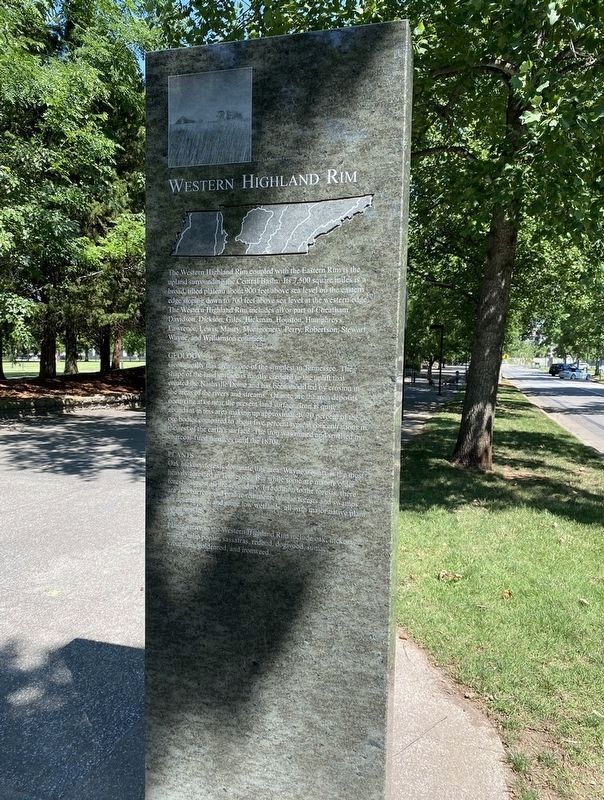
1. Western Highland Rim Marker
The Western Highland Rim coupled with the Eastern Rim is the upland surrounding the Central Basin. Its 7,5000 square miles is a broad, tilted plateau about 900 feet above sea level on the eastern edge sloping down to 700 feet above sea level as the western edge. The Western Highland Rim includes all or part of Cheatham, Davidson, Dickson, Giles, Hickman, Houston, Humphreys, Lawrence, Lewis, Maury, Montgomery, Perry, Robertson, Stewart, Wayne, and Williamson counties.
Geology
geologically this area is one of the simplest in Tennessee. The shape of the land surface is mostly credited to the uplift that created the Nashville Dome and has been modified by erosion in the areas of the rivers and streams. Of note are the iron deposits occurring at or near the present land surface. Iron is quite abundant in this area making up approximately 20 percent of the ore bodies compared to about five percent typical concentration in the rest of the earth's surface. The iron was mined and smelted in charcoal-fired furnaces until the 1870s.
Plants
Oak hickory forests dominate this area. Wayne County is the
this page online
Plants native to the Western Highland Rim include oak, hickory, maple, tulip poplar, sassafras, redbud, dogwood, sumac, viburnum, goldenrod, and ironweed
The oval shaped Central Basin is approximately 50 miles across extending north almost to Kentucky and nearly to the edge of Alabama on the south. The basin is completely encircled by the elevated highland Rim. Its depth is only about 600 feet although it encompasses 500 square miles. The Central Basin contains all or part of Bedford, Cannon, Coffee, DeKalb, Moore, Lincoln, Marshall, Giles, Maury, Williamson, Rutherford, Davidson, Wilson, Smith, Jackson, Sumner, Trousdale, and Macon counties.
Geology
The Central Basin is topographic basin carved by stream erosion from the top of a dome of sedimentary rock-the Nashville Dome. The dome was created millions of years ago by a

Photographed by Darren Jefferson Clay, June 11, 2022
2. Central Basin Marker
Plants
Much of the last community of the Central Basin is characterized by its relationship to the limestone geology. Cedar and cedar/hardwood forest types dominate the region but other notable trees include yellowwood, blue ash, Kentucky coffeetree, and

Photographed by Darren Jefferson Clay, June 11, 2022
3. Western Highland Rim / Central Basin Marker
Plants native to the Central Basin include red cedar, hackberry, blue ash, Kentucky coffeetree, redbud, dogwood, hawthorn, sumac, little bluestem, prickly pear, yucca, and grade phlox.
Topics. This historical marker is listed in this topic list: Natural Features.
Location. 36° 10.255′ N, 86° 47.211′ W. Marker is in Nashville, Tennessee, in Davidson County. It is in North Capitol. It is on 6th Avenue North, on the left when traveling north. Touch for map. Marker is at or near this postal address: 999-837 6th Ave N, Nashville TN 37208, United States of America. Touch for directions.

Regionally, this marker is in Middle Tennessee. It is also in the American South and specifically in the Upper South. Globally, it is in North America, the Western Hemisphere, the Western World, and the Anglosphere. Historically, it finds itself in what was once the territory of the Mississippian Culture, one of the Confederate States of America, and the Antebellum South.
Other nearby markers. At least 8 other markers are within walking distance of this marker: Montgomery County (here, next to this marker); Dickson County (a few steps from this marker); Hickman County (a few steps from this marker); Lewis County (a few steps from this marker); Lawrence County (a few steps from this marker); Stewart County (a few steps from this marker); Giles County (within shouting distance of this marker); Moore County (within shouting distance of this marker). Touch for a list and map of all markers in Nashville.
Credits. This page was last revised on February 7, 2023. It was originally submitted on September 20, 2022, by Darren Jefferson Clay of Duluth, Georgia. This page has been viewed 1,490 times since then and 178 times this year. Photos: 1, 2, 3. submitted on September 29, 2022, by Darren Jefferson Clay of Duluth, Georgia. • Mark Hilton was the editor who published this page.
