
North Capitol in Nashville in Davidson County, Tennessee — The American South (East South Central)
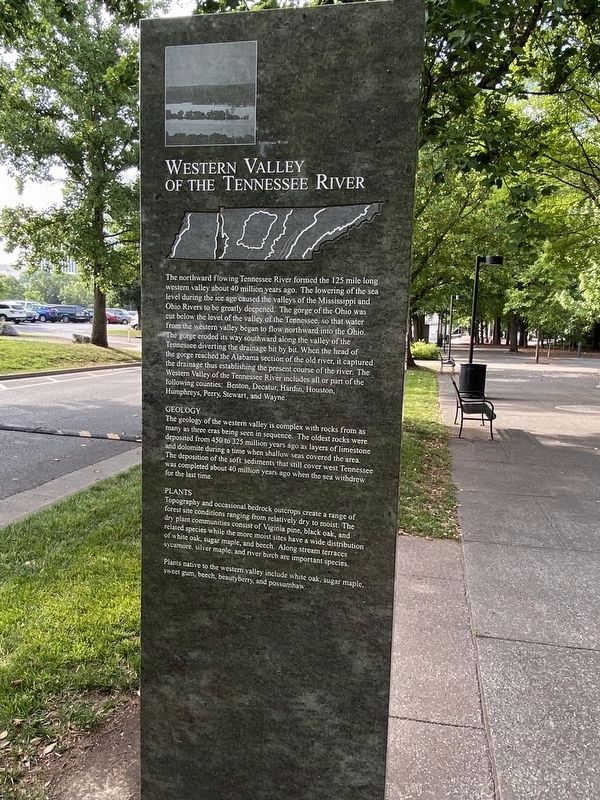
Western Valley of the Tennessee River
⎯⎯⎯
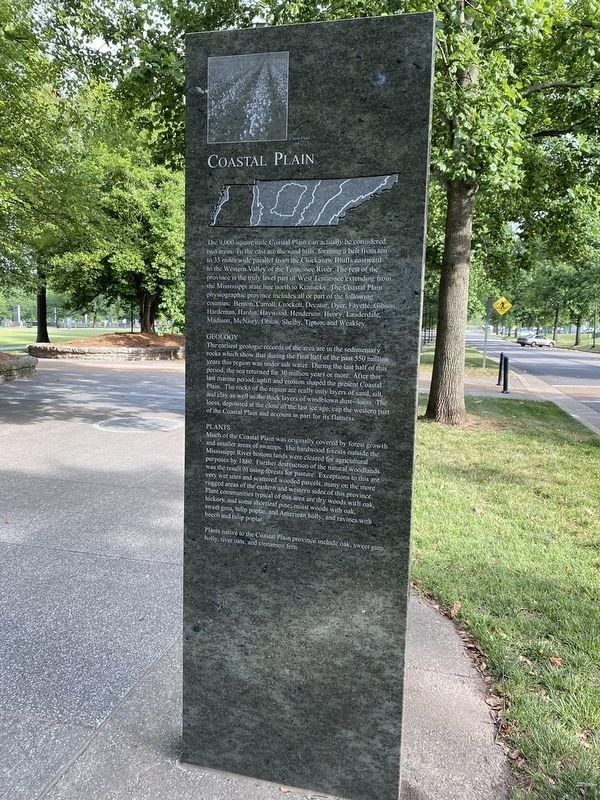
Coastal Plain
Photographed by Darren Jefferson Clay, June 11, 2022
1. Western Valley of the Tennessee River Marker
The northward flowing Tennessee River formed the 125 mile long western valley about 40 million years ago. The lowering of the sea level during the ice age caused the valleys of the Mississippi and Ohio Rivers to be greatly deepened. The gorge of the Ohio was cut below the level of the valley of the Tennessee, so that water from the western valley began to flow northward into the Ohio. The gorge eroded its way southward along the valley of the Tennessee diverting the drainage bit by bit. When the head of the gorge reached the Alabama section of the old river, it captured the drainage thus establishing the present course of the river. The Western Valley of the Tennessee River includes all or part of the following counties: Benton, Decatur, Hardin, Houston, Humphreys, Perry Stewart, and Wayne.
Geology
The geology of the western valley is complex with rocks from as many as three eras being seen in sequence. The oldest rocks were deposited from 450 to 325 million years ago as layers of limestone and dolomite during a time when shallow seas covered the area. The deposition
this page online
Plants
Topography and occasional bedrock outcrops create a range of forest site conditions ranging from relatively dry to moist. The dry plant communities consist of Virginia pine, black oak, and related species while the more moist sites have a wide distribution of white oak, sugar maple, and beech. Along stream terraces sycamore, silver maple, and river birch are important species. Plants native to the western valley include white oak, sugar maple, sweet gum, beech, beautyberry and possumhaw.
The 9,000 square mile Coastal Plain can actually be considered two areas. To the east are the sand hills, forming a belt of ten to 35 miles wide parallel from the Chickasaw Bluffs eastward to the Western Valley of the Tennessee River. The rest of the province is the truly level part of West Tennessee extending from the Mississippi state line north to Kentucky. The Coastal Plain physiographic province includes all or part of the following counties: Benton, Carroll, Crockett,
Photographed by Darren Jefferson Clay, June 11, 2022
2. Coastal Plain Marker
Geology
The earliest geologic records of the area are in the sedimentary rocks which show that during the first half of the past 550 million years this region was under salt water. During the last half of this period, the sea returned for 30 million years or more. After this last marine period, uplift and erosion shaped the present Coastal Plain. The rocks of the region are really only layers of sand, silt, and clay as well as the thick layers of windblown dust-loess. The loess, deposed at the close of the last ice age, cap the western part of the Coastal Plain and account in part of its flatness.
Plants
Much of the Coastal Plain was originally covered by forest growth and smaller areas of swamps. The hardwood forests outside the Mississippi River bottom lands were cleared for agricultural purposes by 1880. Further destruction of the natural woodlands was the result of using forests for pasture. Exceptions to this are very wet sites and scattered wooded parcels, many on the more rugged

Photographed by Darren Jefferson Clay, June 11, 2022
3. Western Valley of the Tennessee River / Coastal Plain Marker
Plants native to the Coastal Plain province include oak, sweet gum, holly, river oats, and cinnamon fern.
Topics. This historical marker is listed in this topic list: Natural Features.
Location. 36° 10.189′ N, 86° 47.166′ W. Marker is in Nashville, Tennessee, in Davidson County. It is in North Capitol. It is on 6th Avenue North, on the left when traveling north. Touch for map. Marker is at or near this postal address: 803 6th Ave N, Nashville TN 37208, United States of America. Touch for directions.

Regionally, this marker is in Middle Tennessee. It is also in the American South and specifically in the Upper South. Globally, it is in North America, the Western Hemisphere, the Western World, and the Anglosphere. Historically, it finds itself in what was once the territory of the Mississippian Culture, one of the
Photographed by Darren Jefferson Clay, June 11, 2022
4. Western Valley of the Tennessee River / Coastal Plain Marker
Other nearby markers. At least 8 other markers are within walking distance of this marker: Tipton County (here, next to this marker); Walkway of the Counties / Mississippi River Valley (here, next to this marker); Shelby County (here, next to this marker); Gibson County (here, next to this marker); Lake County (here, next to this marker); Lauderdale County (here, next to this marker); Haywood County (a few steps from this marker); Dyer County (a few steps from this marker). Touch for a list and map of all markers in Nashville.
Credits. This page was last revised on February 7, 2023. It was originally submitted on September 20, 2022, by Darren Jefferson Clay of Duluth, Georgia. This page has been viewed 680 times since then and 73 times this year. Photos: 1, 2, 3. submitted on September 29, 2022, by Darren Jefferson Clay of Duluth, Georgia. 4. submitted on October 3, 2022, by Darren Jefferson Clay of Duluth, Georgia. • Mark Hilton was the editor who published this page.
