Rochester in Beaver County, Pennsylvania — The American Northeast (Mid-Atlantic)
Girard Locks of the Beaver Division Canal
Photographed by Mike Wintermantel
1. Girard Locks of the Beaver Division Canal Marker
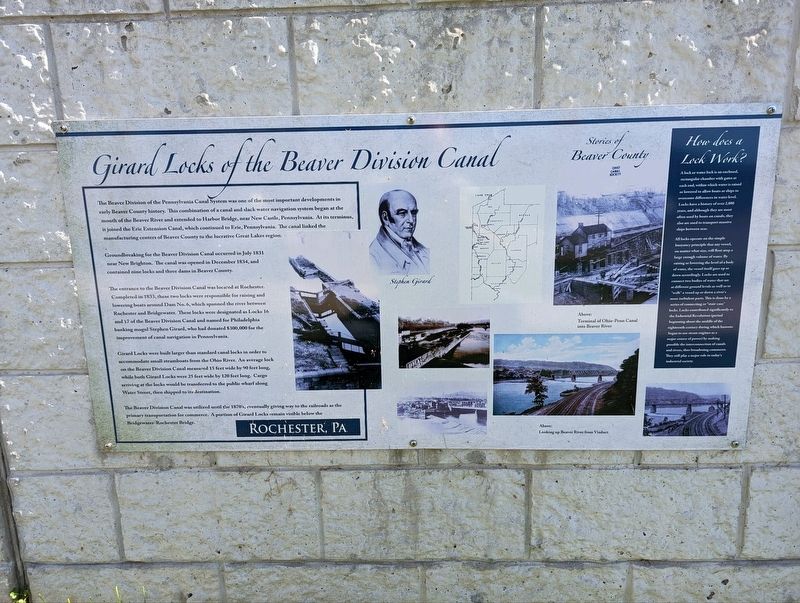
Groundbreaking for the Beaver Division Canal occurred in July 1831 near New Brighton. The canal was opened in December 1834, and contained nine locks and three dams in Beaver County.
The entrance to the Beaver Division Canal was located at Rochester. Completed in 1833, these two locks were responsible for raising and lowering boats around Dam No. 6, which spanned the river between Rochester and Bridgewater. These lock were designated as Locks 16 and 17 of the Beaver Division Canal and named for Philadelphia banking mogul Stephen Girard, who had donated $300,000 for the improvement of canal navigation in Pennsylvania.
Girard Locks were built larger
this page online
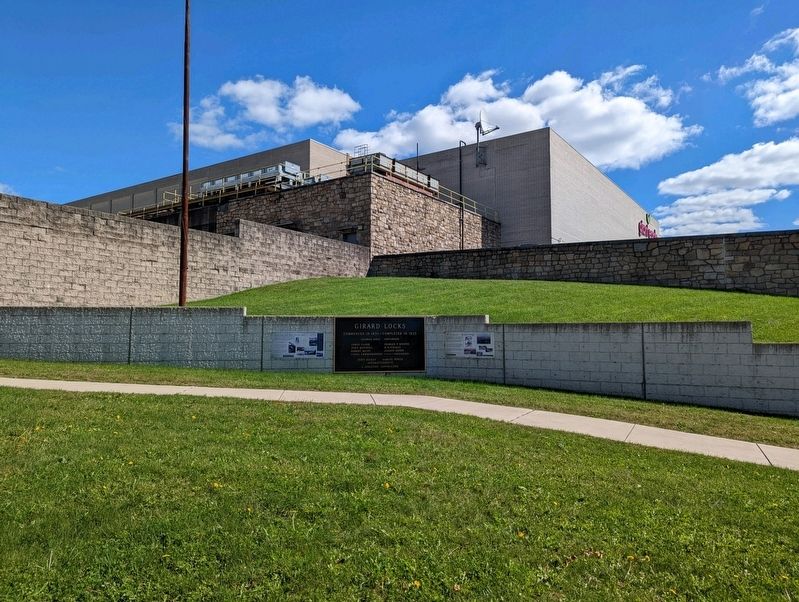
The Beaver Division Canal was utilized until the 1870's, eventually giving way to the railroads as the primary transportation for commerce. A portion of the Girard Locks remain visible below the Bridgewater-Rochester Bridge.
Topics and series. This historical marker is listed in this topic list: Waterways & Vessels. In addition, it is included in the Pennsylvania Canal series list. A significant historical month for this entry is July 1831.
Location. 40° 42.117′ N, 80° 17.346′ W. Marker is in Rochester, Pennsylvania, in Beaver County. It is at the intersection of Madison Street and Delaware Avenue, on the right when traveling east on Madison Street. Touch for map. Marker is in this post office area: Rochester PA 15074, United States of America. Touch for directions.

Regionally, this marker is
Photographed by Mike Wintermantel
2. Girard Locks of the Beaver Division Canal Marker
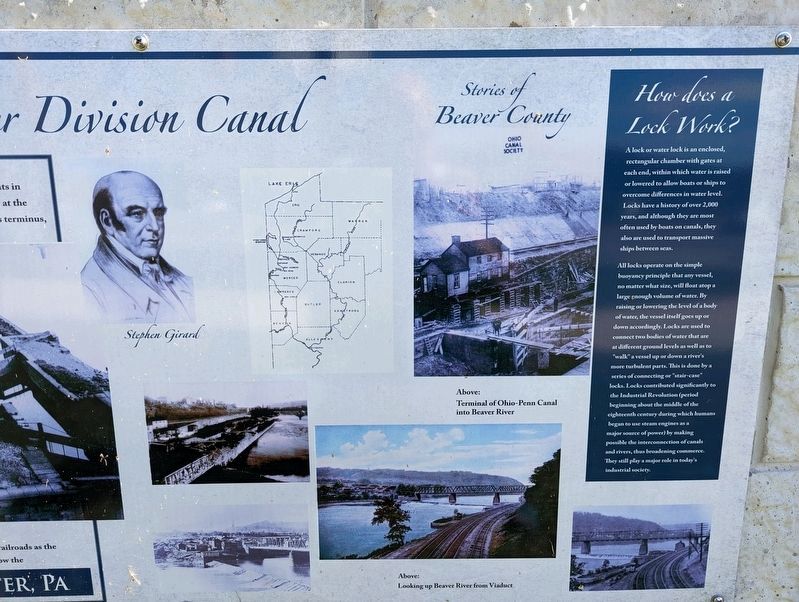
Right Side Images
Stephen Girard
Above: Terminal of Ohio-Penn Canal into Beaver River
Above: Looking up Beaver River from Viaduct
How does a Lock Work
A lock or water lock is an enclosed, rectangular chamber with gates at each end, within which water is raised or lowered to allow boats or ships to overcome differences in water level. Locks have a history of over 2,000 years, and although they are most often used by boats and canals, they are also used to transport massive ships between seas.
All locks operate on the simple buoyancy principle that any vessel, no matter what size, will float atop a large enough volume of water. By raising or lowering the level of a body of water, the vessel itself goes up or down accordingly. Locks are used to connect two bodies of water that are at different ground levels as well as to "walk" a vessel up or down a river's more turbulent parts. This is done by a series of connecting or "stair-case" locks. Locks contributed significantly to the Industrial Revolution (period beginning about the middle of the eighteenth century during which humans began to use steam engines as a major source of power? by making possible the interconnection of canals and rivers, thus broadening commerce. They still play a major role in today's industrial society.
Stephen Girard
Above: Terminal of Ohio-Penn Canal into Beaver River
Above: Looking up Beaver River from Viaduct
How does a Lock Work
A lock or water lock is an enclosed, rectangular chamber with gates at each end, within which water is raised or lowered to allow boats or ships to overcome differences in water level. Locks have a history of over 2,000 years, and although they are most often used by boats and canals, they are also used to transport massive ships between seas.
All locks operate on the simple buoyancy principle that any vessel, no matter what size, will float atop a large enough volume of water. By raising or lowering the level of a body of water, the vessel itself goes up or down accordingly. Locks are used to connect two bodies of water that are at different ground levels as well as to "walk" a vessel up or down a river's more turbulent parts. This is done by a series of connecting or "stair-case" locks. Locks contributed significantly to the Industrial Revolution (period beginning about the middle of the eighteenth century during which humans began to use steam engines as a major source of power? by making possible the interconnection of canals and rivers, thus broadening commerce. They still play a major role in today's industrial society.
Other nearby markers. At least 8 other markers are within walking distance of this marker: The Bridgewater - Rochester Bridge (a few steps from this marker); Joseph H. Bausman D.D. (about 600 feet away, measured in a direct line); Make Way for the Railroad (approx. 0.2 miles away); Rochester Civil War Memorial (approx. 0.2 miles away); H.C. Fry Glass Company (approx. 0.2 miles away); A War Memorial (approx. 0.2 miles away); Stepping into Historic Rochester (approx. 0.2 miles away); Major General Joseph H. Pendleton (approx. 0.2 miles away). Touch for a list and map of all markers in Rochester.
Photographed by Mike Wintermantel
3. Girard Locks of the Beaver Division Canal Marker
Photographed by Mike Wintermantel
4. Girard Locks plaque
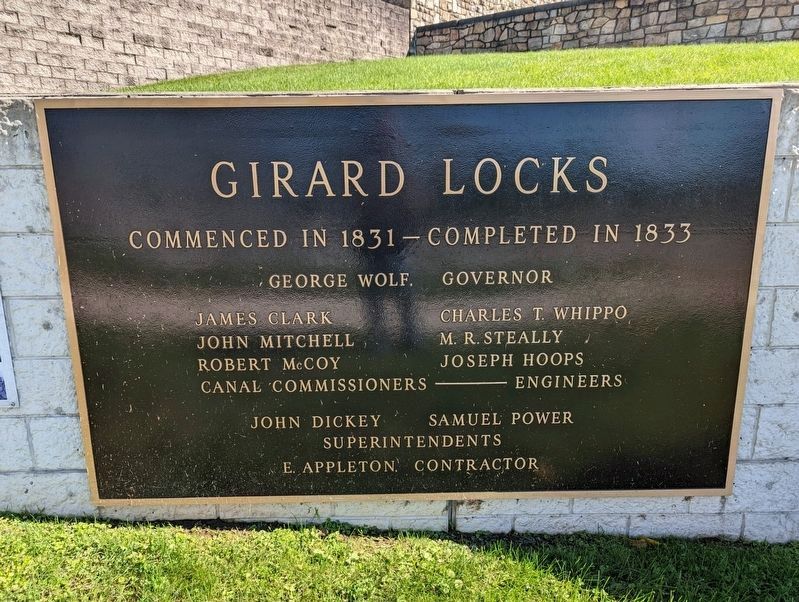
George Wolf, Governer
James Clark
John Mitchell
Robert McCoy
Charles T.Whippo
M.R. Steally
Joseph Hoops
Canal Commissioners - Engineers
John Dickey
Samuel Power
Superintendents
E. Appleton, Contractor
Credits. This page was last revised on September 26, 2022. It was originally submitted on September 25, 2022, by Mike Wintermantel of Pittsburgh, Pennsylvania. This page has been viewed 931 times since then and 102 times this year. Photos: 1. submitted on September 25, 2022, by Mike Wintermantel of Pittsburgh, Pennsylvania. 2. submitted on September 26, 2022, by Mike Wintermantel of Pittsburgh, Pennsylvania. 3, 4. submitted on September 25, 2022, by Mike Wintermantel of Pittsburgh, Pennsylvania. • Bill Pfingsten was the editor who published this page.
