Dayton in Liberty County, Texas — The American South (West South Central)
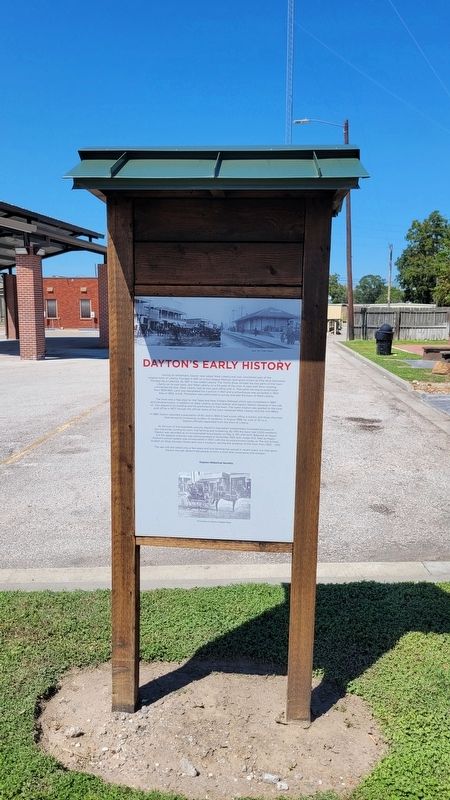
Dayton's Early History

Photographed by James Hulse, September 25, 2022
1. Dayton's Early History Marker
The town was a flag stop for the Texas and New Orleans Railroad which was completed in 1860 and became known, in addition to West Liberty, as Days Station and Dayton Station because of the role I.C. Day played in its building and his prominence in the town. The name Dayton was applied to the local post office in 1877, though the official name of the town remained West Liberty until the mid 1880s.
In 1885 Dayton reported a population of 60, and
this page online
At the turn of the twentieth century, Dayton's population substantially increased because of two industries coming to town: rice farming and lumbering. By 1910 the town had 2,500 residents. Dayton was recorded as an incorporated municipality on May 3, 1911 with W.M. Babcock as Mayor, but for reasons unknown was reincorporated in November 1925 with Judge W.S. Neel as Mayor. Dayton's school system was incorporated in 1907, with the structure known today as The Old School, located on West Houston Street and now a museum, serving the students of the town from 1900-1910.
The saw mill era lasted only a few years and rice farming has waned in recent years, but they gave Dayton enough determined people to form a town that could grow and prosper.
Captions
Upper Left: 1908 Depot Street
Upper Right: circa 1912 Train Depot
Lower Middle: 1912 Arthur G. Hatch on Depot Street
Erected by Dayton Historical Society.
Topics.
Photographed by James Hulse, September 25, 2022
2. Dayton's Early History Marker
Location. 30° 2.776′ N, 94° 53.215′ W. Marker is in Dayton, Texas, in Liberty County. It is at the intersection of North Highway 146 (U.S. 90) and North Church Street, on the right when traveling west on North Highway 146. The marker is located along a pathway in the small city park. Touch for map. Marker is in this post office area: Dayton TX 77535, United States of America. Touch for directions.

Regionally, this marker is in the Houston Metropolitan Area. It is also in the American South and on the Gulf Coast. Globally, it is in North America, a Gulf of Mexico state, the Western Hemisphere, the Western World, and the Anglosphere. Historically, it finds itself in what was once New Spain, the Republic of Texas, and one of the Confederate States of America.
Other nearby markers. At least 8 other markers are within walking distance of this marker: Dayton's Namesake (here, next to this marker); Dayton's Early Economy (a few steps from this marker); Early History of Dayton's African American Community (a few steps from this marker); 1937 Dayton City Hall (within shouting distance of this marker); The Murder of Louis "Frenchy" Cashat (within shouting distance of this marker); Dayton's Volunteer Fire Department (within shouting distance of this marker); Dayton Egg Circle (within shouting distance of this marker); Dayton World War II Memorial (within shouting distance of this marker). Touch for a list and map of all markers in Dayton.
Also see . . . Dayton, TX. Texas State Historical Association
Dayton, on U.S. Highway 90 three miles west of Liberty in southwestern Liberty County, was first called West Liberty and was considered part(Submitted on September 27, 2022, by James Hulse of Medina, Texas.)of the original town of Liberty, founded in 1831. The Trinity River divided the two parts of the town: Liberty was on its east bank, and West Liberty was on a hill three miles west of the river. A new road and a ferry directly connected the two. Both parts of the town were located on the four-league Mexican land grant appropriated for the capital of the old municipality of Santísima Trinidad de la Libertad, which later became known as Liberty. The postmaster of West Liberty from March 25, 1839, through September 15, 1841, was A. Thouvenin, probably the same man as Arnold Thouvenin, who obtained a quarter-league Mexican land grant in Polk County in April 1835.Photographed by James Hulse, September 25, 20223. The Dayton's Early History Marker is the right marker of the two markers

Credits. This page was last revised on September 27, 2022. It was originally submitted on September 27, 2022, by James Hulse of Medina, Texas. This page has been viewed 843 times since then and 62 times this year. Photos: 1, 2, 3. submitted on September 27, 2022, by James Hulse of Medina, Texas.
