North Hollywood in Los Angeles in Los Angeles County, California — The American West (Pacific Coastal)
North Hollywood Metro Station
courtesy City of Los Angeles, 2014
1. North Hollywood Metro Station Marker
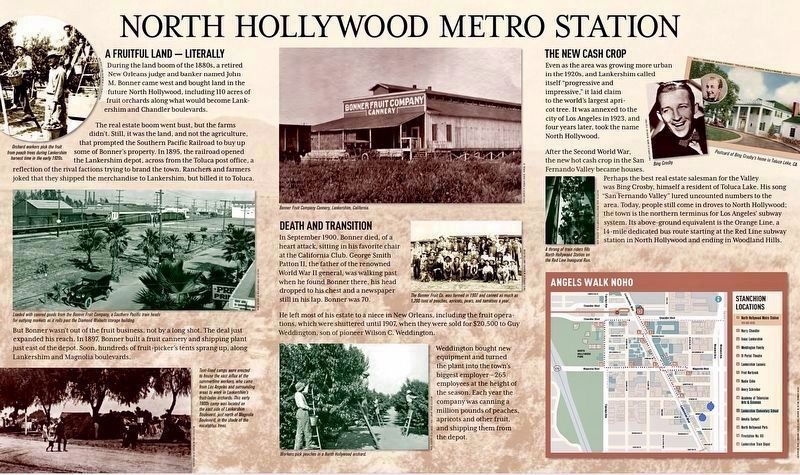
A Fruitful Land — Literally
During the land boom of the 1880s, a retired New Orleans judge and banker named John M. Bonner came west and bought land in the future North Hollywood, including 110 acres of fruit orchards along what would become Lankershim and Chandler boulevards. The real estate boom went bust, but the farms didn't. Still, it was the land, and not the agriculture, that prompted the Southern Pacific Railroad to buy up some of Bonner’s property. In 1895, the railroad opened the Lankershim depot, across from the Toluca post office, a reflection of the rival factions trying to brand the town. Ranchers and farmers joked that they shipped the merchandise to Lankershim, but billed it to Toluca.
But Bonner wasn't out of the fruit business, not by a long shot. The deal just expanded his reach. In 1897, Bonner built a fruit cannery and shipping plant just east of the depot. Soon, hundreds of fruit-picker's tents sprang up along Lankershim and Magnolia boulevards.
Death and Transition
In September 1900, Bonner died of a heart attack, sitting in his favorite chair at the California Club. George
this page online
He left most of his estate to a niece in New Orleans, including the fruit operations, which were shuttered until 1907, when they were sold for $20,500 to Guy Weddington, son of pioneer Wilson C. Weddington.
Weddington bought new equipment and turned the plant into the town's biggest employer - 265 employees at the height of the season. Each year the company was canning a million pounds of peaches, apricots and other fruit, and shipping them from the depot.
The New Cash Crop
Even as the area was growing more urban in the 1920s, and Lankershim called itself "progressive and impressive," it laid claim to the world's largest apricot tree. It was annexed to the city of Los Angeles in 1923, and four years later, took the name North Hollywood.
After the Second World War, the new hot cash crop in the San Fernando Valley became houses. Perhaps the best real estate salesman for the Valley was Bing Crosby, himself a resident of Toluca
from Library of Congress, 2013
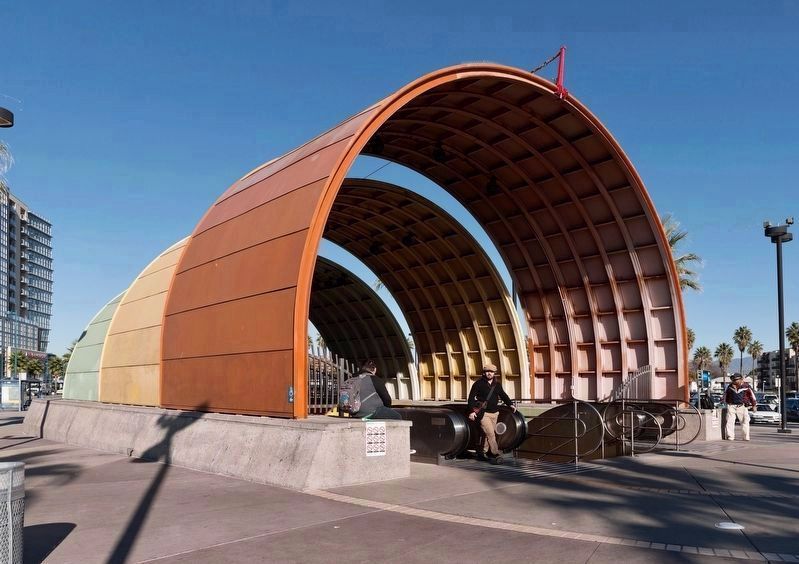
2. North Hollywood Metro Station
Erected 2014 by City of Los Angeles.
Topics. This historical marker is listed in these topic lists: Agriculture • Industry & Commerce • Railroads & Streetcars • Settlements & Settlers.
Location. 34° 10.112′ N, 118° 22.598′ W. Marker is in Los Angeles, California, in Los Angeles County. It is in North Hollywood. It is on Lankershim Boulevard just north of Chandler Boulevard, on the right when traveling north. Touch for map. Marker is at or near this postal address: 5391 Lankershim Blvd, North Hollywood CA 91601, United States of America. Touch for directions.

Regionally, this marker is in California’s The Valley (the San Fernando Valley) and in the Transverse Ranges. It is also on the American Pacific Coast. Globally, it is in North America, on the Ring of Fire, on the Pacific Rim, in the Western Hemisphere, in the Western World, and in the Anglosphere. Historically, it finds itself in what was once New Spain and also Mexico’s Alta California.
Other nearby markers. At least 8 other markers are within walking distance of this marker: Harry Chandler (within shouting distance of this marker); Lankershim Train Depot (about 400 feet away, measured in a direct line); Weddington Family (about 500 feet away); Thomas G. Taylor (about 600 feet away); El Portal Theatre (about 600 feet away); Fire Station No. 60 (about 800 feet away); North Hollywood Park (approx. 0.2 miles away); Lankershim Elementary School (approx. ¼ mile away). Touch for a list and map of all markers in Los Angeles.
More about this marker. The marker was removed and has not been re-installed.
Regarding North Hollywood Metro Station. The nearby Orange Line now ends in Chatsworth. It is now known as the G Line.
Also see . . . Angels Walk L.A. Self-guided walking tours of historic neighborhoods in Los Angeles. This marker is part of the North Hollywood walk. (Submitted on September 28, 2022.)
Credits. This page was last revised on July 3, 2026. It was originally submitted on September 28, 2022, by Craig Baker of Sylmar, California. This page has been viewed 682 times since then and 52 times this year. Photos: 1, 2. submitted on September 28, 2022, by Craig Baker of Sylmar, California.
