Verona Hills in Kansas City in Jackson County, Missouri — The American Midwest (Upper Plains)
Oregon and California National Historical Trails
⎯⎯⎯
Santa Fe National Historic Trail

Photographed by Thomas Onions, July 5, 2009
1. Oregon and California National Historical Trails / Santa Fe National Historic Trail Marker
Oregon and California National Historical Trails
The Oregon and California Trails were pathways to the Pacific for fur traders, gold seekers, missionaries, and emigrants. For 20 years, beginning in 1841, an estimated 300,00 emigrants followed this route from the midwest to fertile Oregon farmlands or California gold fields - trips that took five months to complete.
Santa Fe National Historic Trail
From 182 to 1848, the Santa Fe Trail was an international road for American and Mexican traders. In 1848, the Mexican-American War ended, and New Mexico was added to the United States. The trail became a national road for commercial and military freighting, stagecoach travel, emigration, and mail service. It was replaced over time by the westward-expanding railroad, which reached Santa Fe in 1880.
Erected by National Park Service, U.S. Department of the Interior.
Topics. This historical marker is listed in these topic lists: Roads & Vehicles • Settlements & Settlers. A significant historical year for this entry is 1841.
Location. Marker has been reported missing. It was located near 38° 54.42′ N, 94° 36.353′ W.
this page online

Regionally, this marker was in the American Midwest, in the Lewis & Clark Corridor, in the Corn Belt, and on the Santa Fe Trail Corridor. Globally, it was in North America, the Western Hemisphere, the Western World, and the Anglosphere. Historically, it found itself in what was once the territory of the Mississippian Culture, the Louisiana Purchase, and the Antebellum South.
Other nearby markers. At least 8 other markers are within 3 miles of this location, measured as the crow flies: A different marker also named Trail Remnants (here, next to this marker); New Santa Fe (here, next to this marker); Santa Fe Christian Church (a few steps from this marker); a different marker also named New Santa Fe (within shouting distance of this marker); Santa Fe Trail (about 600 feet away, measured in a direct line); Trail Hazards
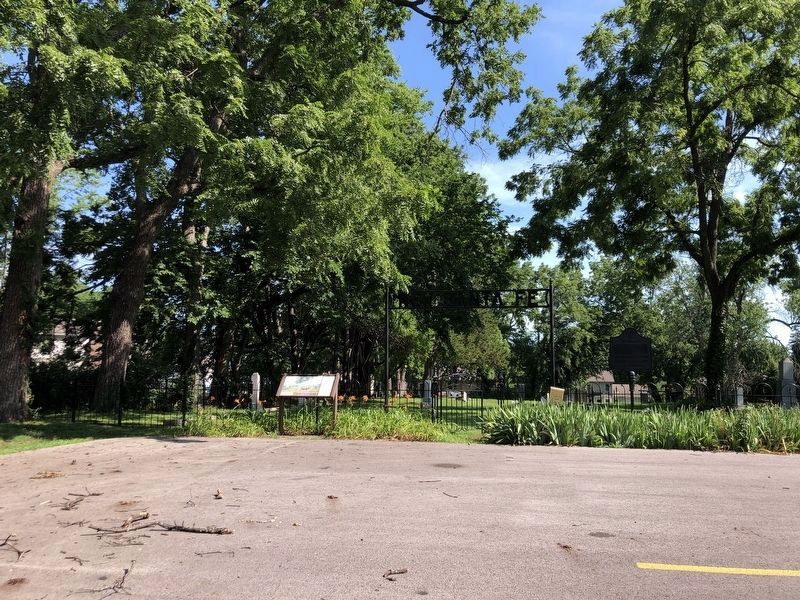
Photographed by Duane and Tracy Marsteller, June 30, 2024
2. Oregon and California National Historical Trails / Santa Fe National Historic Trail Marker
Another marker is no longer nearby. Trail Remnants (was here, next to this marker but has been permanently removed).
Credits. This page was last revised on July 23, 2024. It was originally submitted on September 28, 2022, by Thomas Onions of Olathe, Kansas. This page has been viewed 258 times since then and 22 times this year. Photos: 1. submitted on July 7, 2009, by Thomas Onions of Olathe, Kansas. 2. submitted on July 19, 2024, by Duane and Tracy Marsteller of Murfreesboro, Tennessee. • Devry Becker Jones was the editor who published this page.
