Big Bog State Recreation Area near Waskish in Beltrami County, Minnesota — The American Midwest (Upper Plains)
Where There is Smoke
⎯⎯⎯
Forests of the Agassiz Lowlands
Photographed by McGhiever, August 30, 2021
1. Where There is Smoke marker
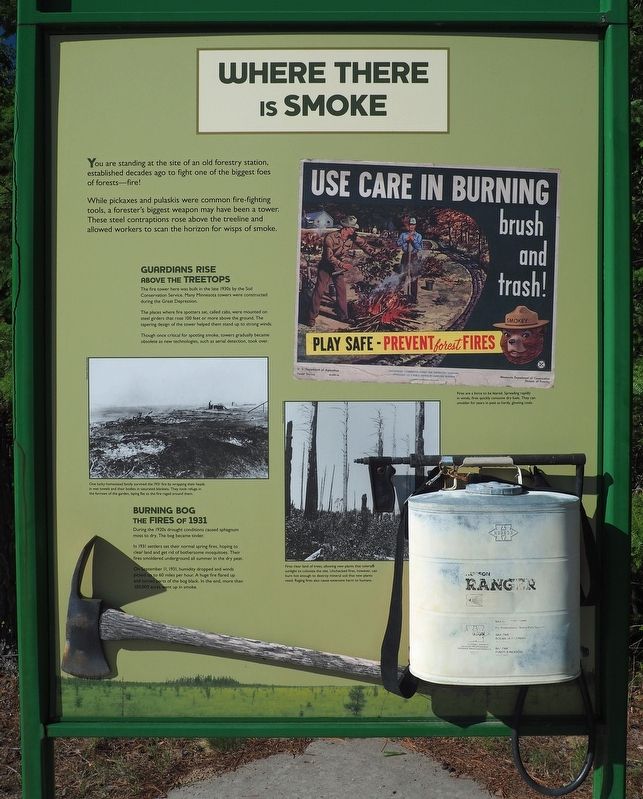
While pickaxes and pulaskis were common fire-fighting tools, a forester's biggest weapon may have been a tower. These steel contraptions rose above the treeline and allowed workers to scan the horizon for wisps of smoke.
Guardians Rise above the Treetops
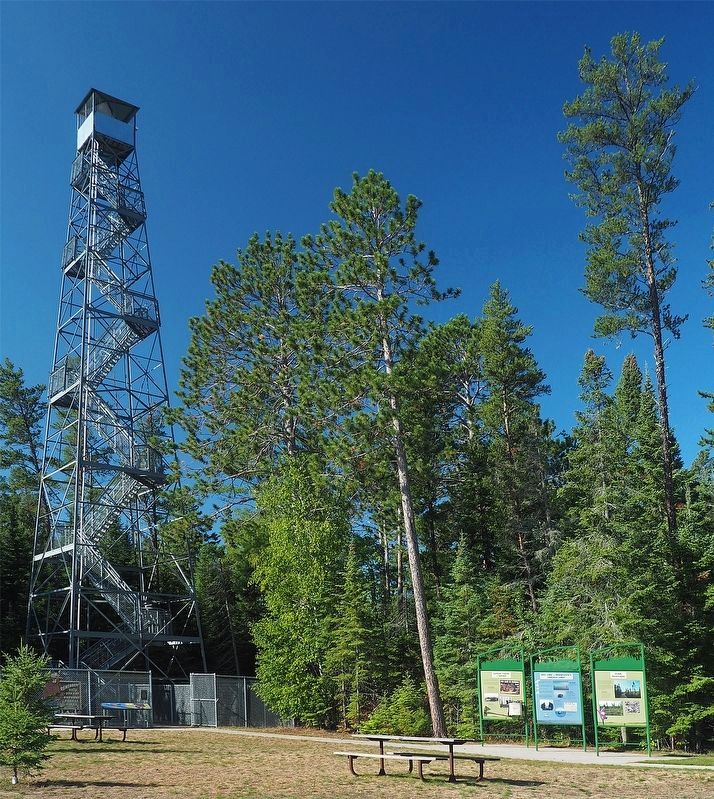
The fire tower here was built in the late 1930s by the Soil Conservation Service. Many Minnesota towers were constructed during the Great Depression.
The places where fire spotters sat, called cabs, were mounted on steel girders that rose 100 feet or more above the ground. The tapering design of the tower helped them stand up to strong winds.
Though once critical for spotting smoke, towers gradually became obsolete as new technologies, such as aerial detection, took over.
Burning Bog
The Fires of 1931
During the 1920s drought conditions caused sphagnum moss to dry. The bog became tinder.
In 1931 settlers set their normal spring fires, hoping to clear land and get rid of bothersome mosquitoes. Their fires smoldered underground
this page online
On September 11, 1931, humidity dropped and winds picked up to 60 miles per hour. A huge fire flared up and turned parts of the bog black. In the end, more than 100,000 acres went up in smoke.
Fires are a force to be feared. Spreading rapidly in winds, fires quickly consume dry fuels. They can smolder for years in peat as hardy, glowing coals.
One lucky homestead family survived the 1931 fire by wrapping their heads in wet towels and their bodies in saturated blankets. They took refuge in the furrows of the garden, laying flat as the fire raged around them.
Fires clear land of trees, allowing new plants that tolerate sunlight to colonize the site. Unchecked fires, however, can burn hot enough to destroy mineral soil that new plants need. Raging fires also cause extensive harm to humans.
[Reverse:] Forests of the Agassiz Lowlands
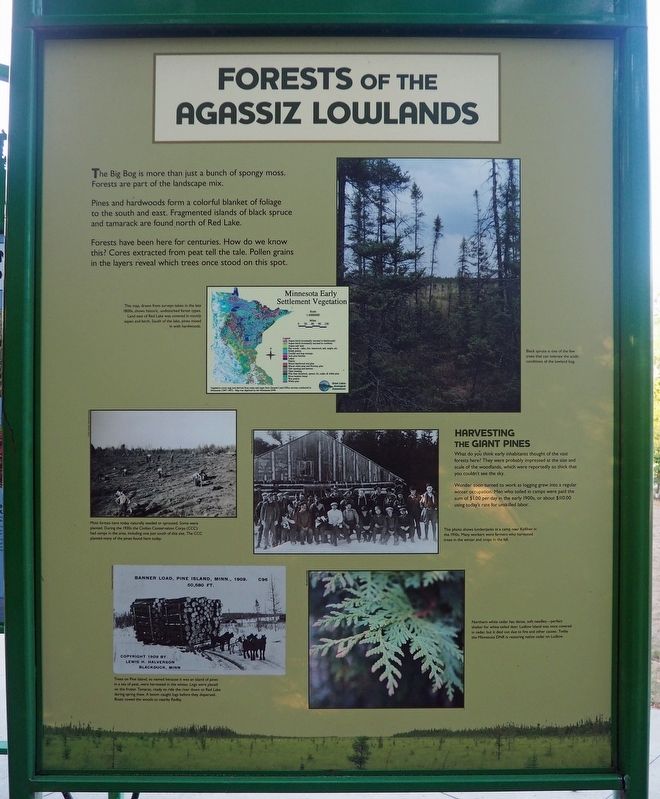
The Big Bog is more than just a bunch of spongy moss. Forests are part of the landscape mix.
Pines and hardwoods form a colorful blanket of foliage to the south and east. Fragmented islands of black spruce and tamarack are found north of Red Lake.
Forests have
Photographed by McGhiever, August 29, 2021
2. Forests of the Agassiz Lowlands marker (reverse)
This map, drawn from surveys taken in the late 1800s, shows historic, undisturbed forest types. Land east of Red Lake was covered in mostly aspen and birch. South of the lake, pines mixed in with hardwoods.
Black spruce is one of the few trees that can tolerate the acidic conditions of the lowland bog.
Harvesting the Giant Pines
What do you think early inhabitants thought of the vast forests here? They were probably impressed at the size and scale of the woodlands, which were reportedly so thick that you couldn't see the sky.
Wonder soon turned to work as logging grew into a regular winter occupation. Men who toiled in camps were paid the sum of $1.00 per day in the early 1900s, or about $110.00 using today's rate for unskilled labor.
Most forests here today naturally seeded or sprouted. Some were planted. During the 1930s the Civilian Conservation Corps (CCC) had camps in the area, including one just south of this site. The CCC planted many of the pines found here today.
Trees on Pine Island, so named because it was an island of pines in a sea of peat, were harvested in the winter. Logs were placed on the frozen Tamarac, ready to ride the river down to Red Lake during spring thaw. A boom caught the logs before they dispersed. Boats towed the woods to nearby Redby.
This photo shows lumberjacks at a camp near Kelliher in the 1910s. Many workers were farmers who harvested trees in the winter and crops in the fall.
Northern white cedar has dense, soft needles—perfect shelter for white-tailed deer. Ludlow Island was once covered in cedar, but it died out due to fire and other causes. Today the Minnesota DNR is restoring native cedar on Ludlow.
Erected by Minnesota
Photographed by McGhiever, August 30, 2021
3. Marker (left) near the fire tower at Big Bog State Recreation Area
Topics. This historical marker is listed in these topic lists: Disasters • Environment • Horticulture & Forestry. A significant historical year for this entry is 1931.
Location. 48° 10.219′ N, 94° 30.712′ W. Marker is near Waskish, Minnesota, in Beltrami County. It is in the Big Bog State Recreation Area. It is at the intersection of Hillman Drive NE (County Highway 9) and Big Bog State Recreation Area entrance road, on the right when traveling south on Hillman Drive NE. The marker is at the south unit of Big Bog State Recreation Area (fee area), in a triptych of markers between the visitor center and the fire tower. Touch for map. Marker is at or near this postal address: 55716 State Highway 72, Waskish MN 56685, United States of America. Touch for directions.

Regionally, this marker is in the Northland. It is also in the American Midwest and in the Corn Belt. Globally, it is in North America, the Great North Woods, the Western Hemisphere, the Western World, and the Anglosphere. Historically, it finds itself in what was once Rupert’s Land, the territory of the Mississippian Culture, the Louisiana Purchase, and the Northwest Territory.
Other nearby markers. At least 8 other markers are within walking distance of this marker: Red Lake is Minnesota's Largest Lake! / Flat Terrain Lets Water Pool (here, next to this marker); Pure Peatland / A Boring Story (here, next to this marker); The Red Lake Walleye Story (about 800 feet away, measured in a direct line); Miskwagami-wizaga-iganing (about 800 feet away); The Marina (approx. 0.2 miles away); Journey along the waters… (approx. 0.3 miles away); Historic Waskish Hatchery 1941–1979 (approx. 0.3 miles away); Harry Davidson (approx. 0.3 miles away). Touch for a list and map of all markers in Waskish.
Credits. This page was last revised on October 8, 2026. It was originally submitted on October 4, 2022, by McGhiever of Minneapolis, Minnesota. This page has been viewed 493 times since then and 46 times this year. Photos: 1, 2, 3. submitted on October 4, 2022, by McGhiever of Minneapolis, Minnesota. • J. Makali Bruton was the editor who published this page.
