Fayetteville in Lincoln County, Tennessee — The American South (East South Central)
Carrying Fire and Sword
Photographed by Darren Jefferson Clay, October 15, 2022
1. Carrying Fire and Sword Marker
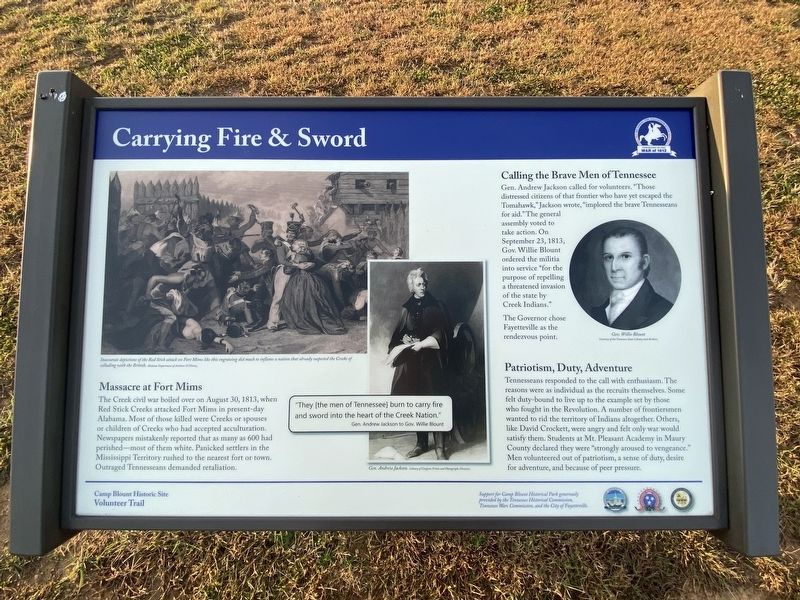
The Creek civil war boiled over on August 30, 1813, when Red Stick Creeks attacked Fort Mims in present-day Alabama. Most of those killed were Creeks or spouses or children of Creeks who had accepted acculturation Newspapers mistakenly reported that as many as 600 had perished-most of them white. Panicked settlers in the Mississippi Territory rushed to the nearest fort or town. Outraged Tennesseans demanded retaliation.
Calling the Brave Men of Tennessee
Gen. Andrew Jackson called for volunteers. "Those distressed citizens of that frontier who have yet escaped the Tomahawk, Jackson wrote, "implored the brave Tennesseans for aid. "The general assembly voted to take action. On September 23, 1813, Gov. Willie Blount ordered the militia into service for the purpose of repelling a threatened invasion of the state by Creek Indians.
The Governor chose Fayetteville as the rendezvous point.
Patriotism, Duty, Adventure
Tennesseans responded to the call with enthusiasm. The reasons were as individual as the recruits themselves. Some felt duty-bound to live up to the example
this page online
Inset text: They (the men of Tennessee) burn to carry fire and sword into the heart of the Creek Nation -Gen Andrew Jackson to Gov. Willie Blount
Topics and series. This historical marker is listed in this topic list: Wars, US Indian. In addition, it is included in the Former U.S. Presidents: #07 Andrew Jackson series list. A significant historical year for this entry is 1813.
Location. 35° 8.449′ N, 86° 33.978′ W. Marker is in Fayetteville, Tennessee, in Lincoln County. It can be reached from U.S. 231. Touch for map. Marker is at or near this postal address: 1371 US-231, Fayetteville TN 37334, United States of America. Touch for directions.

Regionally, this marker is in Middle Tennessee and in the Highland Rim. It is also in
Photographed by Darren Jefferson Clay, October 15, 2022
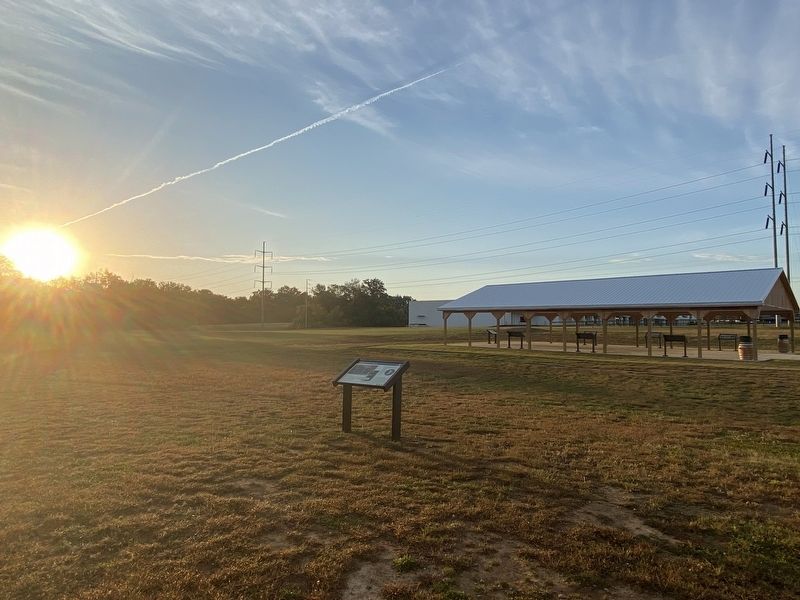
2. Carrying Fire and Sword Marker
Other nearby markers. At least 8 other markers are within walking distance of this marker: About the Sculpture / About the Artist (a few steps from this marker); In the National Spotlight (within shouting distance of this marker); Tennessee Volunteers at Camp Blount (within shouting distance of this marker); Camp Blount & the "Tennessee Volunteers" (within shouting distance of this marker); The War of 1812 (within shouting distance of this marker); Preserving Camp Blount (within shouting distance of this marker); Andrew Jackson (within shouting distance of this marker); President Andrew Jackson (within shouting distance of this marker). Touch for a list and map of all markers in Fayetteville.
Credits. This page was last revised on October 21, 2022. It was originally submitted on October 16, 2022, by Darren Jefferson Clay of Duluth, Georgia. This page has been viewed 296 times since then and 24 times this year. Photos: 1. submitted on October 16, 2022, by Darren Jefferson Clay of Duluth, Georgia. 2. submitted on October 17, 2022, by Darren Jefferson Clay of Duluth, Georgia. • Bill Pfingsten was the editor who published this page.
