Independence in Jackson County, Missouri — The American Midwest (Upper Plains)
An Epicenter of International Commerce
Santa Fe, Oregon and California National Historic Trails

Photographed by Jason Voigt, May 23, 2022
1. An Epicenter of International Commerce Marker
Being at leisure one day, I rode over to Independence [from Westport, in May 1846]. The town was crowded. A multitude of shops had sprang up to furnish the emigrants and Santa Fe traders with necessaries for the journey; and there was an incessant hammering and banging from a dozen blacksmiths' sheds, where the heavy wagons were being repaired, and the horses and oxen shod. The streets were thronged with men, horses, and mules.
-Francis Parkman Jr, 1846
Independence in the 1830s-1840s thrived as a multi-cultural international center for commerce - French Canadians, Europeans, Spanish, Mexicans, Blacks, and American Indians mingled and traded goods on Independence Square.
Local freighters transported European and American-made goods (cotton, glass, iron) through the city from eastern and southern coasts over the Santa Fe Trail to Mexico, and returned with gold, silver, furs, wool, mules, and horses. Independence became known for its wagon factories, blacksmith shops, and yoke and harness making facilities.
Emigrants seeking land in Oregon or gold in California disembarked from steamboats at Wayne City and nearby
this page online
Arriving in early spring, emigrants prepared for the journey of a lifetime. They had filled the hotels and boarded or camped on nearby farms. Now they could depart with their livestock nourished by spring grasses.
(photo captions:)
·The Santa Fe Trail opened trade barriers from Missouri to Mexico, providing economic inroads into America that tendered riches all the way to Europe. Loaded with all of the gods that Independence readily supplied, emigrant wagon trains surged onto the Oregon and California trails - tramping across plains and over the Continental Divide toward the promise of wealth and land.
·The heyday of international commerce lasted until 1850 when trail use began to decline. By 1869 the transcontinental railroad forged the new way westward.
(Highlighted places on map:)
1) Independence Square
Stores, warehouses, hotels, saloons, medical and law offices, and banks surrounded the Jackson County Courthouse, the governmental and administrative seat. Wagons departed with excitement and anticipation.
2) Lewis-Bingham-Waggoner Estate
The
Photographed by Jason Voigt, May 23, 2022
2. An Epicenter of International Commerce Marker
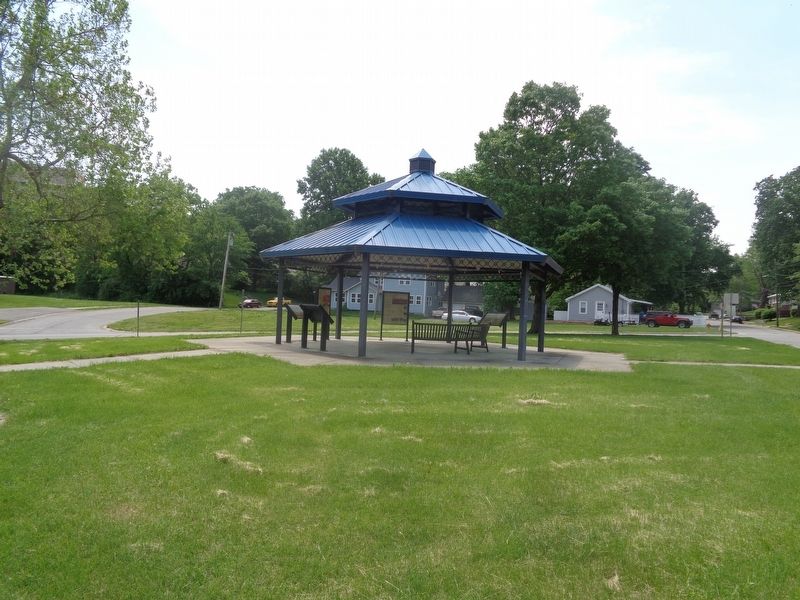
Marker is with four other markers under a shelter at McCoy Park
3) National Frontier Trails Museum
Located on the site of a spring used by traders and emigrants prior to their departure, the museum has exhibits on the Santa Fe, Oregon, California, Mormon Pioneer, and Lewis and Clark national historic trails.
4) Santa Fe Trail Park
Caravans from Independence Square passed through this area, headed in a southwesterly direction. Wagon swales can be seen in the lot just south of the park, and beyond them additional trail swales can be found in the yards of homes.
5) Jim Bridger Memorial
Bridger (1804-1881) was one of the most famous western frontiersmen, explorers, and guides. Originally buried on his farm in present-day south Kansas City, he was reinterred at Mt. Washington Cemetery in 1904.
6) Wayne City Landing Overlook
Goods brought from St. Louis, Philadelphia, New York, and Europe by steamboat were transferred from river to rail and freight wagons to warehouses. Cargo was bound for Santa Fe or sold locally to residents/emigrants.
Erected by McCoy Park, Oregon-California Trails Association, City of Independence and National Park Service.
Topics and series. This historical marker is listed in these topic lists: Industry & Commerce • Roads & Vehicles • Settlements & Settlers. In addition, it is included in the California Trail, the Oregon Trail, and the Santa Fe Trail series lists. A significant historical month for this entry is May 1846.
Location. 39° 5.895′ N, 94° 25.331′ W. Marker is in Independence, Missouri, in Jackson County. It is at the intersection of West College Street and North McCoy Street, on the right when traveling west on West College Street. Marker is located at McCoy Park. Touch for map. Marker is at or near this postal address: 600 W College St, Independence MO 64050, United States of America. Touch for directions.

Regionally, this marker is in Greater Kansas City. It is also in the American Midwest, in the Lewis & Clark Corridor, in the Corn Belt, and on the Santa Fe Trail Corridor. Globally, it is in North America, the Western Hemisphere, the Western World, and the Anglosphere. Historically, it finds itself in what was once the territory of the Mississippian Culture, the Louisiana Purchase, and the Antebellum South.
Other nearby markers. At least 8 other markers are within walking distance of this marker: Trails to the East & West (here, next to this marker); The Railroad Comes to Town! (here, next to this marker); Three Trails From Independence (here, next to this marker); A Man of Means (here, next to this marker); Sawyer-Jennings House (approx. 0.2 miles away); McCoy House (approx. 0.2 miles away); Harry S. Truman Historic District (approx. 0.2 miles away); Noel House (approx. 0.2 miles away). Touch for a list and map of all markers in Independence.
Another marker is no longer nearby. "The Neck" (was approx. 0.2 miles away but has been confirmed missing).
Credits. This page was last revised on October 17, 2022. It was originally submitted on October 17, 2022, by Jason Voigt of Glen Carbon, Illinois. This page has been viewed 280 times since then and 15 times this year. Photos: 1, 2. submitted on October 17, 2022, by Jason Voigt of Glen Carbon, Illinois.
