
Downtown Detroit in Wayne County, Michigan — The American Midwest (Great Lakes)
Germantown
⎯⎯⎯
The Harmonie Club
Photographed by R. C., May 3, 2011
1. Germantown Marker
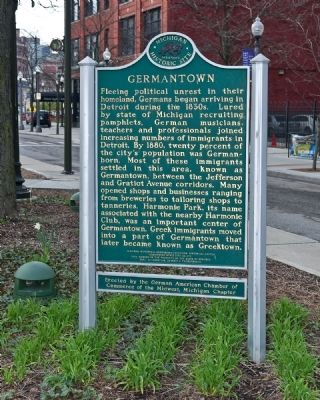
Germantown
Fleeing political unrest in their homeland, Germans began arriving in Detroit during the 1830s. Lured by state of Michigan recruiting pamphlets, German musicians, teachers and professionals joined increasing numbers of immigrants in Detroit. By 1880, twenty percent of the city's population was German-born. Most of these immigrants settled in this area, known as Germantown, between the Jefferson and Gratiot Avenue corridors. Many opened shops and businesses ranging from breweries to tailoring shops to tanneries. Harmonie Park, its name associated with the nearby Harmonie Club, was an important center of Germantown. Greek immigrants moved into a part of Germantown that later became known as Greektown.
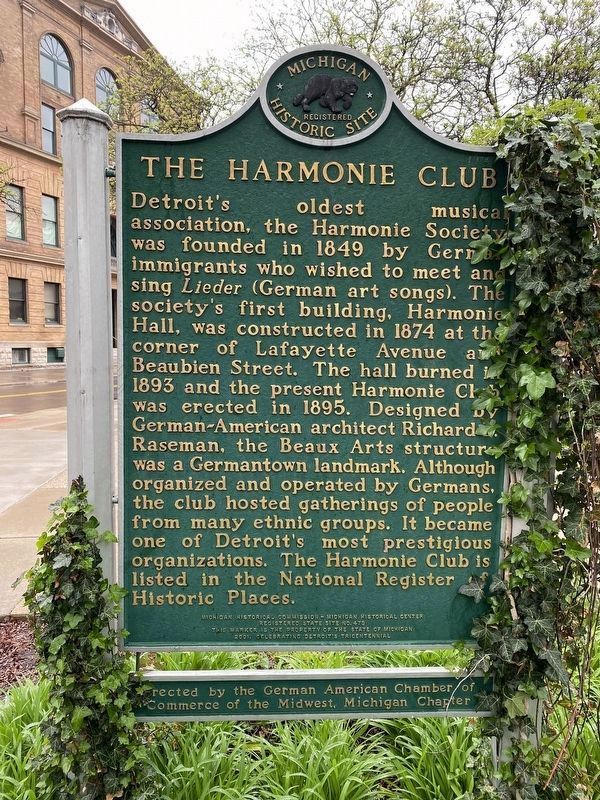
The Harmonie Club
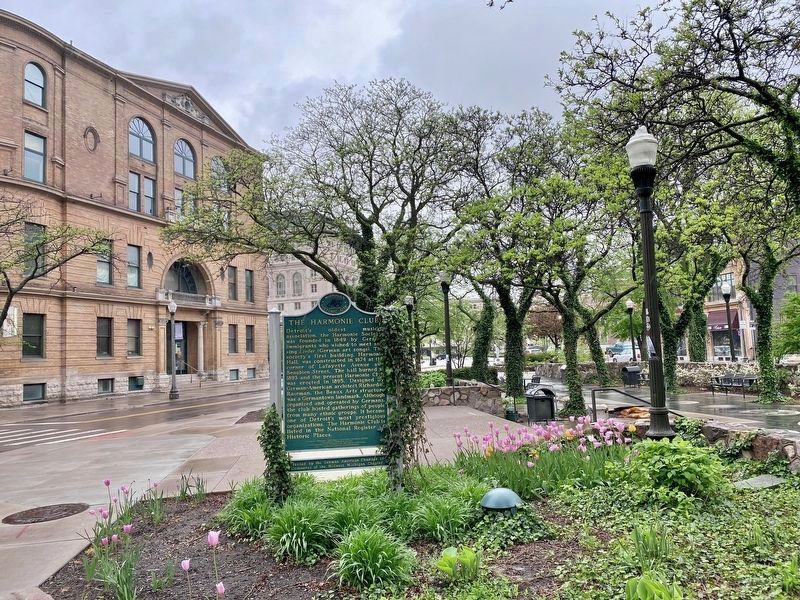
Detroit's oldest musical association, The Harmonie Society, was founded in 1849 by German immigrants who wished to meet and sing Lieder (German art songs). The society's first building, Harmonie Hall, was constructed in 1874 at the corner of Lafayette Avenue abd Beaubien Street. The hall burned in 1893 and the present Harmonie Club was erected in 1895. Designed by German-American architect Richard
this page online
Erected 2001 by German American Chamber of Commerce of the Midwest, Michigan Chapter. (Marker Number S0473.)
Topics and series. This historical marker is listed in these topic lists: Parks & Recreational Areas • Settlements & Settlers. In addition, it is included in the Michigan Historical Commission series list. A significant historical year for this entry is 1880.
Location. 42° 20.166′ N, 83° 2.778′ W. Marker is in Detroit, Michigan, in Wayne County. It is in Downtown Detroit. It is at the intersection of East Grand River Avenue and Centre Street, on the left when traveling south on East Grand River Avenue. Touch for map. Marker is at or near this postal address: 267 E Grand River Ave, Detroit MI 48226, United States of America. Touch for directions.

Regionally, this marker is in Southeast Michigan. It is also in the American
Photographed by J.T. Lambrou
2. The Harmonie Club Marker
Other nearby markers. At least 8 other markers are within walking distance of this marker: Beatrice Buck's Paradise Valley Park (a few steps from this marker); Music Hall (about 400 feet away, measured in a direct line); American Eagle (about 500 feet away); Henry the Hatter (about 500 feet away); L.B. King and Company Building (about 600 feet away); Statue of Abraham Lincoln (about 700 feet away); Parker's Alley (approx. 0.2 miles away); St. Mary's School (approx. 0.2 miles away). Touch for a list and map of all markers in Detroit.
Also see . . . Harmonie Club.
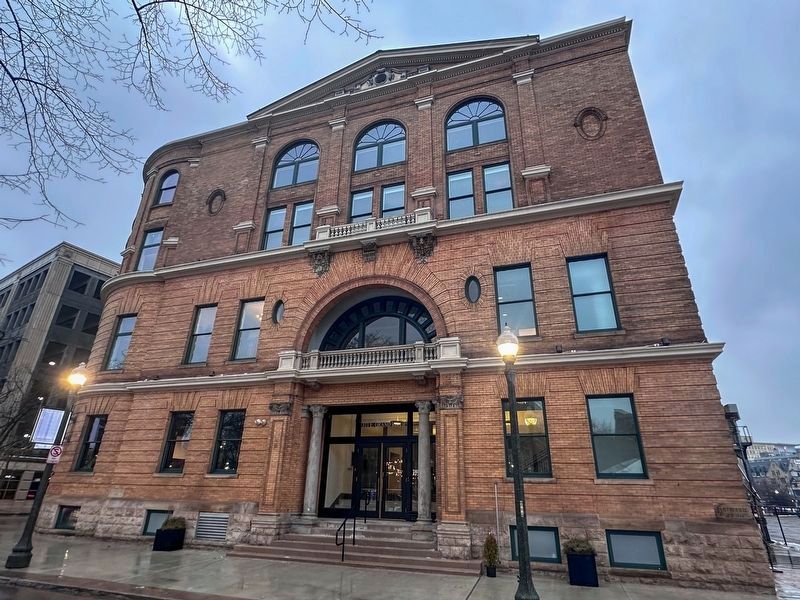
Augustus Woodward's plan for Detroit's streets created uniquely-shaped triangular blocks, including Capitol Park on the west and Harmonie Park on the east.[3] Starting in the 1830s and 1940s, this area was home to a growing number of German immigrants to Detroit. In 1849, to preserve their ethnic traditions,(Submitted on September 1, 2026, by J.T. Lambrou of New Boston, Michigan.)a group of Detroit Germans founded a singing group, the Gesang-Verein Harmonie.[3] The club built a frame clubhouse at the corner of Lafayette and Beaubien in 1874. This frame Harmonie Club structure burned in 1893, and the club almost immediately organized a competition, open to German architects, to design a new building. Richard Raseman (the architect of the Grand Army of the Republic Building) won the competition; the resulting building sits across from Harmonie Park.Photographed by J.T. Lambrou3. Germantown / The Harmonie Club Marker located in Beatrice Buck’s Paradise Valley Park
Additional commentary.
1. National Register of Historic Places
The Harmonie Club was added to the NRHP on September 4, 1980.
— Submitted September 1, 2026, by J.T. Lambrou of New Boston, Michigan.
Photographed by J.T. Lambrou, January 18, 2025
4. Harmonie Club
Credits. This page was last revised on September 4, 2026. It was originally submitted on May 9, 2011, by Ronald Claiborne of College Station, Texas. This page has been viewed 2,973 times since then and 148 times this year. Last updated on October 18, 2022, by Craig Doda of Napoleon, Ohio. Photos: 1. submitted on May 9, 2011, by Ronald Claiborne of College Station, Texas. 2, 3. submitted on May 3, 2021, by J.T. Lambrou of New Boston, Michigan. 4. submitted on September 2, 2026, by J.T. Lambrou of New Boston, Michigan. • J. Makali Bruton was the editor who published this page.
