Naarden in Gooise Meren, North Holland, Netherlands — Northwestern Europe
Het Spaanse Huis
⎯⎯⎯
The Spanish House

Photographed by Andrew Ruppenstein, July 22, 2022
1. Het Spaanse Huis Marker / The Spanish House

The Spanish House takes its name from a gruesome event that took place in 1572 when the building was in use as the town hall. On December 1 of that year about 700 Naarders gathered in or near this building to hear the 'peace conditions of the Spaniards'. It soon became apparent that this was a trap and the defenseless mob was massacred. After the massacre, the city was systematically invaded from four directions at once and set on fire.
this page online
Erected by The ANWB.
Topics. This historical marker is listed in these topic lists: Disasters • Industry & Commerce • Wars, Non-US. A significant historical date for this entry is December 1, 1572.
Location. 52° 17.677′ N, 5° 9.765′ E. Marker is in Naarden, Noord-Holland (North Holland), in Gooise Meren. It is on Turfpoortstraat, on the right when traveling north. Touch for map. Marker is at or near this postal address: Turfpoortstraat 27, Naarden, Noord-Holland 1411 ED, Netherlands. Touch for directions.

Regionally, it is in Europe, the European Union, Atlantic Europe, the Benelux Low Countries, the Schengen Area, Western Europe, and the Western World. Historically, it finds itself in what was once the Holy Roman Empire.
Other nearby markers. At least 8 other markers are within walking distance of this marker: Oude Stadehuis / Old City Hall - Marktstraat 22 Naarden (about 120 meters away, measured in a direct

Photographed by Andrew Ruppenstein, July 22, 2022
2. The Spanish House and Marker
The marker is visible here just to the left of the door. In the building's latest reincarnation, it is used as the Museum of Scales, which according to the sign out front, displays "...an exceptional collection of national and international measuring and weighing instruments, weights and measures."
Also see . . . Massacre of Naarden (Wikipedia).
Excerpt - summary: "The Massacre of Naarden was an episode of mass murder and looting that took place in the Dutch city of Naarden during the Eighty Years' War. The massacre was committed by Spanish soldiers under the command of Fadrique Álvarez de Toledo against the townspeople of Naarden as part of a punitive expedition against Dutch rebels later known as the Spanish Fury. The destruction of the city galvanized the Dutch rebels, leading them to continue the Dutch War of Independence against Spain."(Submitted on October 20, 2022.)
And on the massacre itself: "...It was agreed with Julián Romero that Naardenwould open its gates to a small garrison force, surrender supplies to the Spanish, and that every citizen of the city would swear a new oath to the King of Spain. Instead, the Spanish army arrived in its entirety and entered the city on 22 November, taking up positions in the town square. The people of Naarden were forcefully assembled, then led into the town's church and guildhall. The Spanish army then set fire to the buildings and began to sack the town. Several hundred townspeople burned to death, while hundreds more were killed in the square or in their homes. Around 60 of Naarden's over 3000 inhabitants survived the massacre, with de Toledo stating in a report to King Phillip that "Not a man borne escaped" Naarden. Several days later, the Spanish army conscripted peasants from nearby Gooiland to demolish the remaining buildings in the ruined town."Photographed by Andrew Ruppenstein, July 22, 20223. "Praise the Lord" plaqueThe is the leftmost of the 3 plaques on the building, seen just below the roofline. Dated 1615, the year the building was restored, it notes that "You alone, O Lord, get the honor..." for this building, from the city itself and the House of Nassau.


Photographed by Andrew Ruppenstein, July 22, 2022
4. Massacre Plaque
This is the middle of the three plaques mounted below the eaves on the building, depicting the Spaniards murdering the people of Naarden on December 1, 1572. (Note the Wikipedia article (linked) gives an earlier date for the massacre than reported on the marker).
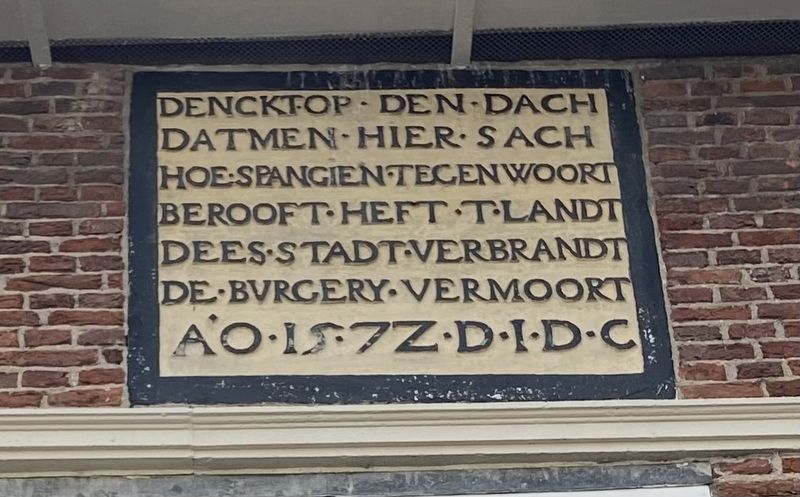
Photographed by Andrew Ruppenstein, July 22, 2022
5. Massacre of Naarden memorial plaque
The rightmost of the three plaques beneath the roofline, this one reminds the reader to remember the massacre of 1572.

Photographed by R.G. Steenbergen, Naarden, circa 1929
6. Spaansche Huis Naarden
Credits. This page was last revised on December 31, 2023. It was originally submitted on October 20, 2022, by Andrew Ruppenstein of Lamorinda, California. This page has been viewed 367 times since then and 43 times this year. Photos: 1, 2, 3, 4, 5, 6. submitted on October 20, 2022, by Andrew Ruppenstein of Lamorinda, California.
