Near Perryville in Perry County, Missouri — The American Midwest (Upper Plains)
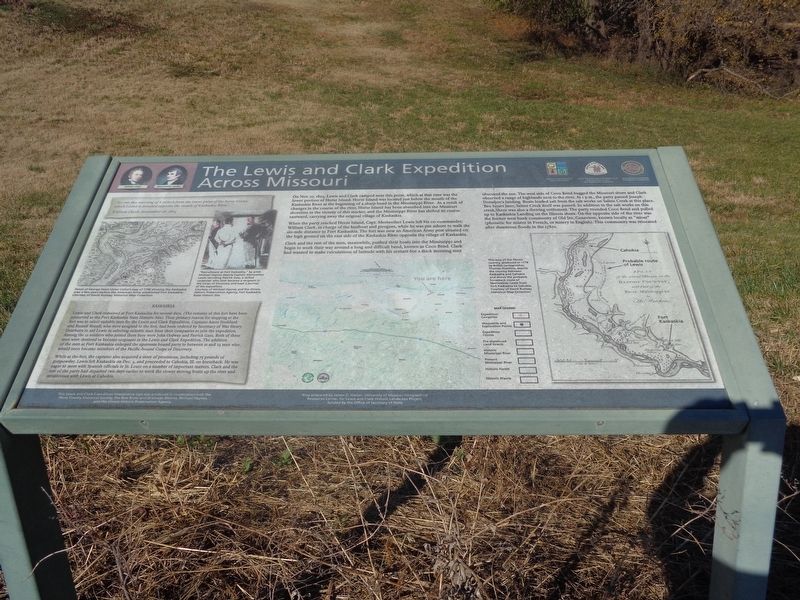
The Lewis and Clark Expedition Across Missouri
Photographed by Jason Voigt, October 26, 2022
1. The Lewis and Clark Expedition Across Missouri Marker
"Set out this morning of 8 oClock from the lower point of the horse Island, which Island is Situated opposite the mouth of Kaskaskia River…"
William Clark, November 28, 1803
On Nov. 27, 1803, Lewis and Clark camped near this point, which at that time was the lower portion of Horse Island. Horse Island was located just below the mouth of the Kaskaskia River at the beginning of a sharp bend in the Mississippi River. As a result of changes in the course of the river, Horse Island has been absorbed into the Missouri shoreline in the vicinity of this marker, and the Mississippi River has shifted its course eastward, carrying away the original village of Kaskaskia.
When the party reached Horse Island, Capt. Meriwether Lewis left his co-commander, William Clark, in charge of the keelboat and pirogues, while he was put ashore to walk the six-mile distance to Fort Kaskaskia. The fort was now an American Army post situated on the high ground on the east side of the Kaskaskia River opposite the village of Kaskaskia.
Clark and the rest of the men, meanwhile, pushed their boats into the Mississippi and begin to work their
this page online
Kaskaskia
Lewis and Clark remained at Fort Kaskaskia for several days. (The remains of this fort have been preserved as the Fort Kaskaskia State Historic Site). Their primary reason for stopping at the fort was to select suitable men for the Lewis and Clark Expedition. Captains
Photographed by Jason Voigt, October 26, 2022
2. The Lewis and Clark Expedition Across Missouri Marker
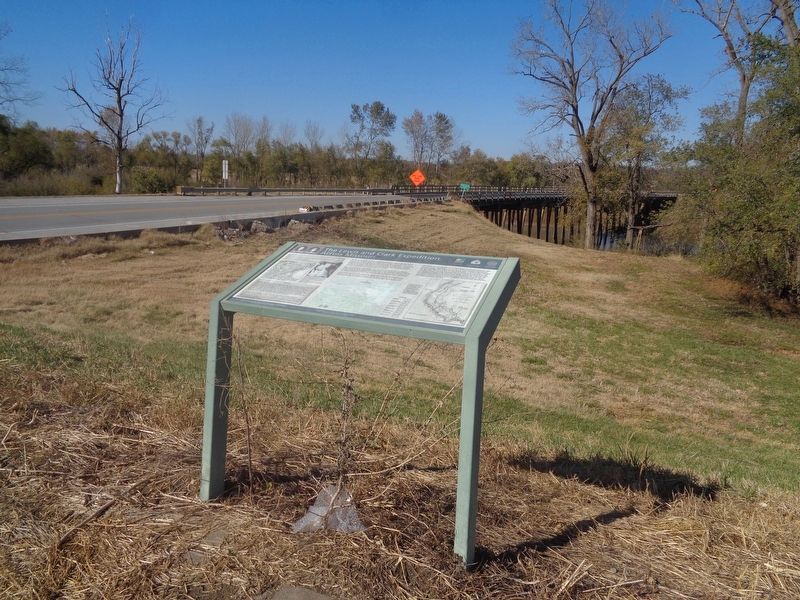
Marker is near the Horse Island Chute Bridge, looking north
While at the fort, the captains also acquired a store of provisions, including 75 pounds of gunpowder. Lewis left Kaskaskia on Dec. 5, and proceeded to Cahokia, Ill. on horseback. He was eager to meet with Spanish officials in St. Louis on a number of important matters. Clark and the rest of the party had departed two days earlier to work the slower moving boats up the river and rendezvous with Lewis at Cahokia.
(photo captions:)
·Detail of George Henri Victor Collot's map of 1796 showing the Kaskaskia area a few years before the American Army established Fort Kaskaskia.
·"Recruitment at Fort
Photographed by Jason Voigt, October 26, 2022
3. The Lewis and Clark Expedition Across Missouri Marker
·This map of the Illinois country, produced in 1778 by British cartographer, Thomas Hutchins, depicts the country between Kaskaskia and Cahokia and shows the probable horseback route of Meriwether Lewis from Fort Kaskaskia to Cahokia.
Erected by Perry County Historical Society, Missouri Department of Natural Resources, National Park Service, U.S. Department of Interior and Missouri Lewis and Clark Bicentennial Commission.
Topics and series. This historical marker is listed in these topic lists: Exploration • Settlements & Settlers • Waterways & Vessels. In addition, it is included in the Lewis & Clark Expedition series list. A significant historical date for this entry is November 28, 1803.
Location. 37° 53.71′ N, 89° 50.537′ W. Marker is near Perryville, Missouri, in Perry County. It is at the intersection of State Highway 51 and County Highway 238, on the right when traveling north on State Highway 51. Touch for map. Marker is at or near this postal address: 174 MO-51, Perryville MO 63775, United States of America. Touch for directions.

Regionally, this marker is in Southeast Missouri. It is also in the American Lewis & Clark Corridor, in the Corn Belt, and in the Great River Road Region. Globally, it is in North America, the Western Hemisphere, the Western World, and the Anglosphere. Historically, it finds itself in what was once the Viceroyalty of New France, the territory of the Mississippian Culture, the Louisiana Purchase, and the Antebellum South.
Other nearby markers. At least 8 other markers are within walking distance of this marker: Flood of 1993 (approx. 0.8 miles away in Illinois); The Chester Bridge (approx. 0.8 miles away in Illinois); Toar (approx. 0.8 miles away in Illinois); The Railroad (approx. 0.8 miles away in Illinois); Lewis and Clark in Illinois (approx. 0.8 miles away in Illinois); Chester, Randolph County, Illinois (approx. 0.8 miles away in Illinois); Port of Chester, Illinois Welcoming Mississippi River Travelers since 1829 (approx. 0.8 miles away in Illinois); The River Boats (approx. 0.8 miles away in Illinois).
Credits. This page was last revised on November 9, 2025. It was originally submitted on October 26, 2022, by Jason Voigt of Glen Carbon, Illinois. This page has been viewed 440 times since then and 39 times this year. Photos: 1, 2, 3. submitted on October 26, 2022, by Jason Voigt of Glen Carbon, Illinois.
