Balboa Park in San Diego in San Diego County, California — The American West (Pacific Coastal)
Cabrillo Bridge
October 29, 2022
1. Cabrillo Bridge Marker
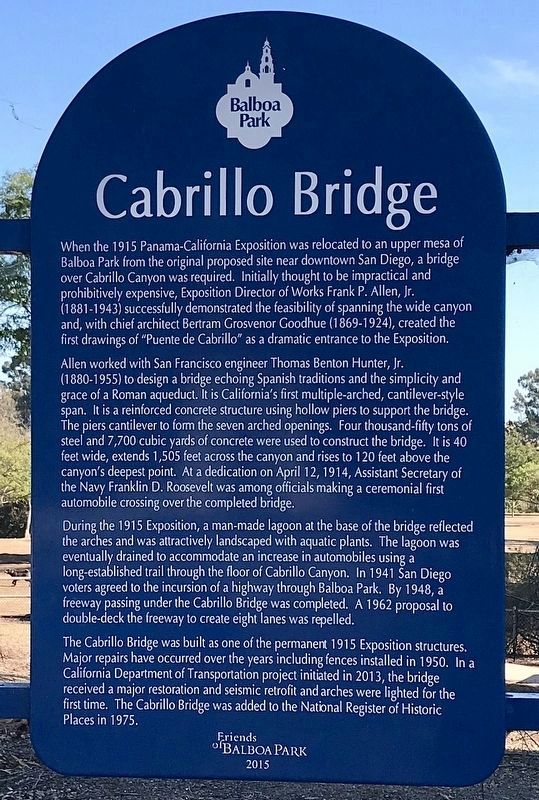
When the 1915 Panama-California Exposition was related to an upper mesa of Balboa Park from the original proposed site near downtown San Diego, a bridge over Cabrillo Canyon was required. Director of Works Frank P. Allen, Jr. (1831-1943) successfully demonstrated the feasibility of spanning the wide canyon and, with chief architect Beatram Grosvenor Goodhue (1869-1924), created the first drawings of "Puerte de Cabrillo" as a dramatic entrance to the Exposition.
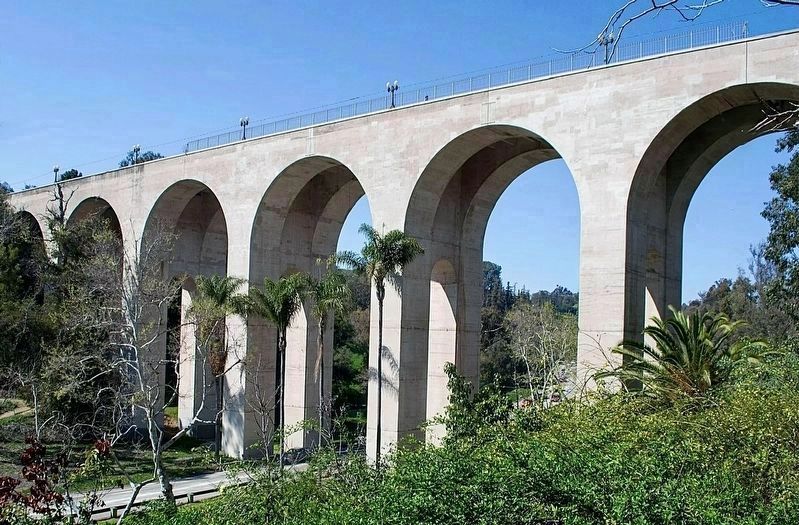
Allen worked with San Francisco engineer Thomas Benton Hunter, Jr. (1880-1955) to design a bridge echoing Spanish traditions and the simplicity and grace of a Roman Aqueduct. It is California's first multiple-arched, cantilever-style span. It is a reinforced concrete structure using hollow piers to support the bridge. The piers cantilever to form the seven arched openings. Four thousand-fifty tons of the steel and 7,700 cubic yards of concrete were used to construct the bridge. It is 40 feet wide, extends 1,505 feet across the canyon and rises 120 feet above the canyon's deepest point. At a dedication on April 12, 1914, Assistant Secretary of the Navy Franklin D. Roosevelt was among officials making a ceremonial first automobile crossing over the completed bridge.
During the 1915 Exposition, a man-made lagoon at the base of the bridge reflected the arches and was attractively landscaped with aquatic plants. The lagoon was eventually drained to accommodate an increase in automobiles using long-established trail through the floor of Cabrillo Canyon. in 1941 San Diego voters agreed to the incursion of a highway through Balboa Park. By 1948, a freeway passing under the Cabrillo Bridge was completed. A 1962 proposal to double deck the freeway to create eight lanes was repealed.
The Cabrillo bridge was built as one of the permanent 1915 Exposition
this page online
Erected 2015 by Friends of Balboa Park.
Topics and series. This historical marker is listed in these topic lists: Bridges & Viaducts • Parks & Recreational Areas • Roads & Vehicles. In addition, it is included in the ASCE Civil Engineering Landmarks series list. A significant historical date for this entry is April 12, 1914.
Location. 32° 43.878′ N, 117° 9.451′ W. Marker is in San Diego, California, in San Diego County. It is in Balboa Park. It is on El Prado east of Balboa Drive, on the right when traveling east. Touch for map. Marker is in this post office area: San Diego CA 92101, United States of America. Touch for directions.

Regionally, this marker is in the Peninsular Ranges. It is also in the American Borderlands and on the Pacific Coast. Globally, it is in North America, on the
Photographed by Adam Margolis, October 29, 2022
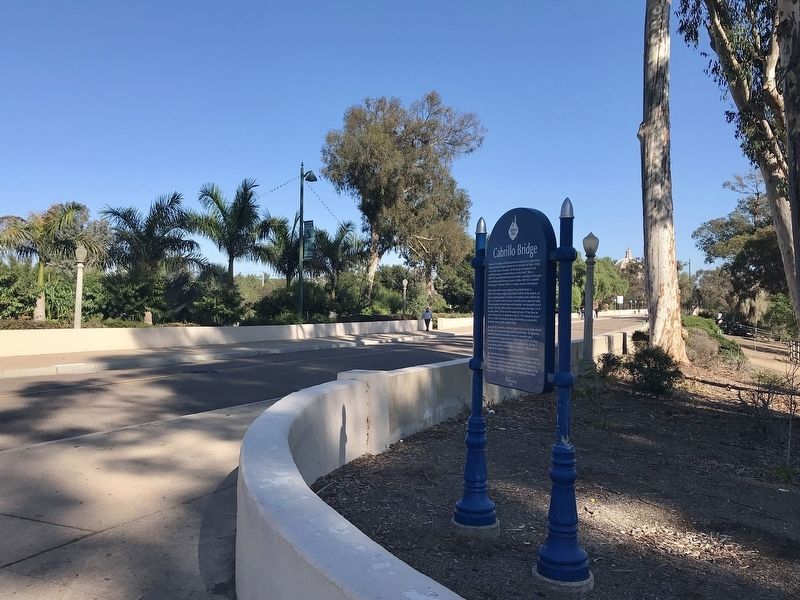
2. Cabrillo Bridge Marker
Other nearby markers. At least 8 other markers are within walking distance of this marker: Balboa Park West Mesa (within shouting distance of this marker); Administration Building (approx. ¼ mile away); The Discovery of California (approx. 0.3 miles away); David Charles Collier (approx. 0.3 miles away); The Balboa Park Club (approx. 0.3 miles away); California Quadrangle (approx. 0.3 miles away); Craig Noel (approx. 0.3 miles away); The Old Globe (approx. 0.3 miles away). Touch for a list and map of all markers in San Diego.
Photographed by Craig Baker
3. Cabrillo Bridge
Photographed by Craig Baker
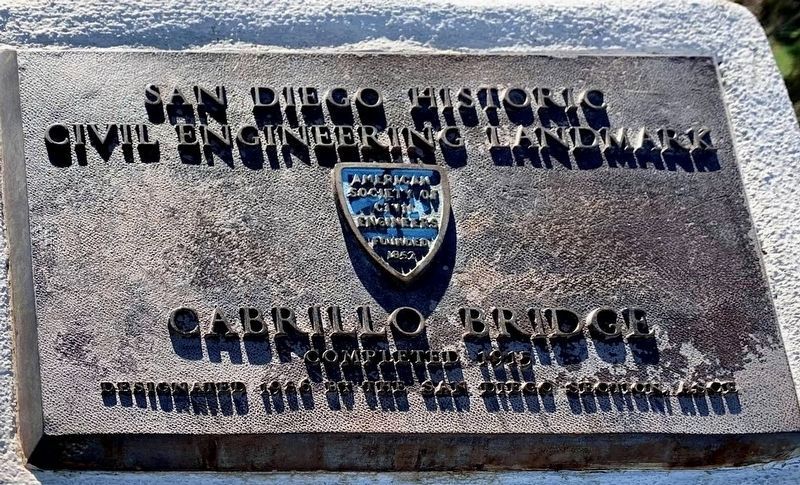
4. ASCE Civil Engineering Landmark
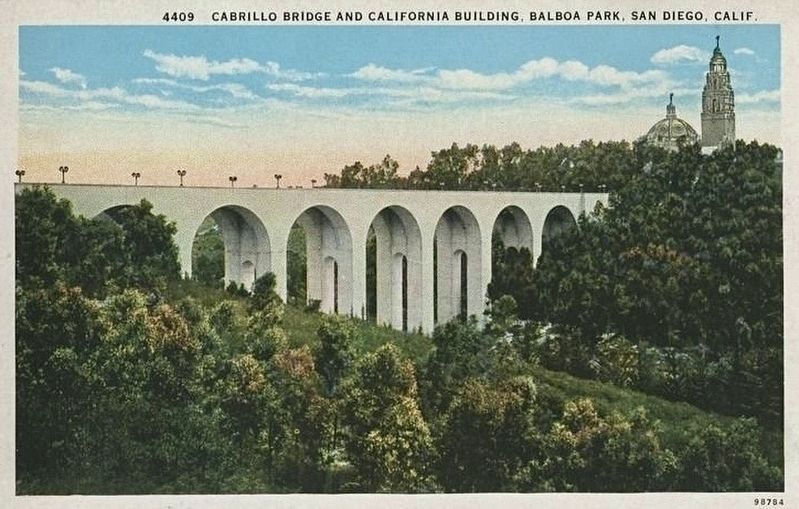
by Western Publishing and Novelty Company (courtesy of UC San Diego), circa 1925
5. Cabrillo Bridge and California Building, Balboa Park
Credits. This page was last revised on May 5, 2026. It was originally submitted on November 3, 2022, by Adam Margolis of Mission Viejo, California. This page has been viewed 718 times since then and 116 times this year. Photos: 1. submitted on March 26, 2026, by Craig Baker of Sylmar, California. 2. submitted on November 3, 2022, by Adam Margolis of Mission Viejo, California. 3, 4. submitted on March 26, 2026, by Craig Baker of Sylmar, California. 5. submitted on November 5, 2022. • Andrew Ruppenstein was the editor who published this page.
