Christiansburg in Montgomery County, Virginia — The American South (Mid-Atlantic)
Slavery
African Americans in Montgomery County
Photographed by Duane and Tracy Marsteller, October 22, 2022
1. Slavery Marker
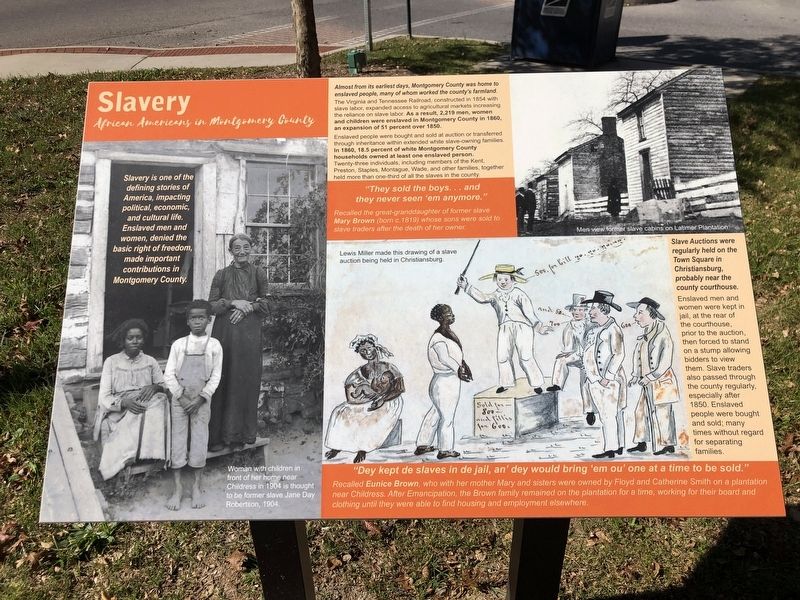
Slavery is one of the defining stories of America, impacting political, economic, and cultural life. Enslaved men and women, denied the basic right of freedom, made important contributions in Montgomery County.
Almost from its earliest days, Montgomery County was home to enslaved people, many of whom worked the county's farmland. The Virginia and Tennessee Railroad, constructed in 1854 with slave labor, expanded access to agricultural markets increasing the reliance on stave labor. As a result, 2,219 men, women and children were enslaved in Montgomery County in 1860, an expansion of 51 percent over 1850.
Enslaved people were bought and sold at auction or transferred through inheritance within extended while slave-owning families. In 1860, 18.5 percent of white Montgomery County households owned at least one enslaved person. Twenty-three individuals, including members of the Kent, Preston, Staples, Montague, Wade, and other families, together held more than one-third of all the slaves in the county.
“They sold the boys … and they never seen 'em anymore.” –Recalled the great-granddaughter of former slave Mary Brown (bornc. 1819) whose sons were sold to slave traders after the death of her owner.
Click or scan to see
this page online
Slave auctions were regularly held on the Town Square in Christiansburg, probably near the county courthouse. Enslaved men and women were kept in jail, at the rear of the courthouse, prior to the auction, then forced to stand on a stump allowing bidders to view them. Slave traders also passed through the county regularly, especially after 1850. Enslaved people were bought and sold, many times without regard for separating families.
“Dey kept de slaves in de jail, an' dey would bring 'em ou' one at a time to be sold.” – Recalled Eunice Brown, who with her mother Mary and sisters were owned by Floyd and Catherine Smith on a plantation near Childress. After Emancipation, the Brown family remained on the plantation for a time, working for their board and clothing until they were able to find housing and employment elsewhere.
Captions (left to right)
• Woman with children in front of her home near Childress in 1904 is thought to be former slave Jane Day Robertson, 1904.
• Lewis Miler made this drawing of a slave auction being held in Christiansburg.
• Men
Photographed by Duane and Tracy Marsteller, October 22, 2022
2. Slavery Marker
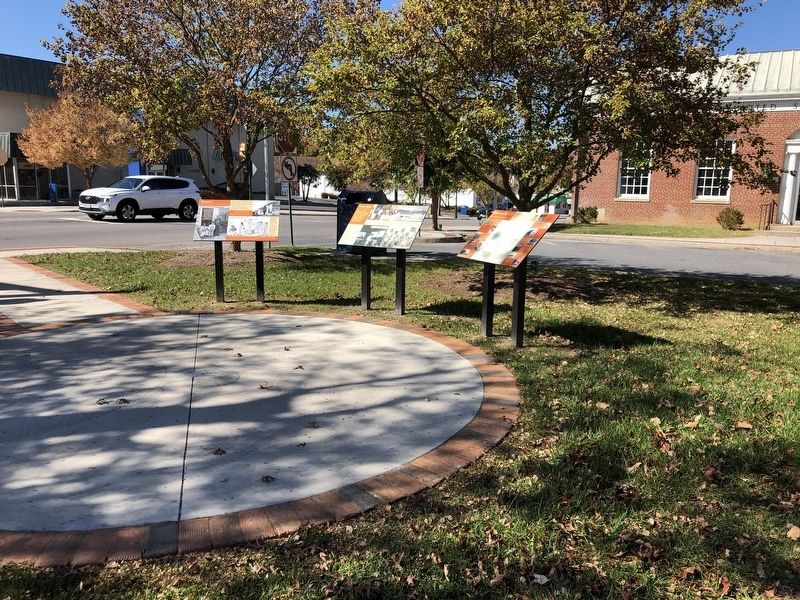
Featured marker is on the left.
Erected by Christiansburg Institute Inc. • Montgomery Museum of Art & History.
Topics. This historical marker is listed in these topic lists: African Americans • Civil Rights. A significant historical year for this entry is 1854.
Location. 37° 7.806′ N, 80° 24.532′ W. Marker is in Christiansburg, Virginia, in Montgomery County. It is at the intersection of East Main Street (U.S. 11) and North Franklin Street, on the right when traveling west on East Main Street. Touch for map. Marker is at or near this postal address: 4 E Main St, Christiansburg VA 24073, United States of America. Touch for directions.

Regionally, this marker is in Southwest Virginia, in the Blue Ridge Highlands, and in the New River Gorge. It is also in the American South, specifically in the Upper South, in Appalachia, and specifically in Southern Appalachia. Globally, it is in North America, the Western Hemisphere, the Western World, and the Anglosphere. Historically, it finds itself in what was once the territory of the Mississippian Culture, one of the original Thirteen Colonies, one of the Confederate States of America, and the Antebellum South.
Other nearby markers. At least 8 other markers are within walking distance of this marker: Education (here, next to this marker); Community Life (here, next to this marker); Montgomery County Confederate Monument (a few steps from this marker); Confederate Christiansburg (a few steps from this marker); Montgomery County Bicentennial (within shouting distance of this marker); Lewis-McHenry Duel (within shouting distance of this marker); Veterans' Monument Park (within shouting distance of this marker); Montgomery County War Memorial (within shouting distance of this marker). Touch for a list and map of all markers in Christiansburg.
More about this marker. It is part of the African American Memory & Storyboard Project, designed to memorialize the history of African Americans in Montgomery County. It and two other markers were placed near a prominent Confederate memorial to provide historical context.
Credits. This page was last revised on April 30, 2026. It was originally submitted on November 3, 2022, by Duane and Tracy Marsteller of Murfreesboro, Tennessee. This page has been viewed 1,017 times since then and 52 times this year. Photos: 1, 2. submitted on November 3, 2022, by Duane and Tracy Marsteller of Murfreesboro, Tennessee.
