
Hell's Kitchen in Manhattan in New York County, New York — The American Northeast (Mid-Atlantic)
Rolls-Royce
⎯⎯⎯
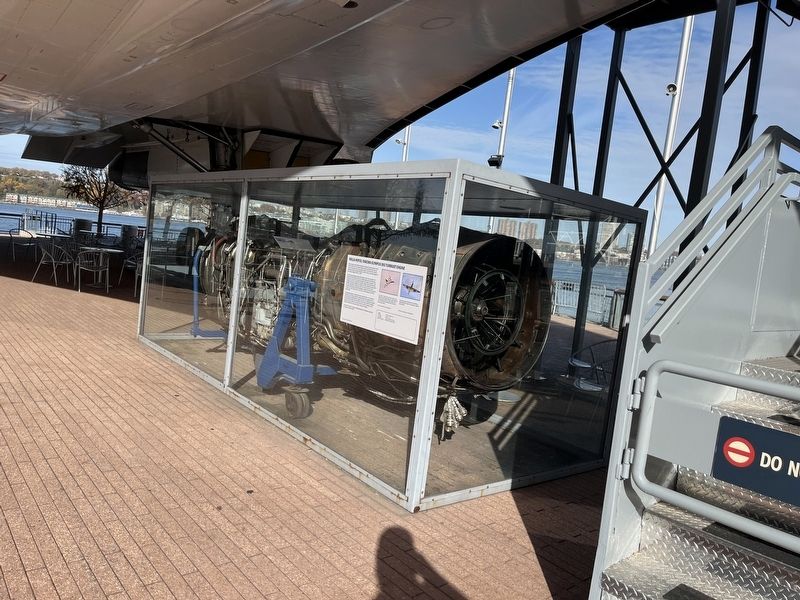
Snecma Olympus 593 Turboject Engine

Photographed by Devry Becker Jones (CC0), November 5, 2022
1. Rolls-Royce / Snecma Olympus 593 Turboject Engine Marker
British inventor Frank Whittle pioneered the design of jet engines before World War II (1939-1945). The famed English company Rolls-Royce built upon his work and created a series of successful engines. The first aircraft to use the Rolls-Royce Olympus turbojet engine was the Avro Vulcan, the United Kingdom's long-range strategic bomber, in 1956.
Concord used upgraded Olympus 593 engines, which were equipped with afterburners. Most commonly found on military fighter jets, the afterburners injected raw fuel into the jet exhaust and gave the engines more power. They enabled Concorde to accelerate to supersonic speeds. With the afterburners engaged, Concorde's engine had a maximum thrust of 38,050 pounds (169.3 kN) and consumed 6,770 gallons (25,627 liters) of fuel per hour. Once it achieved cruise altitude Concorde maintained a speed of two times the speed of sound, or 13,50 miles per hour (2,170 kph), without using the fuel-thirsty afterburners.
All jet engines operate in relatively the same way: they take in air, compress it and eject it out the back to propel the airplane forward. Jet engines can only take in air that is traveling below the speed of sound. Air entering the jet engines at Concorde's top speed—twice the speed of sound—would render the engines useless. A series of deflector ramps and doors on
this page online
Just one of Concorde's Olympus engines generated the horsepower equivalent to 10,000 small automobiles.
Length: 13 feet 3 inches (4 m)
Diameter: 4 feet (1.2 m)
Dry weight: 7,000 pounds (3,175 kg)
Maximum thrust: 38,050 pounds (169.3 kN)
[Captions:]
From 1956 to 1984, the Avro Vulcan served as the backbone of the United Kingdom's nuclear deterrent force during the Cold War. A radical design at the time, the aircraft was powered by early versions of the Olympus engine.
Concorde required afterburners to accelerate to takeoff speed and push it into supersonic flight at high altitudes.
Erected by Intrepid Sea, Air & Space Museum.
Topics. This historical marker is listed in these topic lists: Air & Space • Industry & Commerce • War, Cold. A significant historical year for this entry is 1956.
Location. 40° 45.934′ N, 74° 0.108′ W. Marker is in Manhattan, New York, in New York County. It is in Hell's Kitchen. It can be reached from the intersection of 12th Avenue and West 46th Street, on the right when traveling south. Touch for map. Marker is at or near this postal address: 1 12th Ave, New York NY 10019, United States of America. Touch for directions.

Regionally, this marker is in New York City. It is also in the American Northeast and in the Mid-Atlantic. Globally, it is in the North Atlantic Region, North America, the Western Hemisphere, the Western World, and the Anglosphere. Historically, it finds itself in what was once New Netherland and also one of the original Thirteen Colonies.
Other nearby markers.
Photographed by Devry Becker Jones (CC0), November 5, 2022
2. Rolls-Royce / Snecma Olympus 593 Turboject Engine Marker
Credits. This page was last revised on January 31, 2023. It was originally submitted on November 7, 2022, by Devry Becker Jones of Washington, District of Columbia. This page has been viewed 1,046 times since then and 73 times this year. Photos: 1, 2. submitted on November 7, 2022, by Devry Becker Jones of Washington, District of Columbia.
