Abingdon in Washington County, Virginia — The American South (Mid-Atlantic)
Liberty-Peace Tree
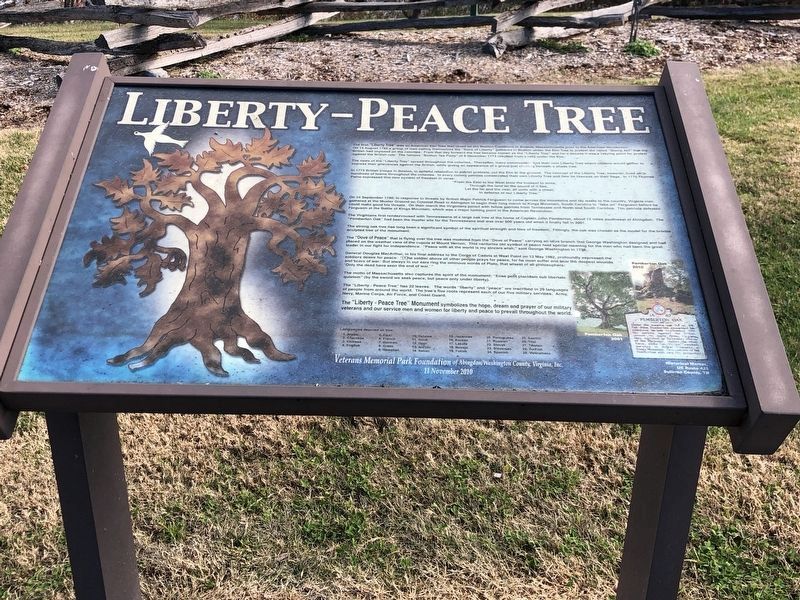
Photographed by Duane and Tracy Marsteller, October 23, 2022
1. Liberty-Peace Tree Marker
The news of the “Liberty Tree” spread throughout the colonies. Thereafter, many communities had their own Liberty Tree where citizens would gather to express their grievances against the British, while giving an appearance of a group just chatting beneath a shade tree.
In 1775 British troops in Boston, in spiteful retaliation to patriot protests, cut the elm to the ground. The concept of the Liberty Tree, however, lived on in hundreds of towns throughout the colonies. In every colony patriots consecrated their own Liberty Tree and flew its likeness on their flags.
this page online
“From the East to the West blow the trumpet to arms,
Through the land let the sound of it flee,
Let the far and the near, all unite with a cheer,
In defense of our Liberty Tree.”
The Virginians first rendezvoused with Tennesseans at a large oak tree at the home of Captain John Pemberton, about 12 miles southwest of Abingdon. The “Pemberton Oak” had been the muster site for the Tennesseans and was over 600 years old when it finally fell in 2001.
The strong oak tree has long been a significant symbol of the spiritual
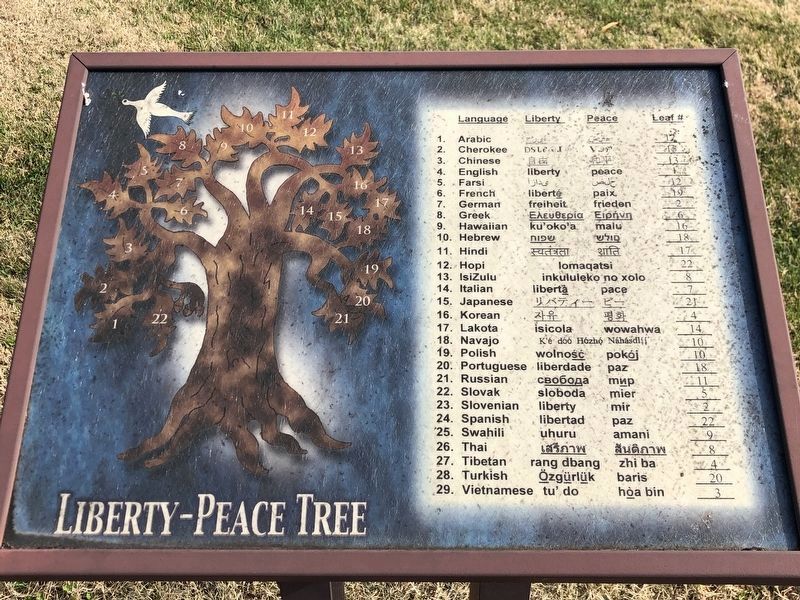
Photographed by Duane and Tracy Marsteller, October 23, 2022
2. Liberty-Peace Tree map
It translates 'liberty' and 'peace' in the 29 languages depicted on the sculpture.
The “Dove of Peace” that is flying over the tree was modeled from the “Dove of Peace” carrying an olive branch that George Washington designed and had placed on the weather vane of the cupola at Mount Vernon. This centuries old symbol of peace held special meaning for the man who had been the great leader in our fight for independence. “Peace with all the world is my sincere wish,” said George Washington in 1798.
General Douglas MacArthur, in his final address to the Corps of Cadets at West Point on 12 May 1962, profoundly expressed the soldiers desire for peace: “The soldier above all other people prays for peace, for he must suffer and bear the deepest wounds and scars of war. But always in our ears ring the ominous words of Plato, that wisest of all philosophers: 'Only the dead have seen the end of war.’”
The motto of Massachusetts also captures the spirit of the monument: “Ense petit placidam sub libertate quietem” (by the sword we seek peace, but peace only under liberty).
The “Liberty - Peace Tree” has 22
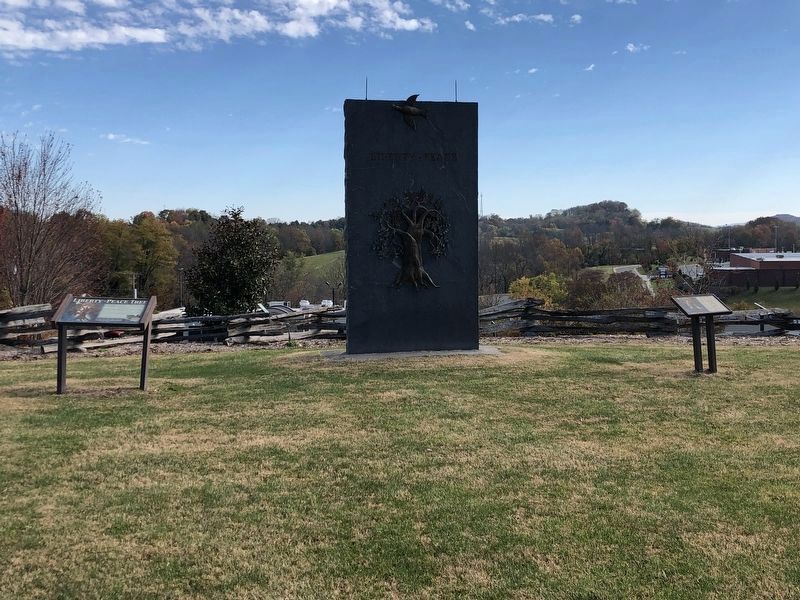
Photographed by Duane and Tracy Marsteller, October 23, 2022
3. Liberty-Peace Tree Markers
The “Liberty-Peace Tree” Monument symbolizes the hope, dream and prayer of our military veterans and our service men and women for liberty and peace to prevail throughout the world.
Languages depicted on tree:
1. Arabic • 2. Cherokee • 3. Chinese • 4. English • 5. Farsi • 6. French • 7. German • 8. Greek • 9. Hawaiian • 10. Hebrew • 11. Hindi • 12. Hopi • 13. IsiZulu • 14. Italian • 15. Japanese • 16. Korean • 17. Lakota • 18. Navajo • 19. Polish • 20. Portuguese • 21. Russian • 22. Slovak • 23. Slovenian • 24. Spanish • 25. Swahili • 26. Thai • 27. Tibetan • 28. Turkish • 29. Vietnamese
Captions
• Pemberton Oak 2001
• Pemberton Oak 2010
• Historical marker, US Route 421, Sullivan County TN
Erected by Veterans Park Memorial Foundation.
Topics and series. This historical marker is listed in these topic lists: Arts, Letters, Music • Colonial Era • War, US Revolutionary. In addition, it is included in the Historic Trees series list. A significant historical date for this entry is August 14, 1765.
Location. 36° 42.254′ N, 81° 58.505′ W. Marker is in Abingdon, Virginia, in Washington County. It can be reached from Lt Billy Webb Avenue 0.1 miles north of Cook Street. Marker is in Veterans Memorial Park. Touch for map. Marker is at or near this postal address: 425 Lt Billy Webb Ave, Abingdon VA 24210, United States of America. Touch for directions.

Regionally, this marker is in Virginia’s Tri-Cities Area, in Southwest Virginia, and in the Blue Ridge Highlands. It is also in the American South, specifically in the Upper South, in Appalachia, and specifically in Southern Appalachia. Globally, it is in North America, the Western Hemisphere, the Western World, and the Anglosphere. Historically, it finds itself in what was once the territory of the Mississippian Culture, one of the original Thirteen Colonies, one of the Confederate States of America, and the Antebellum South.
Other nearby markers. At least 8 other markers are within walking distance of this marker: Washington County Iraq Memorial (a few steps from this marker); Overmountain Men (within shouting distance of this marker); Washington County Vietnam Memorial (within shouting distance of this marker); Spirit of 1776 (within shouting distance of this marker); Pvt. Michael Widener (within shouting distance of this marker); Veterans Memorial Park (within shouting distance of this marker); Purple Heart (within shouting distance of this marker); Lewis & Clark Expedition (within shouting distance of this marker). Touch for a list and map of all markers in Abingdon.
Credits. This page was last revised on February 2, 2023. It was originally submitted on November 10, 2022, by Duane and Tracy Marsteller of Murfreesboro, Tennessee. This page has been viewed 479 times since then and 39 times this year. Photos: 1, 2, 3. submitted on November 10, 2022, by Duane and Tracy Marsteller of Murfreesboro, Tennessee.
