West Palm Beach in Palm Beach County, Florida — The American South (South Atlantic)
Mango Promenade Historic District
Photographed by Jay Kravetz
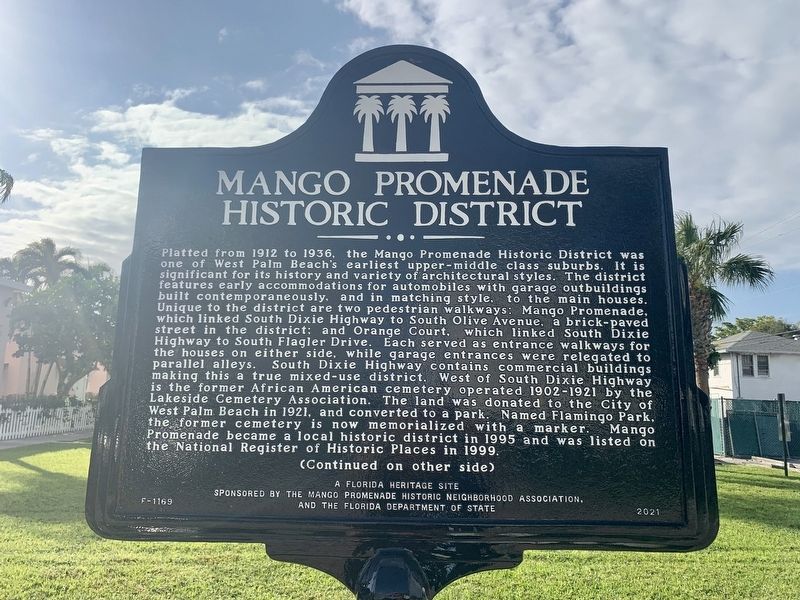
1. Mango Promenade Historic District Marker
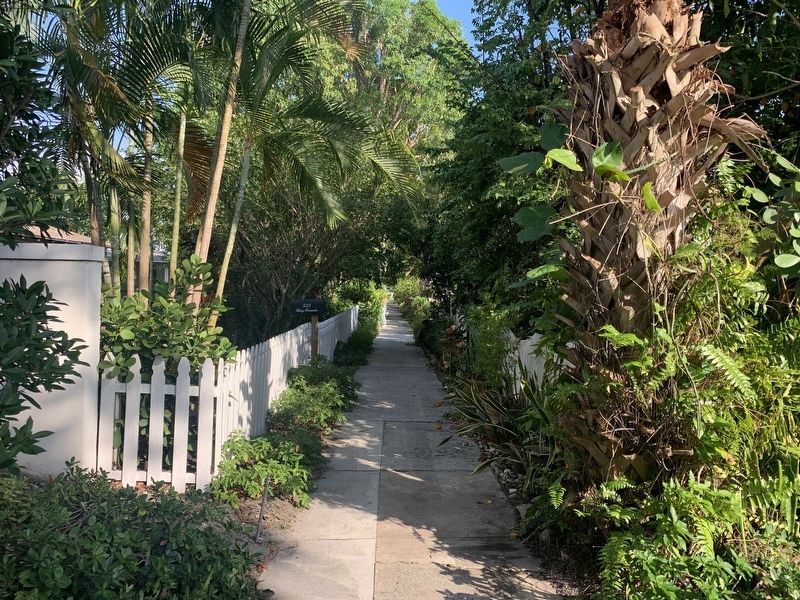
Platted from 1912 to 1936, the Mango Promenade Historic District was one of West Palm Beach's earliest upper-middle class suburbs. It is significant for its history and variety of architectural styles. The district features early accommodations for automobiles with garage outbuildings built contemporaneously, and in matching style, to the main houses. Unique to the district are two pedestrian walkways: Mango Promenade, which linked South Dixie Highway to South Olive Avenue, a brick-paved street in the district; and Orange Court, which linked South Dixie Highway to South Flagler Drive. Each served as entrance walkways for the houses on either side, while garage entrances were relegated to parallel alleys. South Dixie Highway contains commercial buildings making this a true mixed-use district. West of South Dixie Highway is the former African American cemetery operated 1902-1921 by the Lakeside Cemetery Association. The land was donated to the City of West Palm Beach in 1921, and converted to a park. Named Flamingo Park the former cemetery is now memorialized with a marker. Mango Promenade became a local historic
this page online
Photographed by Jay Kravetz
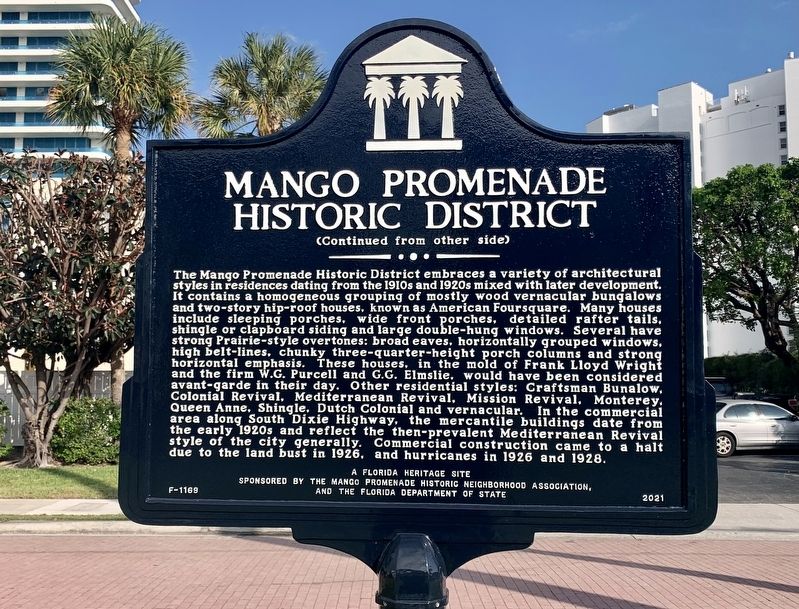
2. Mango Promenade Historic District Marker
Erected 2021 by Mango Promenade Historic Neighborhood Association and the Florida Department of State. (Marker Number F-1169.)
Topics and series. This historical marker is listed in these topic lists: Architecture • Parks & Recreational Areas. In addition, it is included in the Frank Lloyd Wright series list.
Location. 26° 41.957′ N, 80° 3.146′ W. Marker is in West Palm Beach, Florida, in Palm Beach County. It is on South Olive Avenue north of Mango Promenade, on the right when traveling south. Touch for map. Marker is at or near this postal address: 1605 S Olive Ave, West Palm Beach FL 33401, United States of America. Touch for directions.

Regionally, this marker is in South Florida, on the Gold Coast, on the Treasure Coast, and in Greater Miami. It is also in the American South and on the Eastern Seaboard. Globally, it is in the North Atlantic Region, North America,
Photographed by Jay Kravetz
3. Mango Promenade Historic District Marker
Other nearby markers. At least 8 other markers are within walking distance of this marker: Pioneer Memorial Park (about 600 feet away, measured in a direct line); Flamingo Park (about 700 feet away); Grandview Heights Historic District (approx. ¼ mile away); Ann Norton Sculpture Gardens/Ann Weaver Norton (approx. 0.3 miles away); Flamingo Park Historic District (approx. 0.4 miles away); El Cid Neighborhood (approx. 0.6 miles away); Palm Beach High School (approx. ¾ mile away); Palm Beach Junior College (approx. 0.9 miles away). Touch for a list and map of all markers in West Palm Beach.
Photographed by Jay Kravetz
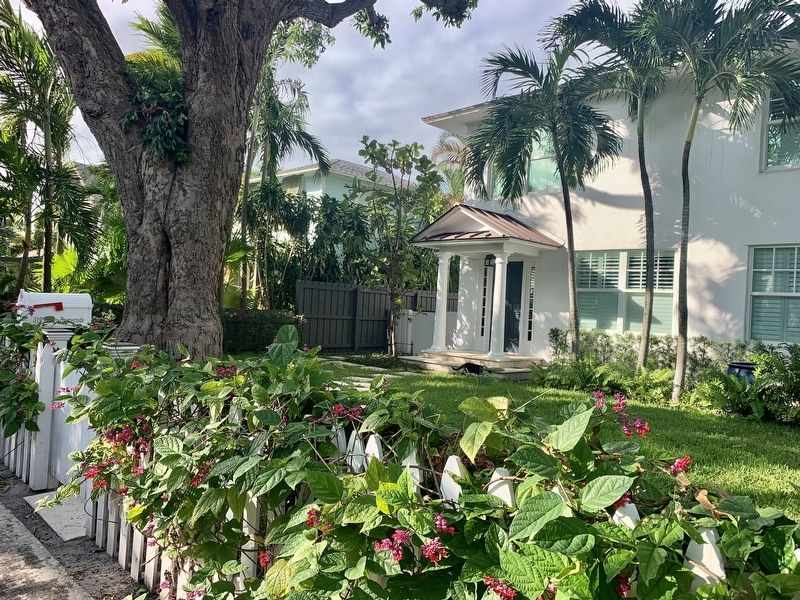
4. Mango Promenade Historic District Marker
Credits. This page was last revised on December 18, 2022. It was originally submitted on November 17, 2022, by Jay Kravetz of West Palm Beach, Florida. This page has been viewed 924 times since then and 139 times this year. Photos: 1, 2, 3, 4. submitted on November 17, 2022, by Jay Kravetz of West Palm Beach, Florida. • Bernard Fisher was the editor who published this page.
