Durham in Durham County, North Carolina — The American South (South Atlantic)
Algonquin Tennis Club
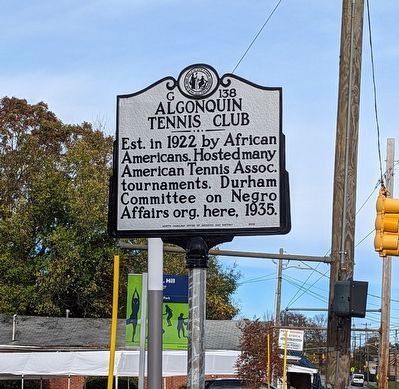
Photographed by Michael Buckner, November 16, 2022
1. Algonquin Tennis Club Marker
Erected 2019 by North Carolina Office of Archives and History. (Marker Number G-138.)
Topics. This historical marker is listed in these topic lists: African Americans • Civil Rights • Sports. A significant historical year for this entry is 1922.
Location. 35° 58.827′ N, 78° 53.981′ W. Marker is in Durham, North Carolina, in Durham County. It is at the intersection of Fayetteville Street and Massey Avenue, on the right when traveling south on Fayetteville Street. Touch for map. Marker is at or near this postal address: 1308 Fayetteville Street, Durham NC 27707, United States of America. Touch for directions.

Regionally, this marker is in the Piedmont and in the Research Triangle. It is also in the American South and specifically in the Upper South. Globally, it is in North America, the Western Hemisphere, the Western World, and the Anglosphere. Historically, it finds itself in what was once the territory of the Mississippian Culture, one of the original Thirteen
this page online
Other nearby markers. At least 8 other markers are within walking distance of this marker: Lincoln Hospital (within shouting distance of this marker); Bull City Blues (about 800 feet away, measured in a direct line); Clyde R. Hoey Building (approx. 0.3 miles away); James Edward Shepard (approx. 0.3 miles away); Shepard House (approx. 0.4 miles away); Former Site of Hillside High School (approx. 0.4 miles away); Centennial Chapel (approx. 0.4 miles away); College Heights Historic District (approx. 0.4 miles away). Touch for a list and map of all markers in Durham.
Regarding Algonquin Tennis Club. The Algonquin Club was evidently both a social club and a community center, primarily for the African-American 'elite' of Durham and Hayti. The club was organized in the 1920s. I've found very little history on the club thus far - perhaps I'll be able to fill in more at a later date. Jean Anderson first notes the existence of the Algonquin Club in 1935, as an organizational meeting was held on August 15, 1935 to form the Durham Committee on Negro Affairs (now

Algonquin Tennis Club, 1954. Arthur Ashe is on the front row, 5th from the right. (From "Durham's Ha
2. Algonquin Tennis Club Marker
It merits a few vague lines in Dorothy Phelps Jones' book, which states, without preamble or further explanation:
"The Algonquin Club voted to become a part of the Algonquin Tennis Club, which was the older organization and emphasized social growth as one of its primary objectives. It was the group that brought Althea Gibson at the height of her fame as a tennis champion and bragged of Arthur Ashe as one of the youngsters who played on their tennis courts - 'the bourgeois has arrived'."
The only pictures available seem to be those that picture a very young Arthur Ashe among groups of young boys with tennis rackets. Per Andre Vann, the Southern Tennis Association provided instruction, equipment, lodging and travel expenses for young tennis players.
Credits. This page was last revised on November 23, 2022. It was originally submitted on November 20, 2022, by Michael Buckner of Durham, North Carolina. This page has been viewed 614 times since then and 48 times this year. Photos: 1, 2. submitted on November 20, 2022, by Michael Buckner of Durham, North Carolina. • Bernard Fisher was the editor who published this page.
