Old City in Philadelphia in Philadelphia County, Pennsylvania — The American Northeast (Mid-Atlantic)
Sarah Mapps Douglass
⎯⎯⎯
Quakers & Social Justice
⎯⎯⎯
Arch Street Meeting House
Photographed by Devry Becker Jones (CC0), November 19, 2022
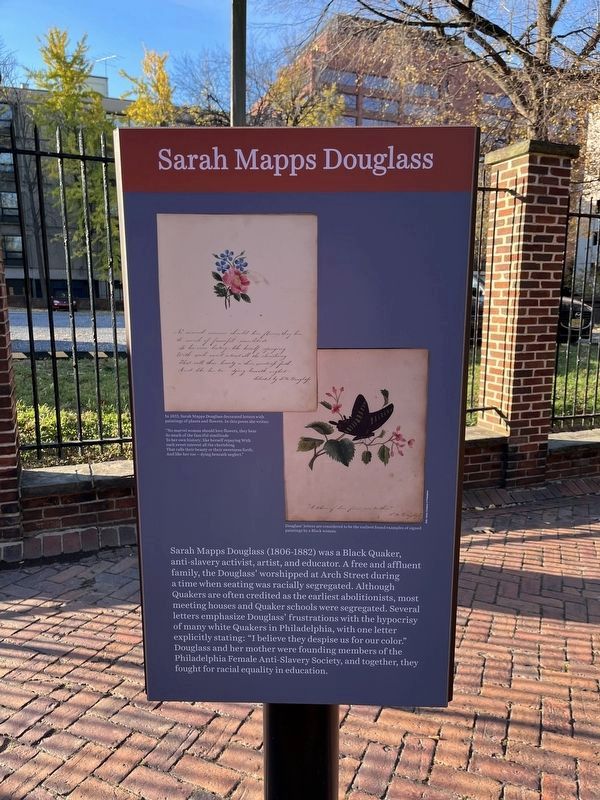
1. Sarah Mapps Douglass side of the marker
Sarah Mapps Douglass
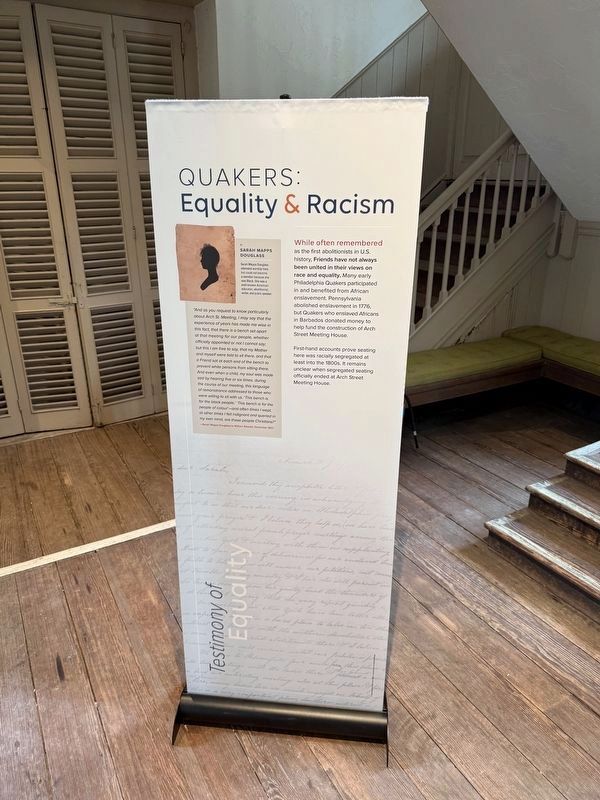
Sarah Mapps Douglass (1806-1882) was a Black Quaker, anti-slavery activist, artist, and educator. A free and affluent family, the Douglass' worshiped at Arch Street during a time when seating was racially segregated. Although Quakers are often credited as the earliest abolitionists, most meeting houses and Quaker schools were segregated. Several letters emphasize Douglass' frustration with the hypocrisy of many white Quakers in Philadelphia, with one letter explicitly stating: "I believe they despise us for our color." Douglass and her mother were founding members of the Philadelphia Female Anti-Slavery Society, and together, they fought for racial equality in education.
[Captions:]
In 1833, Sarah Mapps Douglass decorated letters with paintings of plants and flowers. In this poem she writes:
"No marvel woman should love flowers, they bear
So much of the fanciful similitude
To her own history; like herself repaying With
such sweet interest all the cherishing
That calls their beauty or their sweetness forth;
And like her too – dying beneath neglect."
Douglass' letters are considered to be the earliest found examples of signed paintings by a Black woman.
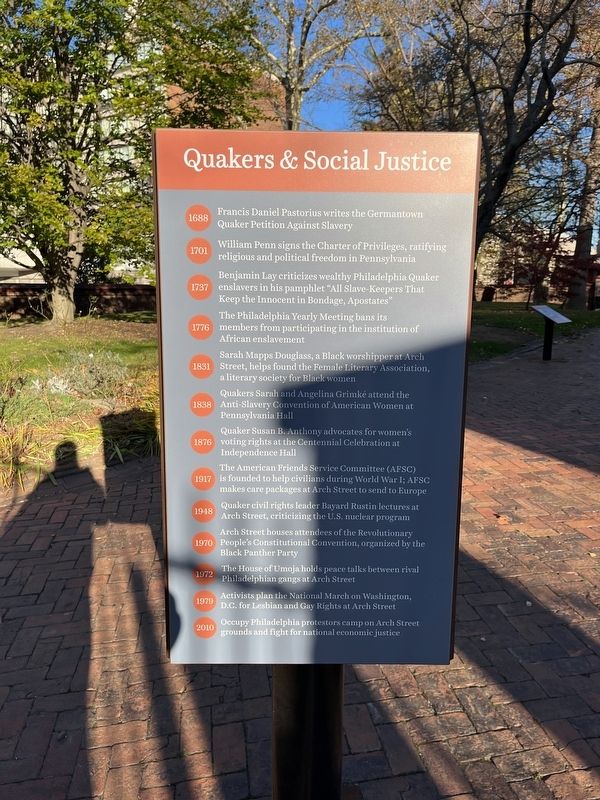
Quakers and Social Justice
1688:
this page online
1701: William Penn signs the Charter of Privileges, ratifying religious and political freedom in Pennsylvania.
1737: Benjamin Lay criticizes wealthy Philadelphia quaker enslavers in his pamphlet "All Slave-Keepers That Keep the Innocent in Bondage, Apostates".
1776: The Philadelphia Yearly Meeting bans its members from participating in the institution of African enslavement.
1831: Sarah Mapps Douglass, a Black worshiper at Arch Street, helps found the Female Literary Association, a literary society for Black women.
1838: Quakers Sarah and Angelina Grimké attend the anti-Slavery Convention of American Women at Pennsylvania Hall.
1876: Quaker Susan B. Anthony advocates for women's voting rights at the Centennial Celebration at Independence Hall.
1917: The American Friends Service Committee (AFSC) is founded to help civilians during World War I; AFSC makes care packages at Arch Street to send to Europe.
1948: Quaker civil rights leader Bayard Rustin lectures at Arch Street, criticizing the U.S. nuclear program.
1970: Arch Street houses
Photographed by Devry Becker Jones (CC0), November 19, 2022
2. Quakers & Social Justice side of the marker
1972: The House of Umoja holds peace talks between rival Philadelphian gangs at Arch Street.
1979: Activists plan the National March on Washington, D.C. for Lesbian and Gay Rights at Arch Street.
2010: Occupy Philadelphia protesters camp on Arch Street grounds and fight for national economic justice.
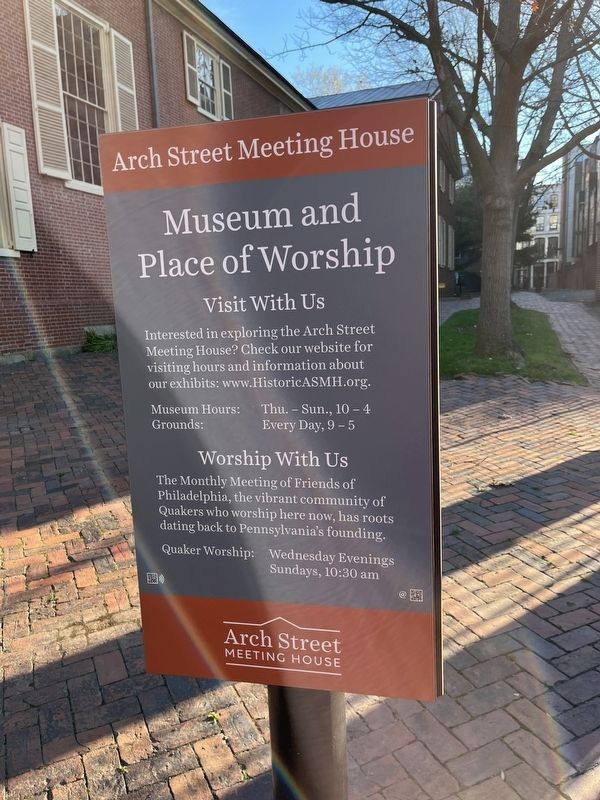
Arch Street Meeting House
Visit With Us
Museum Hours: Thu. - Sun., 10 - 4
Grounds: Every Day, 9 - 5
Quaker Worship: Wednesday Evenings; Sundays, 10:30 am
Erected by Arch Street Meeting House.
Topics. This historical marker is listed in these topic lists: African Americans • Civil Rights • Religion & Religious Structures • Women. A significant historical year for this entry is 1833.
Location. 39° 57.107′ N,
Photographed by Devry Becker Jones (CC0), November 19, 2022
3. Arch Street Meeting House side of the marker

Regionally, this marker is in Southeast Pennsylvania. It is also in the American Northeast and in the Mid-Atlantic. Globally, it is in North America, the Western Hemisphere, the Western World, and the Anglosphere. Historically, it finds itself in what was once the Haudenosaunee (Iroquois) Confederacy, New Netherland, and one of the original Thirteen Colonies.
Other nearby markers. At least 8 other markers are within walking distance of this marker: The Yellow Fever Epidemic of 1793 (a few steps from this marker); What Happened to the Headstones? (a few steps from this marker); Arch Street Meeting House (within shouting distance of this marker); a different marker also named Arch Street Meeting House (within shouting distance of this marker); You're Standing on a Burial Ground
Photographed by Devry Becker Jones (CC0), November 19, 2022
4. Sarah Mapps Douglass / Quakers & Social Justice / Arch Street Meeting House Marker
Additional keywords. LGBT, LGBTQ, 🏳️🌈
Photographed by Devry Becker Jones (CC0), April 4, 2025
5. Equality & Racism signage inside of the Meeting House
Photographed by Devry Becker Jones (CC0), April 4, 2025
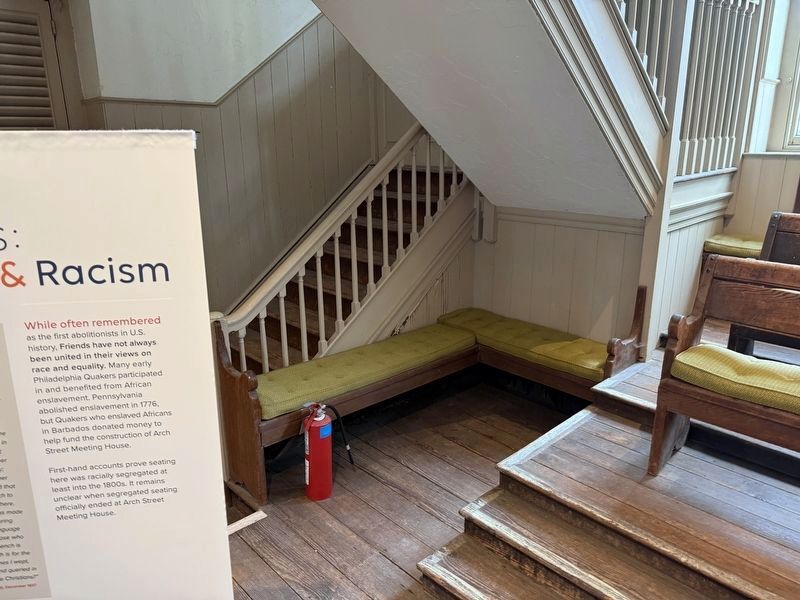
6. Seating in the Meeting House that was dedicated for African American adherants
Note that this seating does not have a backrest like those nearby. Additionally, Quakers of African descent were denied membership in the Meeting through much of the history of the Meeting. The Monthly Meeting of Friends of Philadelphia, who meets at Arch Street Meeting House, owns and acknowledges their history. In the twenty-first century, the Meeting is fully integrated.
Credits. This page was last revised on August 4, 2025. It was originally submitted on November 21, 2022, by Devry Becker Jones of Washington, District of Columbia. This page has been viewed 804 times since then and 71 times this year. Photos: 1, 2, 3, 4. submitted on November 21, 2022, by Devry Becker Jones of Washington, District of Columbia. 5, 6. submitted on April 6, 2025, by Devry Becker Jones of Washington, District of Columbia.
