Capitol Hill in Tallahassee in Leon County, Florida — The American South (South Atlantic)
The Tallahassee Lunch Counter Sit-Ins
Tallahassee - Leon County Civil Rights Heritage Walk
Photographed by Brandon D Cross, November 13, 2022
1. The Tallahassee Lunch Counter Sit-Ins Marker
Inscription.
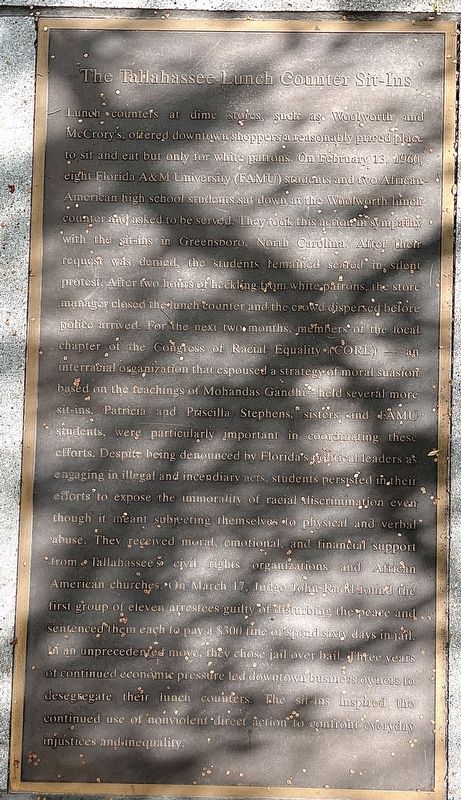
The Tallahassee Lunch Counter Sit-Ins. Tallahassee - Leon County Civil Rights Heritage Walk. Lunch counters at dime stores, such as Woolworth and McCrory's, offered downtown shoppers a reasonably priced place to sit and eat but only for white patrons. On February 13, 1960, eight Florida A&M University (FAMU) students and two African-American high school students sat down at the Woolworth lunch counter and asked to be served. They took this action in sympathy with the sit-ins in Greensboro, North Carolina. After their request was denied, the students remained seated in silent protest. After two hours of heckling from white patrons, the store manager closed the lunch counter and the crowd dispersed before police arrived. For the next two months, members of the local chapter of the Congress of Racial Equality (CORE), interracial onganization that espoused a strategy of moral suasion based on the teaching of Mohandas Gandhi, held several more sit-ins. Patricia and Priscilla Stephens, sisters and FAMU students, were particularly important in coordinating these efforts. Despite being denounced by Florida's political leaders as engaging in illegal and incendiary acts, students persisted in their efforts to expose the immorality of racial discrimination even though it meant subjecting themselves to physical and verbal abuse. They received moral, emotional, and financial support from Tallahassee civil rights organizations and African American churches. On March 17, Judge John Rudd found the first group of eleven arrestees guilty of disturbing the peace and sentenced them each to pay a $300 fine or spend sixty days in jail. In an unprecedented move, they chose jail over bail. Three years of continued economic pressure led downtown business owners to desegregate their lunch counters. The sit-ins inspired the continued use of nonviolent-direct action to confront everyday injustices and inequality.
Lunch counters at dime stores, such as Woolworth and McCrory's, offered downtown shoppers a reasonably priced place to sit and eat but only for white patrons. On February 13, 1960, eight Florida A&M University (FAMU) students and two African-American high school students sat down at the Woolworth lunch counter and asked to be served. They took this action in sympathy with the sit-ins in Greensboro, North Carolina. After their request was denied, the students remained seated in silent protest. After two hours of heckling from white patrons, the store manager closed the lunch counter and the crowd dispersed before police arrived. For the next two months, members of the local chapter of the Congress of Racial Equality (CORE)interracial onganization that espoused a strategy of moral suasion based on the teaching of Mohandas Gandhiheld several more sit-ins. Patricia and Priscilla Stephens, sisters and FAMU students, were particularly important in coordinating these efforts. Despite being denounced by Florida's political leaders as engaging in illegal and incendiary acts, students persisted in their efforts to expose the immorality of racial discrimination even though it meant subjecting themselves to physical and verbal abuse. They received moral, emotional, and financial support from Tallahassee civil rights organizations and African American churches. On March 17, Judge John Rudd found the first group of eleven arrestees guilty of disturbing the peace and
sentenced them each to pay a $300 fine or spend sixty days in jail. In an unprecedented move, they chose jail over bail. Three years of continued economic pressure led downtown business owners to desegregate their lunch counters. The sit-ins inspired the continued use of nonviolent-direct action to confront everyday injustices and inequality.
Erected 2012
Click or scan to see this page online
by The Tallahassee - Leon County Planning Department.
Topics. This historical marker is listed in these topic lists: African Americans • Civil Rights. A significant historical date for this entry is February 13, 1960.
Location. 30° 26.382′ N, 84° 16.852′ W. Marker is in Tallahassee, Florida, in Leon County. It is in Capitol Hill. It can be reached from the intersection of East Jefferson Street and South Monroe Street (U.S. 27), on the right when traveling west. Touch for map. Marker is at or near this postal address: 120 E Jefferson St, Tallahassee FL 32301, United States of America. Touch for directions.

Regionally, this marker is in North Florida. It is also in the American South and specifically in the Deep South. Globally, it is in the North Atlantic Region, North America, a Gulf of Mexico state, the Western Hemisphere, the Western World, and the Anglosphere. Historically, it finds itself in what was once New Spain, the territory of the Mississippian Culture, one of the Confederate States of America, and the Antebellum South.
Other nearby markers. At least 8 other markers are within walking distance of this marker: Tallahassee Bus Boycott
Photographed by Brandon D Cross, November 13, 2022
3. The Tallahassee Lunch Counter Sit-Ins
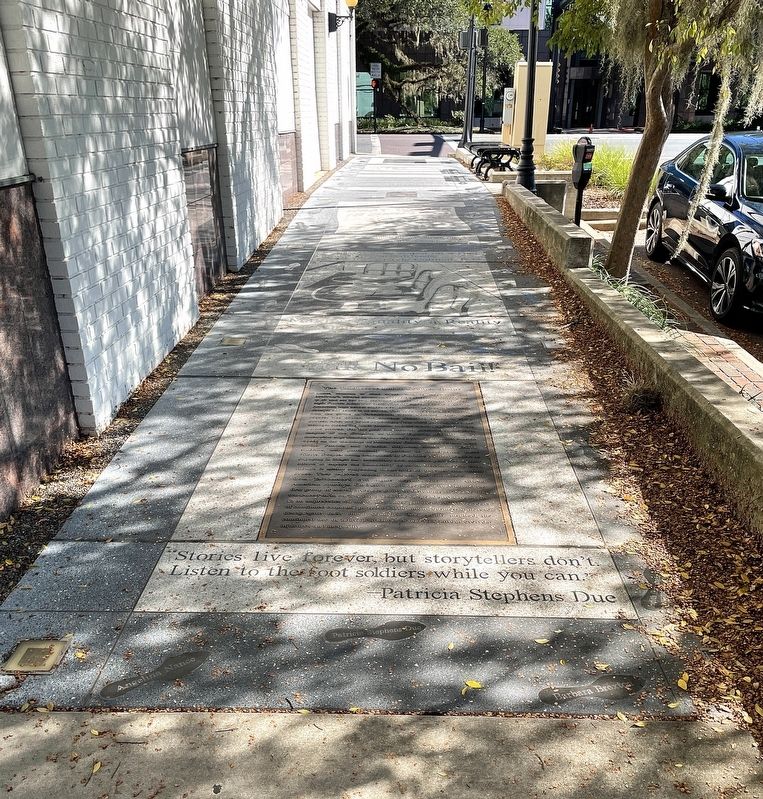
The right to be seated on a first come first served basis.
— Inter-Civic Council, ICC
Making Equality a reality
— CORE
Photographed by Brandon D Cross, November 13, 2022
4. The Tallahassee Lunch Counter Sit-Ins
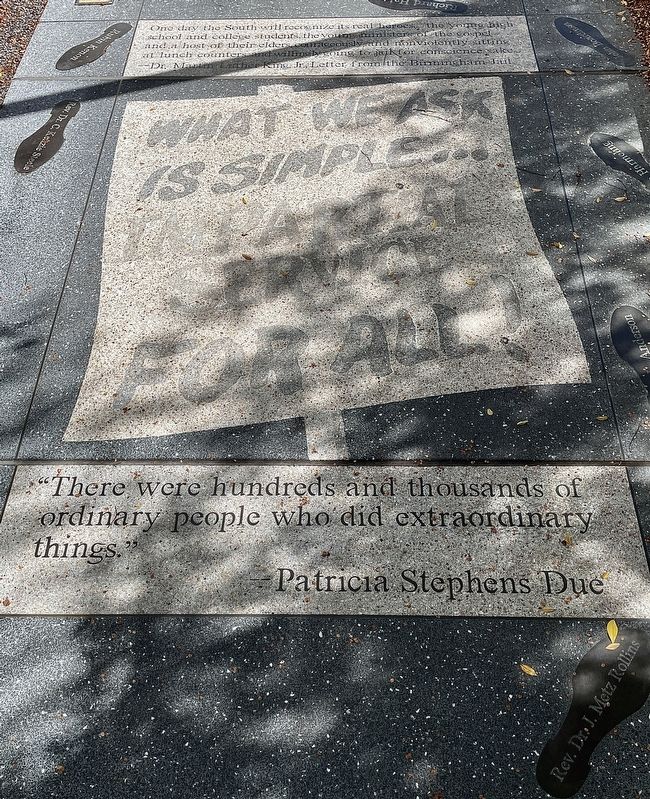
One day the South will recognize its real heroes, the young high school and college students, the young ministers of the gospel and a host of their elders, courageously and nonviolently sitting at lunch counters and willingly going to jail for conscience sake
— Dr. Martin Luther King, Jr., Letter from the Birmingham Jail
What We Ask Is Simple Impartial service For All
There were hundreds and thousands of ordinary people who did extraordinary things.
— Patricia Stephens Due
Photographed by Brandon D Cross, November 13, 2022
5. Tallahassee - Leon County Civil Rights Heritage Walk Dedication Plaque
Credits. This page was last revised on February 12, 2023. It was originally submitted on November 24, 2022, by Brandon D Cross of Flagler Beach, Florida. This page has been viewed 1,141 times since then and 72 times this year. Photos:1, 2, 3, 4, 5. submitted on November 24, 2022, by Brandon D Cross of Flagler Beach, Florida. • Bernard Fisher was the editor who published this page.
