Capitol Hill in Tallahassee in Leon County, Florida — The American South (South Atlantic)
Tallahassee Bus Boycott
Tallahassee - Leon County Civil Rights Heritage Walk
Photographed by Brandon D Cross, November 13, 2022
1. Tallahassee Bus Boycott Marker
Inscription.
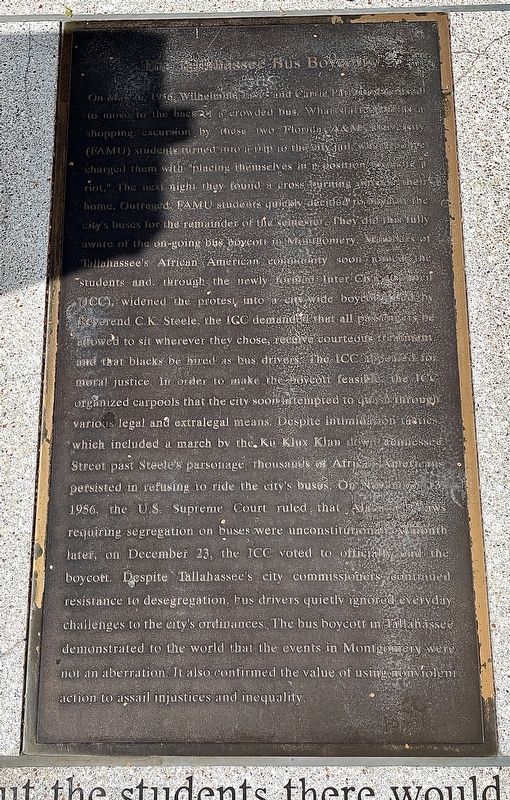
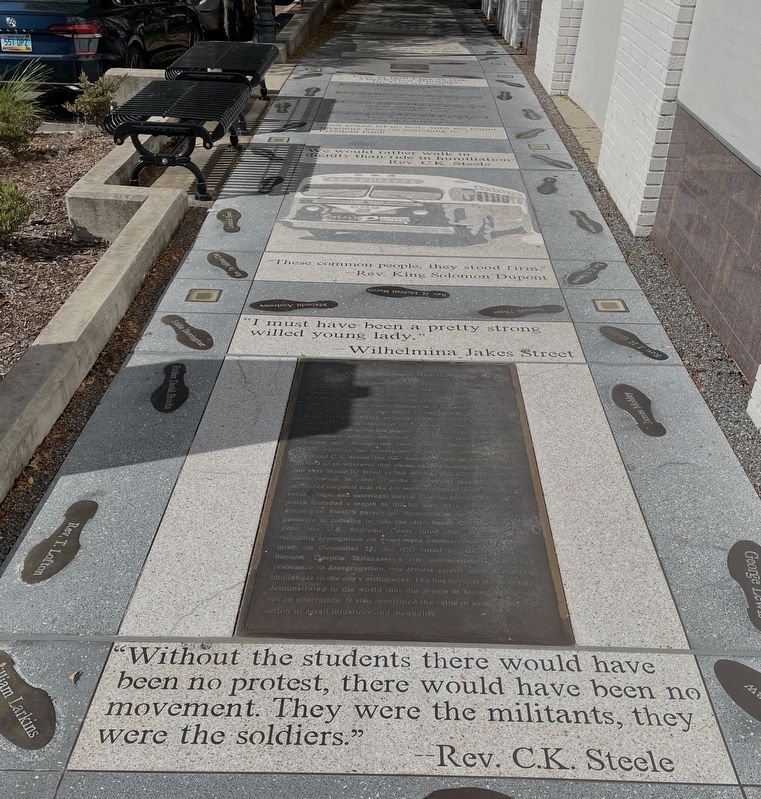
On May 28, 1956, Wilhelmina Jakes and Carrie Patterson refused to move to the back of a crowded bus. What started off as a shopping excursion by these two Florida A&M University (FAMU) students turned into a trip to the city jail where police charged them with "placing themselves in a position to incite a riot.” The next night they found a cross burning outside their home. Outraged, FAMU students quickly decided to boycott the city's buses for the remainder of the semester. They did this fully aware of the on-going bus boycott in Montgomery. Members of Tallahassee's African American community soon joined the students and, through the newly formed Inter-Civic Council (ICC), widened the protest into a city-wide boycott. Led by Reverend C.K Steele, the ICC demanded that all passengers be allowed to sit wherever they chose, receive courteous treatment, and that blacks be hired as bus drivers. The ICE appealed for moral justice. In order to make the boycott feasible, ICC organized carpools that the city soon attempted to quash through various legal and extralegal means. Despite intimidation tactics, which included a march by the Ku KIux Klan down Tennessee Street past Steel’s parsonage, thousands of African Americans persisted in refusing to ride the city's buses. On November 13, 1956, U.S. Supreme Court ruled that Alabama’s laws requiring segregation on buses were unconstitutional. A month later, on December 23, the ICC voted to officially end the boycott. Despite Tallahassee's city commissioners continued resistance to desegregation, bus drivers quietly ignored everyday challenges to the city’s ordinances. The bus boycott in Tallahassee demonstrated to the world that the events in Montgomery were not an aberration. It also confirmed the value of using nonviolent action to assail injustices and inequality.
Erected 2012
Click or scan to see this page online
by The Tallahassee - Leon County Planning Department.
Topics. This historical marker is listed in these topic lists: African Americans • Civil Rights • Women. A significant historical date for this entry is May 28, 1956.
Location. 30° 26.38′ N, 84° 16.85′ W. Marker is in Tallahassee, Florida, in Leon County. It is in Capitol Hill. It can be reached from the intersection of East Jefferson Street and South Monroe Street (U.S. 27), on the right when traveling west. Touch for map. Marker is at or near this postal address: 120 E Jefferson St, Tallahassee FL 32301, United States of America. Touch for directions.
Regionally, this marker is in North Florida. It is also in the American South and specifically in the Deep South. Globally, it is in the North Atlantic Region, North America, a Gulf of Mexico state, the Western Hemisphere, the Western World, and the Anglosphere. Historically, it finds itself in what was once New Spain, the territory of the Mississippian Culture, one of the Confederate States of America, and the Antebellum South.
Other nearby markers. At least 8 other markers are within walking distance of this marker:
Photographed by Brandon D Cross, November 13, 2022
Photographed by Brandon D Cross, November 13, 2022
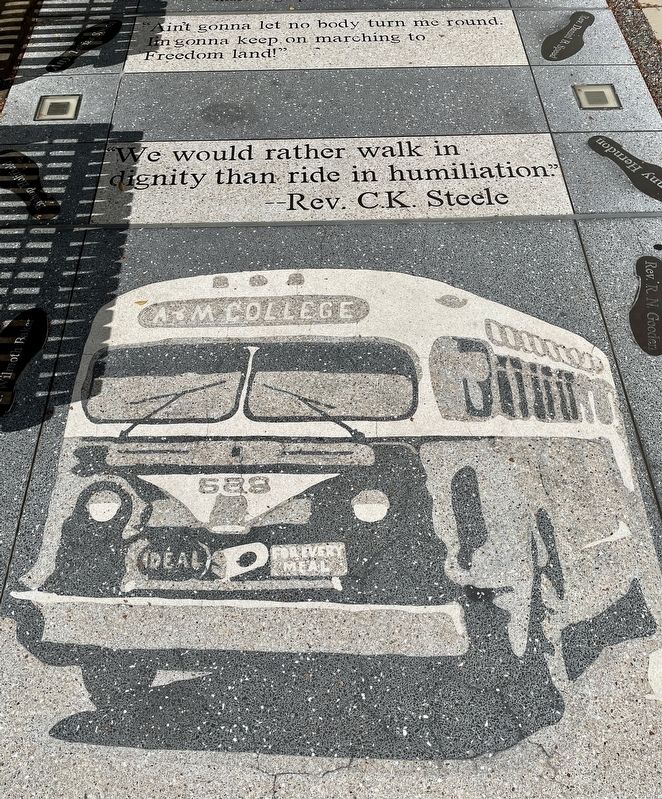
3. Tallahassee Bus Boycott
Photographed by Brandon D Cross, November 13, 2022
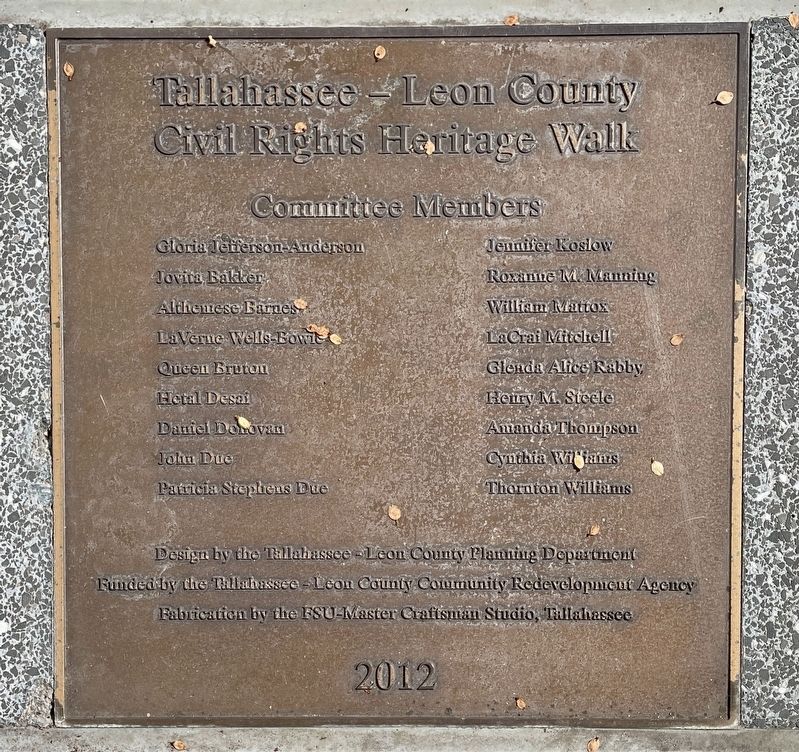
4. Tallahassee - Leon County Civil Rights Heritage Walk Dedication Plaque
Credits. This page was last revised on February 12, 2023. It was originally submitted on November 25, 2022, by Brandon D Cross of Flagler Beach, Florida. This page has been viewed 999 times since then and 66 times this year. Photos:1, 2, 3, 4. submitted on November 25, 2022, by Brandon D Cross of Flagler Beach, Florida. • Bernard Fisher was the editor who published this page.