Brentwood in Jacksonville in Duval County, Florida — The American South (South Atlantic)
Lynching in America ⎯⎯⎯ The Lynching of Bowman Cook and John Morine
Community Remembrance Project
Photographed by Tim Fillmon, February 2, 2023
1. Lynching in America marker
Inscription.
Lynching in America
Thousands of African Americans were victims of lynching and racial violence in the United States between 1877 and 1950. The lynching of African Americans during this era was a form of racial terrorism used to intimidate Black people and enforce racial hierarchy and segregation. Racial terror lynching was most prevalent in the South, but during what became known as the Red Summer of 1919, anti-black riots erupted in over two dozen American cities in Florida, Arkansas, Georgia, Nebraska, New York, Pennsylvania, Texas, and other states. White mobs intent on protecting their economic and social dominance from growing Black communities and an increase in Black workers destroyed property and killed or injured hundreds of Black people. In this era, racial terror lynchings had become the most public form of racial terror and was frequently tolerated or even supported by law enforcement and elected officials. Racial terror lynchings generally took place in communities that had functioning criminal justice systems but chose to deny due process to racial terror lynching victims, who were frequently pulled from
Click or scan to see this page online
jails or delivered to mobs by law officers legally required to protect them, often based on mere accusations. The names of many lynching victims were not recorded or remain unknown, but at least 318 documented racial terror lynchings took place in Florida between 1877 and 1950, including 8 in Duval County.
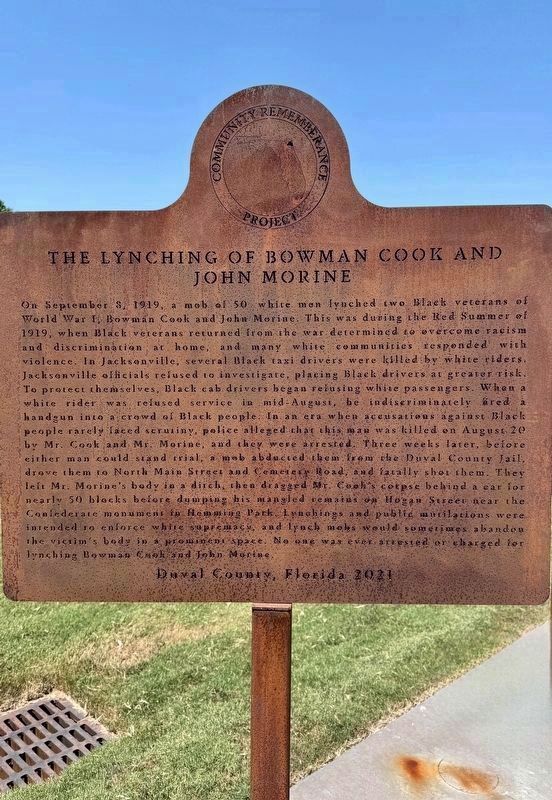
The Lynching of Bowman Cook and John Morine
On September 8, 1919, a mob of 50 White men lynched two Black veterans of World War I, Bowman Cook and John Morine. This was during the Red Summer of 1919, when Black veterans returned from the war determined to overcome racism and discrimination at home, and many White communities responded with violence. In Jacksonville, several Black taxi drivers were killed by White riders. Jacksonville officials refused to investigate, placing Black drivers at greater risk. To protect themselves, Black cab drivers began refusing White passengers. When a White rider was refused service in mid-August, he indiscriminately fired a handgun into a crowd of Black people. In an era when accusations against Black people rarely faced scrutiny, police alleged that this man was killed on August 20 by Mr. Cook
Photographed by Tim Fillmon, February 2, 2023
2. The Lynching of Bowman Cook and John Morine marker
and Mr. Morine, and they were arrested. Three weeks later, before either man could stand trial, a mob abducted them from the Duval County Jail, drove them to North Main Street and Cemetery Road, and fatally shot them. They left Mr. Morine's body in a ditch, then dragged Mr. Cook's corpse behind a car for nearly 50 blocks before dumping his mangled remains on Hogan Street near the Confederate monument in Hemming Park. Lynchings and public mutilations were intended to enforce white supremacy, and lynch mobs would sometimes abandon the victim's body in a prominent space. No one was ever arrested or charged for lynching Bowman Cook and John Morine.
Erected 2021 by Equal Justice Initiative - Jacksonville Community Remembrance Project.
Topics and series. This historical marker is listed in these topic lists: African Americans • Civil Rights. In addition, it is included in the Lynching in America series list. A significant historical date for this entry is April 8, 1919.
Location. 30° 21.921′ N, 81° 39.151′ W. Marker is in Jacksonville, Florida, in Duval County. It is in Brentwood. It is at the intersection of Winona Drive and North Main Street,
Photographed by Tim Fillmon, February 2, 2023
3. Lynching in America / The Lynching of Bowman Cook and John Morine Marker
on the right when traveling east on Winona Drive. Marker is along the bike path that runs parallel to Winona Drive. Touch for map. Marker is in this post office area: Jacksonville FL 32206, United States of America. Touch for directions.
Regionally, this marker is in First Coast. It is also in the American South and on the Eastern Seaboard. Globally, it is in the North Atlantic Region, North America, a Gulf of Mexico state, the Western Hemisphere, the Western World, and the Anglosphere. Historically, it finds itself in what was once New Spain, the territory of the Mississippian Culture, one of the Confederate States of America, and the Antebellum South.
A replica of one side of this marker is located at the Equal Justice Initiatives' National Memorial for Peace and Justice in Montgomery, Alabama. The Equal Justice Initiative supports efforts to locally memorialize documented victims of racial violence and to educate communities about the history of racial injustice.
Another marker is no longer nearby. Joseph E. Lee (was approx. 1.2 miles away but has been confirmed missing).
Also see . . . Marker dedication. Equal Justice Initiative website entry (Submitted on December 2, 2022, by Tim Fillmon of Webster, Florida.)
Credits. This page was last revised on October 21, 2024. It was originally submitted on December 2, 2022, by Tim Fillmon of Webster, Florida. This page has been viewed 1,065 times since then and 69 times this year. Photos:1, 2, 3. submitted on February 12, 2023, by Tim Fillmon of Webster, Florida. 4. submitted on October 14, 2024, by Brandon D Cross of Flagler Beach, Florida.