La Grange in Fayette County, Texas — The American South (West South Central)
Grandmother's Flower Garden
A Turn-of-the-Century Texas Garden, 1893-1930
Photographed by James Hulse, October 4, 2021
1. Grandmother's Flower Garden Marker
Inscription.
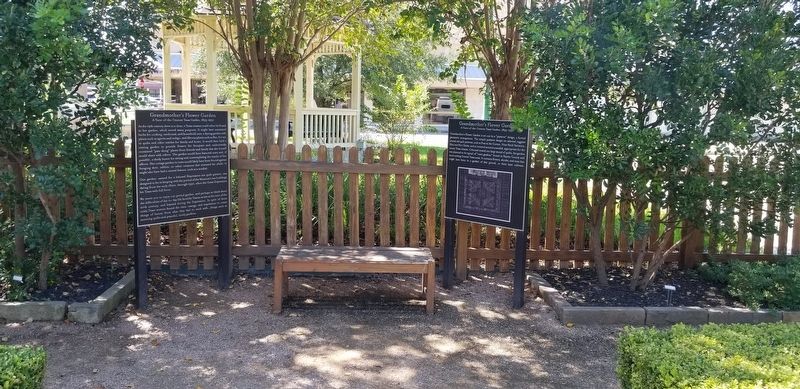
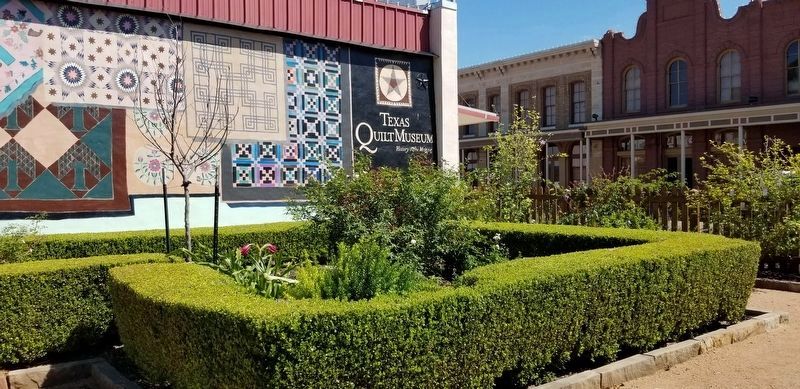
Grandmother's Flower Garden. A Turn-of-the-Century Texas Garden, 1893-1930. As the 19th century drew to a close, a Texas woman could often be found in her garden, which served many purposes. It might have contained herbs for cooking, medicinal, and household uses; a dyeing garden with plants such as agarita and indigo; and fibrous plants such as flax, for use in quilts and other textiles for family and home. It would have held a cutting garden to provide flowers for bouquets and undoubtedly contained "pass-along" plants from friends and family that she herself would share with others. The garden would have featured roses and, if possible, a shady bower for sitting and contemplating the results of her efforts. Her cottage garden in town would likely have been fenced against foraging deer, rabbits, or other creatures that ventured far afield. It might also have had a central feature, such as a sundial., Our garden, named for a beloved Depression-era quilt pattern, was designed to be in keeping with the period of the Museum's two buildings dating from the early 1890s, through 1930, when the Great Depression hit Texas with full force., We invite you to enjoy our period garden, and perhaps to think about the difficulties of day-to-day life faced by Texans as late as the turn of the 20th century, and beyond during the Depression. In spite of those trials, Texas women found the time, energy, and inspiration to create things of beauty from what they had to work with...things such as stunning quilts and peaceful, lovely gardens., 2nd Plaque , Grandmother's Flower Garden is set out in a "parterre" design, a formal geometric arrangement. The simple parterre design we selected suggests several old quilt patterns, such as Puss in the Corner, Nine Patch Variation, Hen and Her Chicks, and is centered around a sundial, appropriate for the sunny Texas climate. Oriented toward our large mural of quilts, the garden was planned to be typical of "town gardens" found in Fayette County and surrounding Central Texas areas. It contains flowers, shrubs, and trees that might have been in a garden of that period, or their later cultivars.
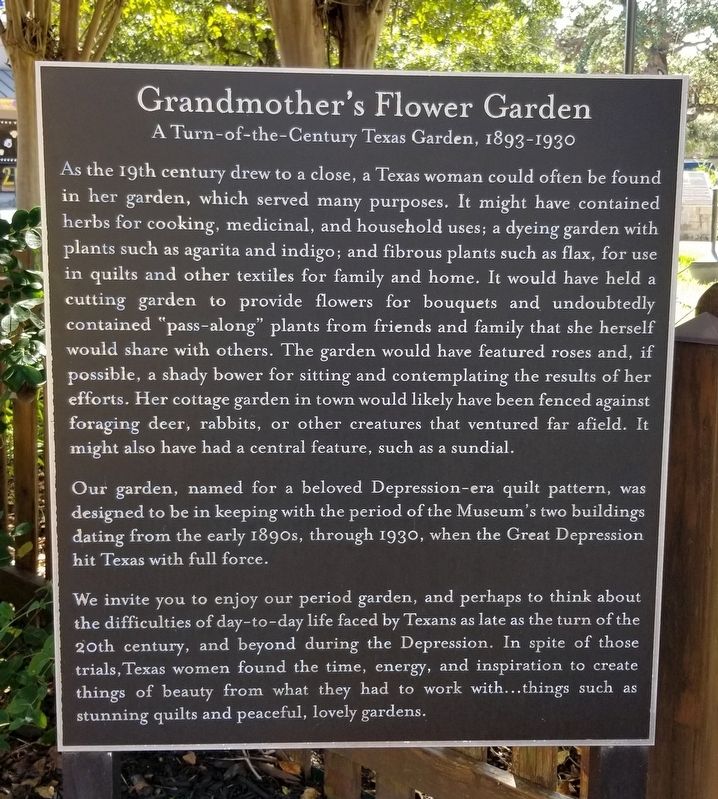
As the 19th century drew to a close, a Texas woman could often be found in her garden, which served many purposes. It might have contained herbs for cooking, medicinal, and household uses; a dyeing garden with plants such as agarita and indigo; and fibrous plants such as flax, for use in quilts and other textiles for family and home. It would have held a cutting garden to provide flowers for bouquets and undoubtedly contained "pass-along" plants from friends and family that she herself would share with others. The garden would have featured roses and, if possible, a shady bower for sitting and contemplating the results of her efforts. Her cottage garden in town would likely have been fenced against foraging deer, rabbits, or other creatures that ventured far afield. It might also have had a central feature, such as a sundial.
Our garden, named for a beloved Depression-era quilt pattern, was designed to be in keeping with the period of the Museum's two buildings dating from the early 1890s, through 1930, when the Great Depression hit Texas with full force.
We invite you to enjoy our period garden, and perhaps to think about the difficulties of day-to-day life faced by Texans as late as the turn of the 20th century, and beyond during the Depression. In spite of those trials, Texas women found the time, energy, and
Click or scan to see this page online
inspiration to create things of beauty from what they had to work with...things such as stunning quilts and peaceful, lovely gardens.
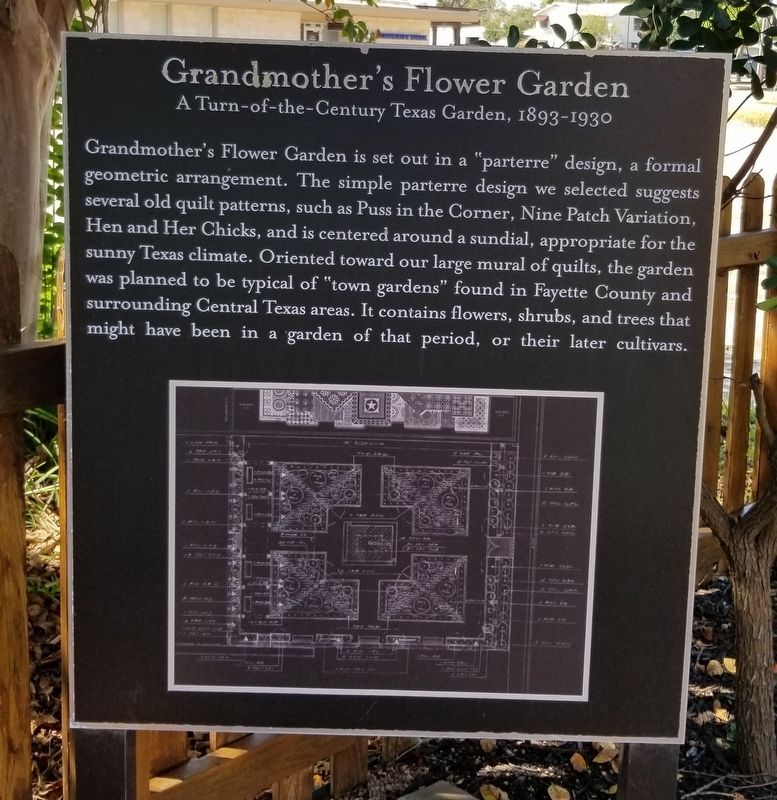
2nd Plaque Grandmother's Flower Garden is set out in a "parterre" design, a formal geometric arrangement. The simple parterre design we selected suggests several old quilt patterns, such as Puss in the Corner, Nine Patch Variation, Hen and Her Chicks, and is centered around a sundial, appropriate for the sunny Texas climate. Oriented toward our large mural of quilts, the garden was planned to be typical of "town gardens" found in Fayette County and surrounding Central Texas areas. It contains flowers, shrubs, and trees that might have been in a garden of that period, or their later cultivars.
Location. 29° 54.378′ N, 96° 52.692′ W. Marker is in La Grange, Texas, in Fayette County. It is at the intersection of West Colorado Street and North Washington Street on West Colorado Street. The marker is located in the west section of the garden. Touch for map. Marker is at or near this postal address: 162 West Colorado Street, La Grange TX 78945, United States of America. Touch for directions.
Regionally, this marker is in the American South and on the Gulf Coast. Globally, it is in North America, a Gulf of Mexico state, the Western Hemisphere, the Western World, and the Anglosphere. Historically, it finds itself in what was once New Spain, the Republic of Texas, one of the Confederate States of America, and the Antebellum South.
4. The view of the garden and the Texas Quilt Museum from the markers
Credits. This page was last revised on December 3, 2022. It was originally submitted on December 3, 2022, by James Hulse of Medina, Texas. This page has been viewed 270 times since then and 20 times this year. Photos:1, 2, 3, 4. submitted on December 3, 2022, by James Hulse of Medina, Texas.