
Traverse City in Grand Traverse County, Michigan — The American Midwest (Great Lakes)
Our Sun
Photographed by Cosmos Mariner, circa September 7, 2022
1. Our Sun Marker
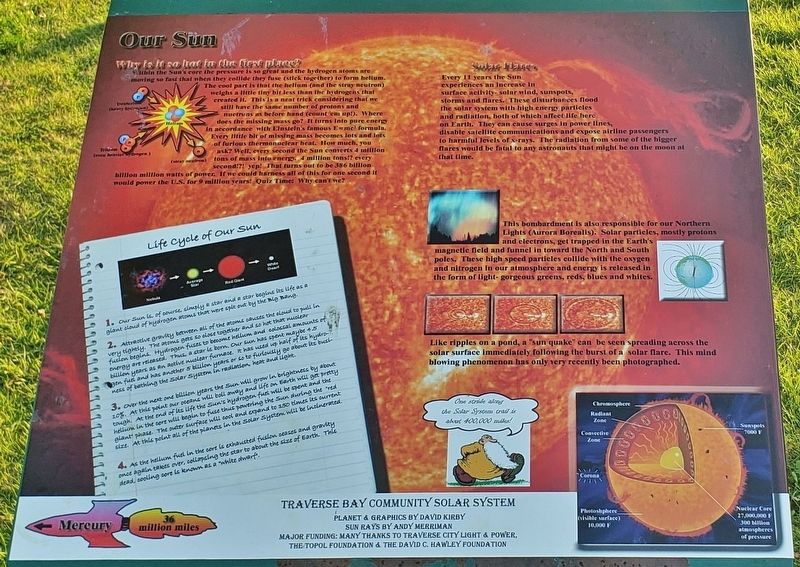
Why is it so hot in the first place?
Within the Sun's core the pressure is so great and the hydrogen atoms are moving so fast that when they collide they fuse (stick together) to form helium. The cool part is that the helium (and the stray neutron) weighs a little tiny bit less than the hydrogens that created it. This is a neat trick considering that we still have the same number of protons and neutrons as before hand (count 'em up!). Where does the missing mass go? It turns into pure energy in accordance with Einstein's famous E=mc2 formula. Every little bit of missing mass becomes lots and lots of furious thermonuclear heat. How much, you ask? Well, every second the Sun converts 4 million tons of mass into energy. 4 million tons!? every second!?! yep! That turns out to be 386 billion billion million watts of power. If we could harness all of this for one second it would power the U.S. for 9 million years! Quiz Time: Why can't we?
Solar Flares
Every 11 years the Sun experiences an increase in surface activity — solar wind, sunspots, storms and flares. These disturbances flood the solar system with high energy particles and
this page online
This bombardment is also responsible for our Northern Lights (Aurora Borealis). Solar particles, mostly protons and electrons, get trapped in the Earth's magnetic field and funnel in toward the North and South poles. These high speed particles collide with the oxygen and nitrogen in our atmosphere and energy is released in the form of light — gorgeous greens, reds, blues and whites.
Like ripples on a pond, a "sun quake" can be seen spreading across the solar surface immediately following the burst of a solar flare. This mind blowing phenomenon has only very recently been photographed.
Life Cycle of Our Sun
1. Our Sun is, of course, simply a star and a star begins its life as a giant cloud of hydrogen atoms that were spit out by the Big Bang.
2. Attractive gravity between all of the atoms causes the cloud to pull in very tightly. The atoms get
Photographed by Cosmos Mariner, September 7, 2022
2. Our Sun Marker
3. Over the next one billion years the Sun will grow in brightness by about 10%. At this point our oceans will boil away and life on Earth will get pretty tough. At the end of its life the Sun’s hydrogen fuel will be spent and the helium in the core will begin to fuse thus powering the Sun during the “red giant” phase. The outer surface will cool and expand to 150 times its current size. At this point all of the planets in the Solar System will be incinerated.
4. As the helium fuel in the core is exhausted fusion ceases and gravity once again takes over, collapsing the star to about the size of Earth. This dead, cooling core is known as a “white dwarf.”
Erected by Traverse Bay Community Solar System.
Topics. This historical marker
Photographed by Cosmos Mariner, circa September 7, 2022
3. Our Sun Marker
Location. 44° 45.413′ N, 85° 36.614′ W. Marker is in Traverse City, Michigan, in Grand Traverse County. It can be reached from Hannah Avenue just west of Woodmere Avenue, on the left when traveling west. Marker is located along the Boardman Lake Trail in Hull Park. Touch for map. Marker is at or near this postal address: 660 Hannah Avenue, Traverse City MI 49686, United States of America. Touch for directions.

Regionally, this marker is in Northern Michigan Lower Peninsula and in the Grand Traverse Bay Region. It is also in the American Midwest. Globally, it is in North America, the Western Hemisphere, the Western World, and the Anglosphere. Historically, it finds itself in what was once the Northwest Territory.
Other nearby markers. At least 8 other markers are within walking distance of this marker: Mercury (within shouting distance of this marker); Venus (about 400 feet away, measured in a direct line); Mother Earth (about 600 feet away); Mars (about 800 feet away); U.S.S. Sabine Parrott Rifle (approx. 0.4 miles away); Civil War Memorial (approx. 0.4 miles away); Spanish-American War Memorial (approx. 0.4 miles away); World War Memorial (approx. 0.4 miles away). Touch for a list and map of all markers in Traverse City.
Related markers. Click here for a list of markers that are related to this marker. Traverse Bay Community Solar System
Credits. This page was last revised on January 2, 2023. It was originally submitted on January 1, 2023, by Cosmos Mariner of Cape Canaveral, Florida. This page has been viewed 188 times since then and 15 times this year. Photos: 1. submitted on January 1, 2023, by Cosmos Mariner of Cape Canaveral, Florida. 2. submitted on January 2, 2023, by Cosmos Mariner of Cape Canaveral, Florida. 3. submitted on January 1, 2023, by Cosmos Mariner of Cape Canaveral, Florida.
